About Nikita Joshi, MD

ALiEM Chief People Officer and Associate Editor
Clinical Instructor
Department of Emergency Medicine
Stanford University

Reflections on CMS Simulation Instructor Course
Screen Shot 2013-06-17 at 3.03.29 PMI just completed the 4 day intensive Center for Medical Simulation Institute for Medical Simulation Instructor Course.  The title of the course is a mouthful and just as intense and high yield as the actual course was itself.  The chief purpose of the course is to develop debriefing skills as a medical instructor. The structure and nature of the course seemed so effortless and fluid, and yet at the end of the 4 days, I knew that the debriefing skills I had learned were ingrained into my brain. I highly recommend this course to any medical educator with simulation interest.  In this post, I want to share with you a few of the highlights and encourage everyone to learn more. (more…)

By |2016-11-17T08:48:10-08:00Jun 22, 2013|Medical Education, Simulation|

Navigating the waters of medical education and social media

SUNY Downstate Department of Emergency Medicine held a lecture series May 22, 2013 as a primer for the EM residents on how to use social media to enhance medical education. This session was designed to be an introduction for the novice on how to get the most out of FOAM (Free Open Access Meducation), Twitter, and Blogging with a section on professionalism. Invited speakers included Drs. David Marcus, Jeremy Faust, Jordana Haber, and myself Nikita Joshi. The slides from the session are presented below. Enjoy!

(more…)

By |2016-10-26T17:04:57-07:00Jun 21, 2013|Medical Education, Social Media & Tech|

Pitfalls to avoid in collecting patient related teaching materials

Brugada SyndromeEducators are eager to gather valuable learning tools such as EKGs and x-rays to be used in teaching for our learners, whether from our home institutions or internationally through the internet. However, this may not always be seen as altruistic; history and even modern day medicine is full of examples of misguided attempts to further medicine at the expense of patients such as the Tuskegee Syphilis Experiment from 1932-1972.

The focus of this post is how to go about collecting patient data for teaching purposes and avoiding confidentiality and consent violations while always remaining respectful of the patient and their rights.   

(more…)

By |2016-11-11T19:02:21-08:00Jun 21, 2013|Medical Education, Social Media & Tech|

Maximizing Conferences through Twitter

Conferences are necessary. It’s how we network, exchange research ideas, and share advances in emergency medicine. The reality is that we cannot attend every conference out there because of time, money, and schedule conflicts. But thanks to Twitter, it is no longer necessary to be physically present to reap the benefits of a conference.

This post lists information on how to get involved and stay involved with the Twitter conversation and learn from our great conferences without breaking your bank or schedule.

(more…)

By |2017-03-05T14:14:47-08:00May 24, 2013|Medical Education, Social Media & Tech|

ALiEM Sim Case Series: Pediatric WPW

Case Writer: Nikita Joshi, MD

Keywords

Pediatrics, Syncope, Wolff Parkinson White (WPW), PALS

Educational Objectives

Medical

  • Discuss a broad differential diagnosis for pediatric syncope
  • Identify critical findings in pediatric EKG
  • Manage WPW tachycardia

Communication

  • Obtain a focused history in a pt with WPW focusing upon family history
  • Communicate as an interdisciplinary team

Case Synopsis

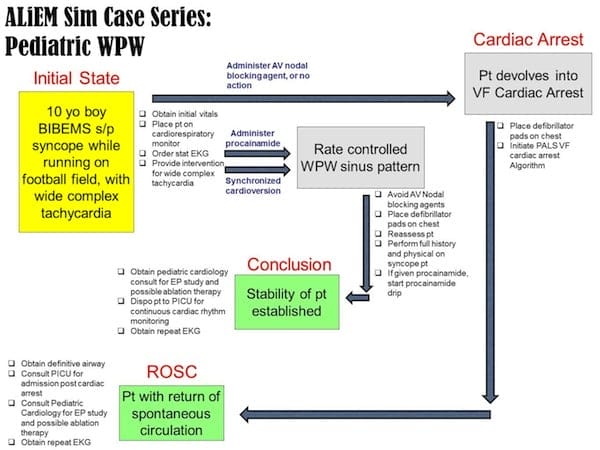
10 yo boy BIBEMS s/p syncope. Pt was playing on the football field, running down field when he suddenly collapsed. Bystanders quickly went to the boy and within 1 minute the pt had regained consciousness without any intervention. When EMS arrived on the scene, the boy was sitting with his mother telling everyone he wanted to go back and play.Upon arrival in the ED, pt is well appearing, however had a heart rate of 180 bpm and BP of 115/80.  EKG shows a wide complex tachycardia rhythm.  If team gives AV nodal blocking agents, the pt will devolve into a VF rhythm, and the pt will become nonresponsive. If team administers procainamide, pt will go into a rate controlled rhythm that reveals WPW and should then be placed on a procainamide drip. If team performs cardioversion, the pt will go into a rate controlled rhythm that reveals WPW. If the team does nothing, the pt will eventually go into a ventricular fibrillation cardiac arrest.

 
Peds WPW Case Flow3

Download PDF of this flowchart

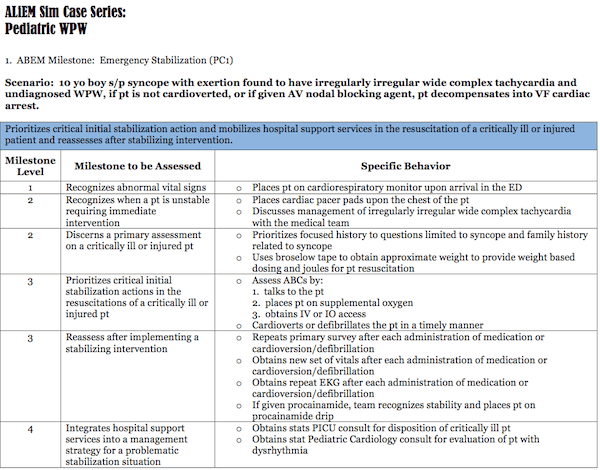
Peds WPW ABEM Milestone PC1
PDF this case-specific ABEM Milestone breakdown of PC1
PDF of more detailed scenario description

Critical Actions

  1. Analyze and interpret pediatric EKG for life threatening causes of syncope
  2. Initiate PALS for tachydysrhythmia
  3. Avoid AV nodal blocking agents in undifferentiated wide complex tachycardias
  4. Cardiovert pt early to avoid further decompensation
  5. Obtain family history of WPW with ablation

Learners

  • Residents (EM, pediatrics)
  • Nurses
  • EMS providers
  • Students (medical, nursing, EMS)

Location

ED resuscitation bay

Patient

10 yo boy

Equipment

  • Advanced airway equipment
  • Airway adjuncts
  • Broselow tape
  • Cardiac monitor
  • Cardioverter / defibrillator
  • IV fluid
  • Pediatric cardiac arrest cart
  • Syringes

Moulage

  • Sports clothing for manikin

Confederates

  • EMS provider – Gives history of well appearing pt on the football field. They did not obtain vitals because pt was so well appearing upon their arrival.
  • Mother – Unconcerned of syncopal episode, not good historian, thinks her son does not require medical care
  • Nurse – Completes and executes all orders provided
  • PICU attending (voice) – Discusses case with team over phone
  • Pediatric cardiology attending (voice) – Discusses case with team over phone

Supporting Files / Media

  • CXR – normal
  • EKG 1 – wide complex tachycardia, irregularly irregular
  • EKG 2 – VF
  • Echocardiography – normal, no effusion, good ejection fraction

Translation

AV = atrioventricular
BIBEMS = brought in by EMS
BP = blood pressure
CXR = chest x-ray
HR = heart rate
IV = intravenous
LOC = loss of consciousness
neg = negative
RR = respiratory rate
pt = patient
s/p = status post
T = temperature
WPW = Wolff Parkinson White
US = ultrasound
VF = ventricular fibrillation
yo = year old


References

  1. Boren SD. Commotio cordis. N Engl J Med. 2010. 362(23):2229-30. PMID: 20568311
  2. Fischer JWJ. Cho CS. Pediatric Syncope: Cases from the Emergency Department. Emergency Medicine Clinics of North America. 2010. 28;3. PMID 20709241
  3. Life in the Fast Lane Blog Post:  http://lifeinthefastlane.com/ecg-library/pre-excitation-syndromes/
  4. Mottram AR. Svenson JE. Rhythm Disturbances. Emergency Medicine Clinics of North America. 2011. 29;4. PMID 22040704

By |2019-02-19T18:02:41-08:00May 17, 2013|Pediatrics, Simulation|

Deception and Simulation

Have you ever created a simulation case with hidden objectives that the learners were not aware of? Would you ever purposefully try to trick or deceive learners in a simulation case?

Simulation can be used to reinforce clinical and procedural knowledge. It can teach important teamwork skills. It can also be used to learn about ourselves in morally and ethically challenging situations.

By |2016-11-11T18:38:34-08:00May 10, 2013|Medical Education, Simulation|

Death and Simulation

Should the manikin ever die in a simulation scenario?

Effective simulations require suspension of disbelief and willingness by learners to play along with the game created by the facilitators. Without this buy-in, learners could argue against discrepancies, simply on the basis that the scenario is not real. Learners give their trust that the educators will also play the same game, and that the rules will not change.

(more…)

By |2016-11-11T19:59:21-08:00May 3, 2013|Medical Education, Simulation|
Go to Top