How I Work Smarter: Rodney Fullmer, DO, MBS

One word that best describes how you work?

Passionately

Current mobile device

Samsung Galaxy 9 (sorry not an apple/mac guy)

Computer

PC- Dell XPS

What is something you are working on now?

I am working on two very cool education projects right now within our ED.

  1. I am creating a new curriculum for our senior ED residents at Swedish called MastER’s Class. The curriculum aims to prepare senior ED residents for life post-residency; looking at everything from contracts, litigation, finances, wellness, the business side of EM, job opportunities outside of the ED, and many more.
  2. Resident T-ED talks. Swedish ED residents give mini-talks/lectures to our ED nursing staff on varying topics. Some examples: talk on a metric that our ED could be doing better on, how to debrief as an ED better, or winter is coming so look out for frostbite and CO poisoning. Our staff loves these and I have needed to expand the scope and number of times the lecture is produced. So I recently bought my first microphone and downloaded editing software. We are now recording the lecture and mini wrap-up, starting a mini podcast-like series for our staff to be able to listen to our T-ED talks whenever they want.

How did you come up with this Idea/Project?

Project #1 came to me after listening to my residents and remembering my anxiety of becoming an attending. I realized there was so much I didn’t know about the other aspects of being an ED attending besides seeing patients. I wanted to make sure my residents were as best informed as possible prior to graduation or had the toolset to seek out their own answers. Enter, social media for the title idea of MastER’s Class.

Project #2 This is a project that has blossomed after talking to Dr. Tarlan Hedayati. I built it off an idea she was using at Cook County and expanded the scope. It has snowballed from there! Kudos to a colleague, Dr. Tarlan Hedayati for her inspiration.

What’s your office workspace setup like?

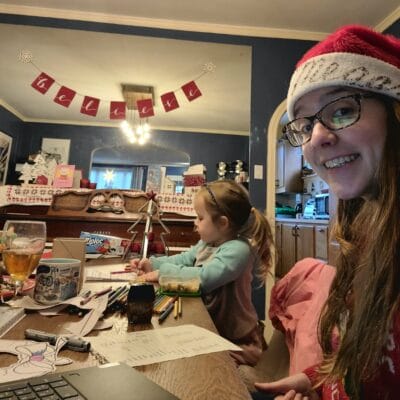
I am lucky enough to have a hospital office (not using much during Covid) and a home office that I split with my wife who works from home full time. But, honestly, my kitchen island gets the most action! I am a firm believer that a laptop, a good playlist, and headphones can help make any space a workspace.


What’s your best time-saving tip in the office or home?

Decrease distraction and set yourself up for success. I don’t work near a TV, I turn my cellphone to vibrate and avoid social media. Lastly, I set myself up with a good cup of coffee and workspace that isn’t cluttered with distractions and has just what I need for the project I am currently working on ( post-its, highlighter, book, microphone, etc.) Don’t forget to take breaks to keep you fresh- use this time to get out of the chair and check your social media if you can’t resist!

What’s your best time-saving tip regarding email management?

Google nudge is a great new tool I use for a follow-up! I use my Google calendar to set reminders as well for follow-up or reminders for email. I leave my emails marked as “unread” until I have responded or completed that task, using the bold font as my reminder that I need to do something with that specific email.

What apps do you use to keep yourself organized?

Google everything! Google Keep #1, Calendar #2, and Assistant #3. I use what I call “dead space time” to do other things. For example, I listen to a mini-podcast on local and world news events and “this day in history” (history buff) while getting ready. Makes brushing your teeth or showering informative! The same with driving. Medical podcasts fill my speakers while driving or when I go for a run. Often, I will have a great idea or something that needs follow-up while driving so I use Google voice assistant to set reminders for me. Google Keep is my online notepad and external brain. I can open my notes from any device. If you really want to know what’s going on in my mind, Google Keep will tell you everything. I use these apps to keep organized so I can cognitively off-load tasks. This clears my head and lets me focus and be more productive.

How do you stay up to date with resources?

  • I use Twitter to catch up on the FOAMed community and CME. Something I learned from Salim Rezaie about Twitter is to only follow a few specific accounts when it comes to FOAMed and education sources.
  • Mini podcasts (5 minutes or less) keep me up to date on current events. My day starts with “OK google read me the news”… This Day in History by the History Channel, NPR News Now, followed by a local Chicago news update.
  • Crowdsourcing: My Swedish ED residents keep me on my toes. It seems every week one of my residents asks me about a new journal article or FOAMed piece. I find myself adding it to my read list on Google keep. For years, my residency class has kept a running messenger feed that we started when we were in residency and continues to this day. It always has knowledge bombs and great GIFs.

What’s your best time-saving tip in the ED?

The ED needs to run like a restaurant: Always know where your patients are in their work-up. Anticipate! You have a really good idea who is going to get admitted and discharged after the initial H/P. Start your discharge instructions when you sit down to write your initial note on the patients you anticipate sending home. Know that the ED is a team sport so cognitively off-load where you can. Use your techs and nurses to help you with tasks. Have them double check on why a lab result hasn’t come back or if you’ll need vitals every 15 minutes for the next hour, can they complete these and let me know if BP or Heart rate is X? Closed-loop communication is key.

ED charting: Macros or no macros?

Macros! But carefully. As an educator, I see where Macros can and do go wrong. I built my own macros so I know everything that is them. I try to always do my focused PE the same way every time which matches the flow of my Macro. I can then quickly edit the pertinent positives/negatives or remove any part of the macro that wasn’t completed.

Advice

  • What’s the best advice you’ve ever received about work, life, or being efficient?

    • Residency is a sprint but being an Attending is a Marathon
    • Be kind to everyone
    • Most recently during the pandemic: Find balance, set boundaries, protect your wellness
  • What advice would you give other doctors who want to get started, or who are just starting out?

Say Yes. Be willing to volunteer for projects, lectures, or leadership roles, even if you feel under-qualified. Keep doors open by saying yes to these opportunities, as you may find your niche’. Be a sponge and soak up the knowledge you personally learn from each experience and tuck it away- you may not use that knowledge on your next project or leadership opportunity but it will come in handy sometime in the future. Get involved and be engaged in whatever you are involved in. Lastly, be kind and don’t burn bridges, always leave on good terms when an opportunity ends. It’s a small world out there.

  • Is there anything else you’d like to add that might be interesting to readers?

Make sure to have mentors (more than one and for different parts of your life) aka your boardroom. Also, make sure you have someone that can give you honest, impartial feedback.

Who would you love for us to track down to answer these same questions?

  • Sean Dyer @SpyderEM
  • Tarlan Hedayati @HedayatiMD
  • Michael Gottlieb @MGottliebMD

Read other How I Work Smarter posts, sharing efficiency tips and life advice.

SAEM Clinical Image Series: What’s This Thing on My Face?

A 91-year-old female patient presented with her family after concern for multiple new lesions on her face and hands. The patient thinks the lesions grew over the course of a few months. There is no pain at the sites, no erythema, and no pruritis. She has caught the lesions on clothing and bedding, which has irritated the lesions on occasion, and the family is concerned/embarrassed by the growths on her face, which are harder to conceal than those on her hand.

(more…)

By |2021-02-21T07:51:46-08:00Feb 22, 2021|Academic, Dermatology, SAEM Clinical Images|

SAEM Clinical Image Series: Finger Pain

finger

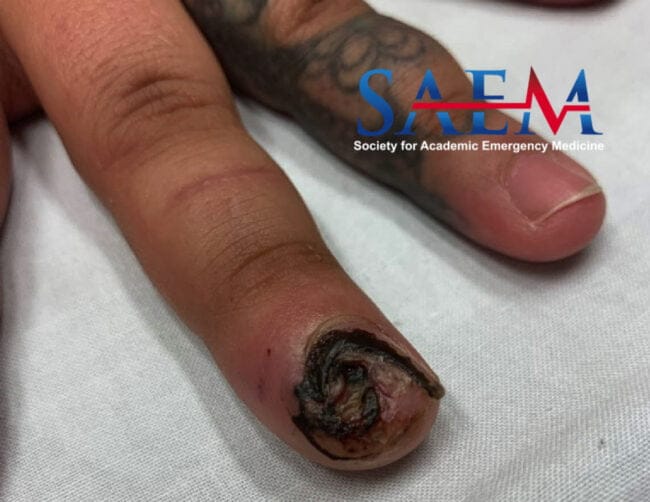
The patient is a 24-year-old female who presents to the emergency department for left middle finger pain and swelling. She is right hand dominant and works in a kitchen. The patient states that ten days ago she avulsed the distal tip of the left middle finger, including the majority of the nail. At that time, the patient was evaluated at an outside hospital where the wound was cauterized with silver nitrate due to soft tissue bleeding. Since then, the patient states that she has had swelling over the dorsal distal phalanx.

(more…)

How I Work Smarter: Megan Stobart-Gallagher, DO

Megan Stobart-Gallagher, DO

One word that best describes how you work?

Innovative

Current mobile device

Galaxy S10

Computer

Lenovo Yoga (my 2nd one!)

What is something you are working on now?

I wish I could say something wonderfully innovative, but I am mostly just working on tying up numerous projects with our medical education fellows that resulted from the global shift to virtual learning. However, I have had a blast over the last few months building an asynchronous Toxicology curriculum with one of my fellows and a new EMS curriculum for our interns. My next project as chair of our clinical competency committee is to create a series of mini flipped-classroom sessions or asynchronous modules (or a combo!) for faculty development to help prepare junior faculty for their participation!

How did you come up with this Idea/Project?

It has been brewing since my first CCC meeting as a junior faculty meeting where I felt like a fish out of water and everyone else was speaking a language I had never heard before! I am hoping to make help to not only develop junior faculty’s knowledge of ACGME requirements but also to improve the quality of conversations had during our meetings!

What’s your office workspace setup like?

Currently tucked away in our 3rd-floor spare bedroom – a cozy space with natural light, and built-in bookshelves filled with EM texts and my children’s artwork. I am usually kept company by my live-in officemate, Hippo (a 7 year old rescue mutt!) with occasional visits from my girls.


What’s your best time-saving tip in the office or home?

If you have something you really want to dedicate time to completing – schedule it! Start your day by not opening your email and keeping your cell phone alerts off. It saves time in the long run – get in that Deep Work (and read that book by Cal Newport if you haven’t!)

What’s your best time-saving tip regarding email management?

While it is tempting to respond to every single email as soon as you see it – I try to triage them and respond to the emergent first and keep those that require more thought as “unread.” It helps me be able to focus longer amounts of time on projects/issues that really need it! Also, if it can be solved in a phone call or a text – just do that instead of filling up someone else’s email box!

What apps do you use to keep yourself organized?

I am old school and still use a written planner and post-it notes! But as for technology, my life lives on Google calendar.

How do you stay up to date with resources?

I usually binge EMRAP instead of Netflix! Also, anything that I assign my residents for asynchronous learning including EMedHome lectures or ALIEMu modules – I do first!

What’s your best time-saving tip in the ED?

Real-time verbal communication with nursing and ancillary staff.

ED charting: Macros or no macros?

I have templated notes for sign-outs and resident addendums so I do not miss any important information but try to limit macro utilization to keep my charting personable and conversational. It does slow me down but helps tell the story should a patient bounce back or if someone logs into Epic and needs to read my note!

Advice

  • What’s the best advice you’ve ever received about work, life, or being efficient?

“You are enough.”

“When you see a hill, thank it for making you stronger.”

“Don’t hit send when you are angry.”

  • What advice would you give other doctors who want to get started, or who are just starting out?

Be kind to everyone you meet. Stay humble. Never stop asking questions.

  • Is there anything else you’d like to add that might be interesting to readers?

You can learn from EVERYONE inside and outside of medicine and just keep your mind open. Listening the first time will save you a tremendous amount of time in the long run – do it right, the first time. :)

Who would you love for us to track down to answer these same questions?

  • @k_goodsell (Kelly Goodsell)
  • @BossyLadyDoctor (Katrina Kissman)

Read other How I Work Smarter posts, sharing efficiency tips and life advice.
IDEA Series: Handheld Ultrasound for Emergency Medicine Residents Rotating on Cardiology Services

US System

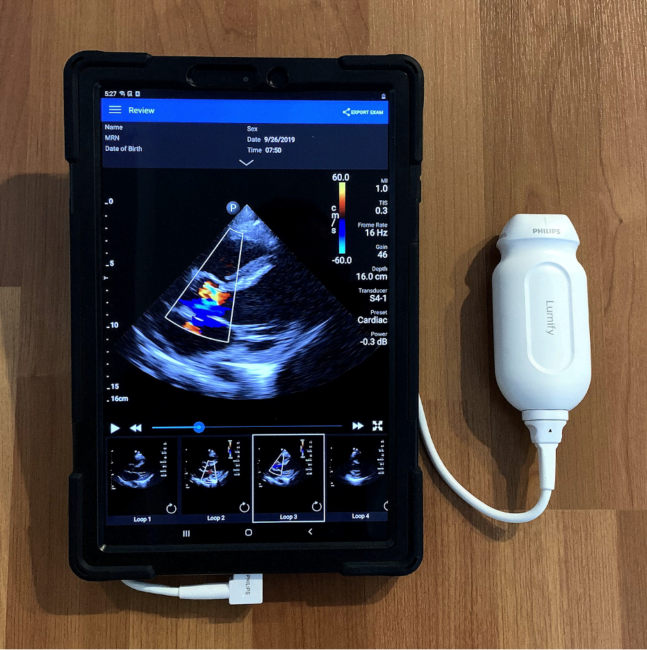
Point-of-care ultrasound (PoCUS) has become an essential skill that emergency medicine (EM) residents learn during their training [1]. Accordingly, most EM programs schedule a block early in residency dedicated to obtaining and interpreting high-quality PoCUS images. Likewise, the ability to efficiently diagnose and manage acute cardiovascular pathologies is a critical aspect of EM, and most EM residents also rotate on a cardiology service to develop these skills. Despite evidence that PoCUS improves the ability of both cardiologists and non-cardiologists to quickly diagnose cardiac disease at the bedside, integration of this relatively novel technology on cardiology services is often limited by lack of PoCUS availability as well as lack of a convenient platform to share recorded images [2]. Equipping EM residents on cardiology rotations with a portable, handheld ultrasound (US) system (Figure 1. Philips Lumify handheld US system with tablet) can enhance the learning of echocardiography acquisition and interpretation while simultaneously providing cardiology teams with clinically actionable information [3]. In addition to improving patient care, performing and interpreting PoCUS from the lens of a cardiologist is a simple yet innovative way to solidify the skills that are crucial to becoming an excellent bedside echocardiographer.

(more…)

By |2021-02-03T21:14:52-08:00Feb 5, 2021|IDEA series, Medical Education, Ultrasound|

SAEM Clinical Image Series: Edema Got Your Tongue?

angioedema

A 57-year-old male presented to the emergency department with a swollen mouth for three hours. He reported never having experienced this before and denied starting any new medications. The patient endorsed a feeling that his mouth was swollen and had difficulty swallowing. The edema had been increasing in size since its onset. He had been drooling for the past hour and endorsed mild pain around the area. He denied any shortness of breath, rash, nausea, vomiting, or other areas of edema. His past medical history included hypertension, diabetes, and allergies, with no known drug allergies. His family history was unknown. His medications included Metformin and Lisinopril.

(more…)

SAEM Clinical Image Series: Sun-burnt Hands and Lips

blistering

A 44-year-old Caucasian male with a past medical history of hepatitis C presents with a complaint of pain, swelling, and skin blistering of his hands. He also notes skin sores on his nose, lower lip, and the tops of his ears. The patient claims that these have become progressively worse since starting work a month ago in outdoor construction. The patient denies the use of medications or illicit drugs and denies any medical allergies. He admits to tobacco use and daily alcohol use. The patient denies any other symptoms.

(more…)

Go to Top