


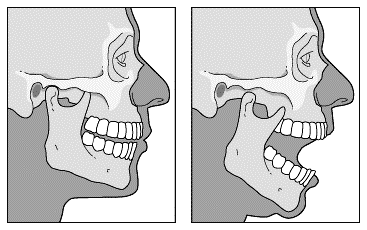
Trick of the Trade: Temperomandibular (TMJ) dislocation
Mandible, or TMJ, dislocations occur when the patient excessively opens the mouth, such as in a yawn. They are typically bilateral and are difficult to relocate because of masseter and medial pterygoid muscle spasm. You can relocate the condyles back into the TMJ space with gentle but firm intraoral pressure inferiorly and posteriorly. Often it requires some sedation to help relax the muscles of mastication. [+]
Paucis Verbis: Asthma classification
Emergency physicians have the opportunity to educate patients and prescribe chronic inhaled corticosteroids to patients who should be on these medications chronically. Patients may be more receptive to education and advice given immediately after an asthma exacerbation, managed in the ED. Using the National Institute of Health/ National Asthma Education and Prevention Program classification system, physicians can quickly determine if the patient is a candidate for inhaled corticosteroids and initiate therapy accordingly. PV Card: Asthma Classification system In short, patients can be classified into one of 4 classes: intermittent, mild persistent, moderate persistent, and severe persistent asthma. Patients in these [+]

Trick of the trade: Nebulized … orange juice?
In my theme of detoxifying malodorous smells in the ED, I recently learned of a new way of masking odors. Imagine the stress on your olfactory nerves from the combined effects of urinary and fecal incontinence from a nursing home patient. An ingenious nurse proposed nebulizing actual coffee within the room. Unfortunately, our ED was out of coffee at the moment. [+]
Paucis Verbis: Dental infections
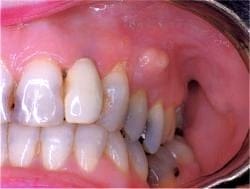
To follow up with the wildly popular Paucis Verbis card made by Dr. Hans Rosenberg (University of Ottawa), here is his card on Dental Infections. This card summarizes common dental infection complaints (like the periapical abscess seen to the right) that we see in the Emergency Department. PV Card: Dental Infections Adapted from [1] Go to ALiEM (PV) Cards for more resources. Reference Nguyen D, Martin J. Common dental infections in the primary care setting. Am Fam Physician. 2008;77(6):797-802. [PubMed]
Trick of the Trade: Corneal reflex test
The corneal reflex test (blink test) examines the reflex pathway involving cranial nerves V and VII. Classically the provider lightly touches a wisp of cotton on the patient’s cornea. This foreign body sensation should cause the patient to reflexively blink. This maneuver always makes me a little worried about causing a corneal abrasion, especially if you are examining a very somnolent patient. You are wondering — Is there no blinking because you’re not touching the cornea hard enough? You apply harder pressure but still no blink. You repeat the test and now the patient finally blinks. That’s 3 times you’ve [+]

Paucis Verbis: Dental trauma
How cool is this -- I have talented emergency physicians contributing Paucis Verbis card content! This week features excellent pearls on Dental Trauma by Dr. Hans Rosenberg (University of Ottawa). Here's his recent article in Annals of EM on reimplantation of avulsed teeth.1 PV Card: Dental Trauma Go to ALiEM (PV) Cards for more resources. Reference Rosenberg H, Rosenberg H, Hickey M. Emergency management of a traumatic tooth avulsion. Ann Emerg Med. 2011;57(4):375-377. [PubMed]

Trick of the Trade: Oblique CXR to look for pneumothorax
Supine chest xrays have an extremely low sensitivity (12-24%) in detecting pneumothoraces. Because a pneumothorax layers anteriorly on an AP CXR film, the xray beam is perpendicular rather than tangential to the pneumothorax edge. This makes visualizing a small to moderate sized pneumothorax extremely difficult. So you are left to look for indirect signs such as a deep sulcus at the costophrenic angle or subcutaneous air. I’m often surprised at how large of a pneumothorax can be missed on CXR based on CT imaging. The image to the right shows a large left-sided pneumothorax on CT. What if you [+]

Paucis Verbis: AMI and ECG Geography
Sometimes a picture is worth MORE than a 1000 words. Such is the case of the above illustration that I saw on the Life In The Fast Lane blog. When I first saw it, I knew that I immediately had to find out who made the graphic. It turns out it is the multitalented Dr. Tor Ercleve, who is an emergency physician at Sir Charles Gairdner Hospital and an established medical illustrator. This graphic demonstrates the EKG findings for the various types of acute MI's as broken down by coronary vascular anatomy (right coronary artery, left circumflex artery, left anterior descending [+]
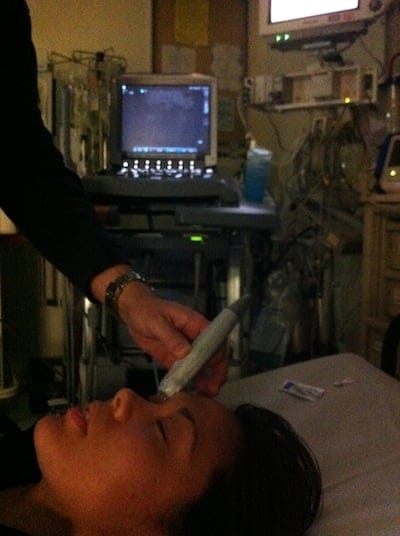
Trick of the Trade: Check pupillary constriction with ultrasound
In some trauma patients with head and face trauma, you will need to check their pupillary response to light. Severe periorbital and eyelid swelling, however, make this difficult. You want to minimize multiple attempts to retract the eyelids because of the risk of a ruptured globe. What’s a minimally painful and traumatic way to check for pupillary constriction? [+]

Paucis Verbis: Post-exposure prophylaxis (non-occupational)
You know how chief complaints present to the ED in multiples? In one week, I had several cases where patients were asking for post-exposure prophylaxis treatment NOT in the content of a sexual assault. I haven't had to manage such cases in a long time and so needed to look up the recent guidelines from the CDC.1 The trick is not to forget about all the co-existing problems and infections beyond just HIV. Specifically, don't forget about gonorrhea, chlamydia, and trichomonas. PV Card: Post-Exposure Prophylaxis for Non-Occupational Contact Adapted from [2] Go to ALiEM (PV) Cards for more resources. [+]

Director of Growth, Strategic Alliance Initiative, Center for Innovation and Digital Health
Massachusetts General Hospital;
Chief Scientific Officer, Conductscience.com
Latest posts by Shuhan He, MD (see all)
- The Discharge Severity Index: Early Research on ED Readmission Risk Assessment - August 14, 2025
- Suboxone and the Emergency Physician: Get Waivered Training - August 12, 2022
- A Tale of Two Epidemics: COVID-19 and the Opioid Crisis - April 23, 2020