


Sim Case: Cocaine toxicity and placental abruption
.jpg) Case Synopsis
Case Synopsis
.jpg)
17 yo girl, 24 weeks pregnant, is brought to the ED with an overbearing, controlling, and older boyfriend (BF). The chief complaint is abdominal discomfort and vaginal spotting. The patient is initially reluctant and quiet, but then gets hysterical as the case progresses. Upon questioning, the patient admits that she took cocaine prior to arrival to induce an abortion, because her BF is married and does not want her to keep the baby.
The patient becomes altered and goes into a shock state from significant vaginal bleeding. Blood work shows significant anemia, acute renal failure, and coagulopathy. The team needs to recognize cocaine toxicity, discuss and manage placental abruption, intubate the patient, control acute hemorrhage, and get a stat OB consult to take the patient to OR for management of placenta abruption and emergent c-section. The team needs to recognize signs of domestic violence and consult the social worker.
Case Writer: Nikita Joshi, MD
Keywords: Cocaine toxicity, placental abruption, domestic violence
UPDATE: 6-22-23 – The PDF is no longer available.
Educational Objectives
Medical:
- Recognize and manage cocaine toxicity
- Identify causes of 2nd trimester vaginal bleeding
- Manage emergency airway
- Recognize signs and symptoms of domestic violence
Communication:
- Assess for unsafe environment due to hostile family
- Crowd management
- Resource utilization
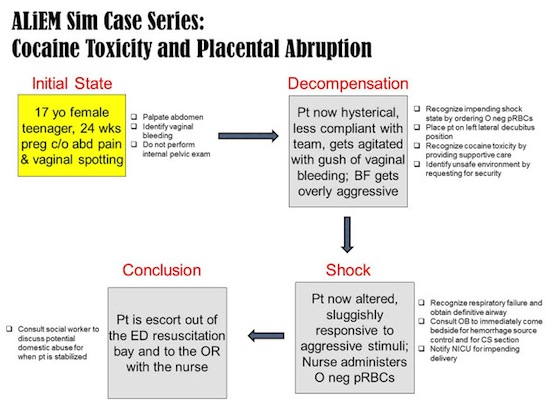
Critical Actions
- Recognize cocaine toxicity
- Recognize severe hemorrhage and impending fetal demise due to placental abruption
- Give blood products immediately
- Intubate unstable patient
- Recognize potential for domestic violence and treat appropriately
Learners
- ED residents
- ED nurses
- Medical students
Location
ED resuscitation bay
Patient
17 yo female teenager who is 24 weeks pregnant
Equipment
- Advanced airway equipment
- Airway adjuncts
- Bedside ultrasound
- Fake blood
- IV fluid
- pRBCs
- Stretcher with sheets
Moulage
- Manikin capable of showing pregnancy and pelvic bleeding
- Fake blood around pelvic area (initially covered by sheet)
- Ace bandage wrapped around the right wrist (“old” broken wrist)
- Abrasions and healing bruises of various stages over body
Confederates
- Patient (voice) – hysterical, sobbing, at times rapid speech, denies bruises are related to trauma, laughs it off when asked about her poorly healing broken right wrist, initially says she just has abdominal pain and vaginal bleeding, finally admits the cocaine use after questioning. She says she loves her boyfriend and would never do anything to compromise the relationship, and perhaps this baby would risk their relationship.
- Boyfriend – older man, overbearing, hovering, questions everything that the team does, refuses to leave the bedside, denies hurting her.
- Nurse – helpful, asks about bruises, asks about wrist deformity.
- Security – arrives when asked by team; escorts the boyfriend away.
- OB (voice) – calls when asked by team, discusses case with team.
Supporting Files and Media
- Bedside ultrasound images of fetus with fetal heart movement
- CXR post intubation with correct ETT placement
- CBC – very low hemoglobin and hematocrit
- BMP – elevated creatinine
- Coagulation profile – elevated INR
- Beta HCG
- Urine tox – positive for cocaine
- Type and screen and/or cross
References
- Deak TM, Moskovitz JB. Hypertension and pregnancy. Emerg Med Clin North Am. 2012 Nov;30(4):903-17. PMID 23137402
- Selvidge R, Dart R. Emergencies in the second and third trimesters: hypertensive disorders and antepartum hemorrhage. Emergency Medicine Practice. Dec 2004. Website
 One of my interests is medical simulation and the writing of simulation cases. I have already written two related posts: Case Writing and Story Board Writing. I believe that simulation is a wonderful modality to engage learners, teach critical EM concepts, and keep the patients safe.
 Last week I wrote about the important components in writing a simulation case. It is an exhausting list, but the thoroughness pays off.