


SAEM Clinical Images Series: Pain and Swelling in a Roofer’s Right Wrist
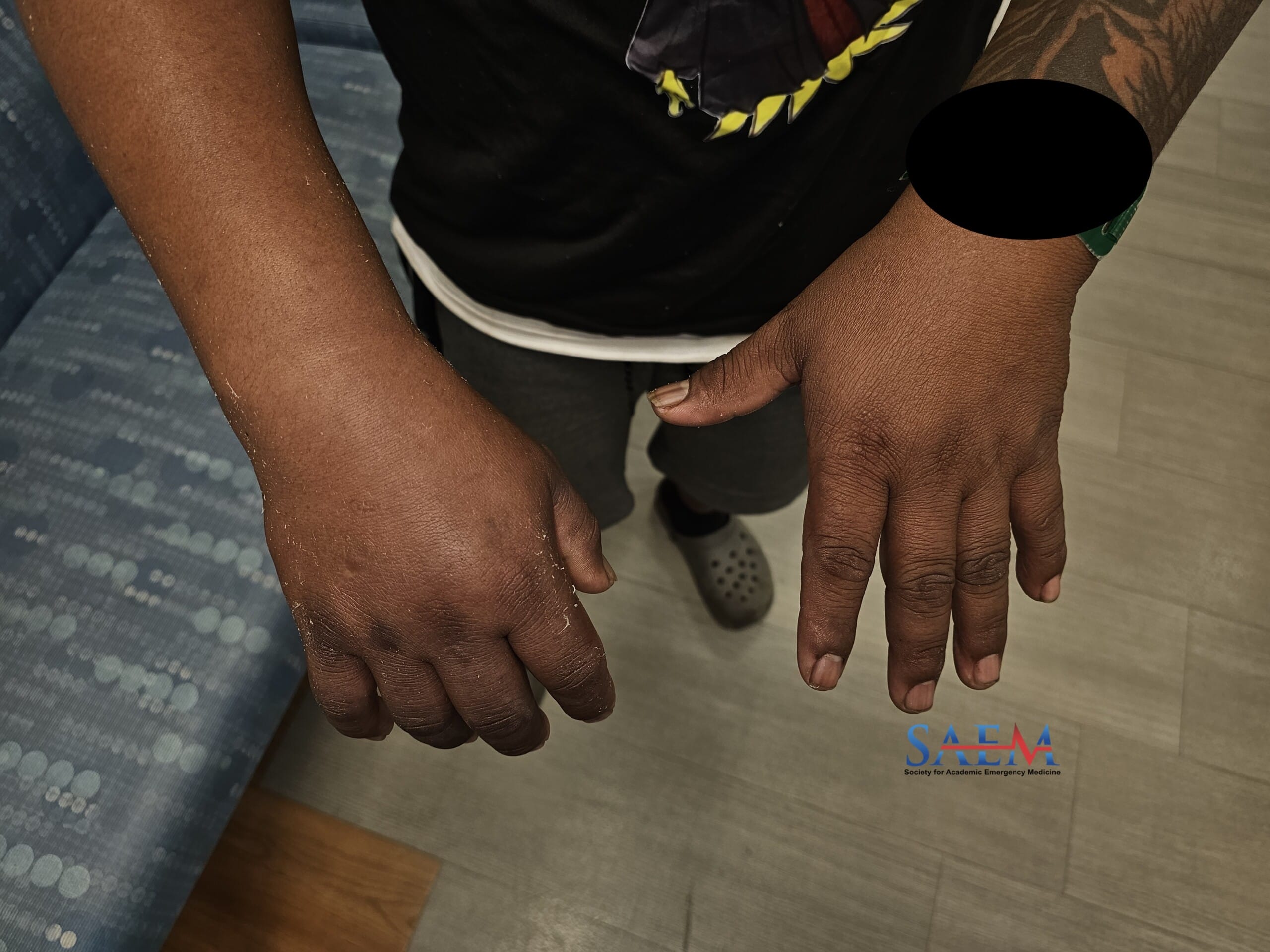
A 27-year-old male with no significant past medical history presented to the ED due to right hand pain and swelling. The patient reported that he works as a roofer and felt severe, sharp pain in his right hand immediately after using a nail gun this morning. The pain was followed by gradual swelling of the right wrist and hand. There was no loss of sensation or bleeding from the injury site. He additionally denied any injury from the nail itself. The patient was in moderate pain but hemodynamically stable while in the ED.
Vitals: Temp 36.6 °C; BP 155/99; HR 71; RR 18; SpO2 99%
General: Alert, mild distress.
Musculoskeletal: No gross deformities to right hand, reduced right hand flexion/extension due to pain, normal ROM of right shoulder and elbow, pain with right forearm supination/pronation, swelling of right hand and fingers and diffusely tender carpal bones.
Non-contributory
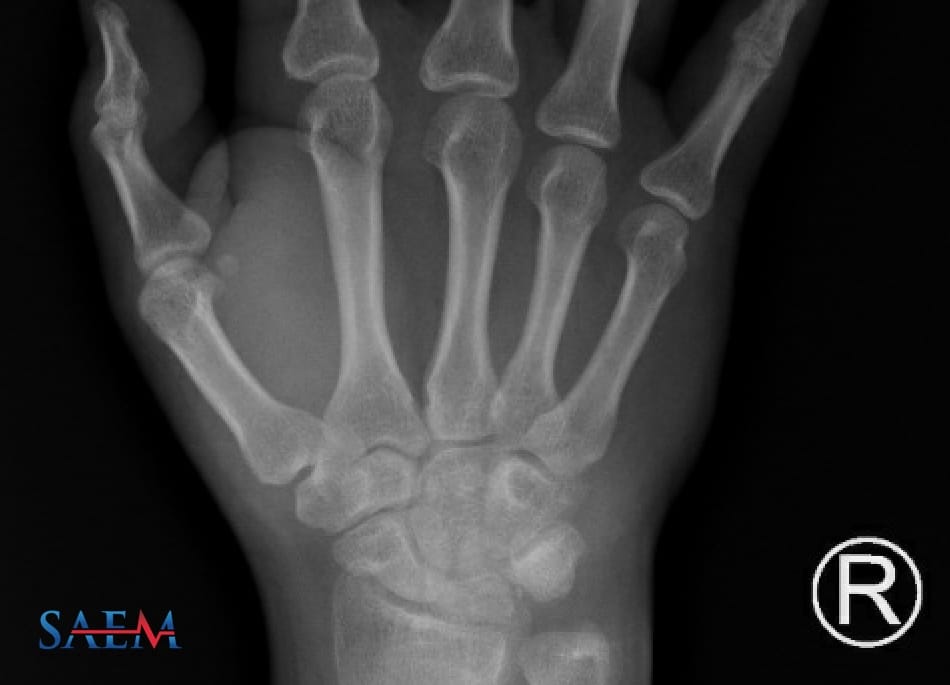
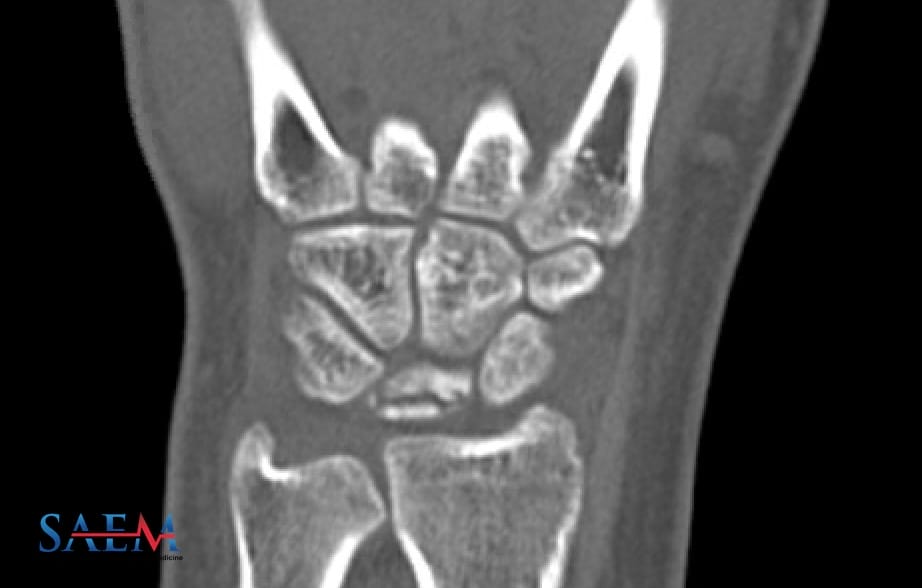
Comminuted lunate fracture. Lunate fractures, especially comminuted lunate fractures, usually result from high-energy trauma, with an incidence ranging from only 0.5% to 6.5% of carpal fractures. Up to one-third of wrist fractures appear to be overlooked on traditional radiography. Further imaging should be warranted for patients who are clinically suspicious of wrist fractures in the ED. Multidetector Computed Tomography (MDCT) with multiplanar reformat capability is a useful method to identify occult wrist fractures.
The blood supply of the lunate bone comes from the palmar and medial arteries of the carpometacarpal branch of the radial artery. Damage to the artery may lead to avascular necrosis (Kienböck disease). Comminuted lunate fractures may result in severe intraosseous destruction of vasculature, increasing the risk of lunate bone necrosis. An at-risk nerve is the median nerve, which runs through the carpal tunnel. If the lunate is fractured or displaced, it may compress or damage the median nerve, resulting in pain, paresthesia, or sensory loss in the palmar surface of the thumb, index, and middle fingers and radial half of the ring finger.
Take-Home Points
-
Associated risk factors for a lunate fracture include occupations or sports involving repetitive pressure to the base of the hand with the wrist in extension (eg, roofer, gymnast, jack-hammer operator).
-
Due to complex carpal anatomy, traditional radiography may not be sufficient to detect lunate fractures.
-
At-risk structures that require evaluation in the case of lunate fracture include the palmar and medial branches of the radial artery and the median nerve.
-
Li, Jun, et al. “Comminuted lunate fracture combined with distal radius fracture and scaphoid fracture: A case report.” Medicine, vol. 102, no. 29, 2023, https://doi.org/10.1097/md.0000000000034393.
-
Balci, Ali, et al. “Wrist fractures: Sensitivity of radiography, prevalence, and patterns in MDCT.” Emergency Radiology, vol. 22, no. 3, 2014, pp. 251–256, https://doi.org/10.1007/s10140-014-1278-1.
-
Geissler, William B. “Carpal fractures in athletes.” Clinics in Sports Medicine, vol. 20, no. 1, 2001, pp. 167–188, https://doi.org/10.1016/s0278-5919(05)70254-4.