


SAEM Clinical Images Series: Quirky Quincke’s
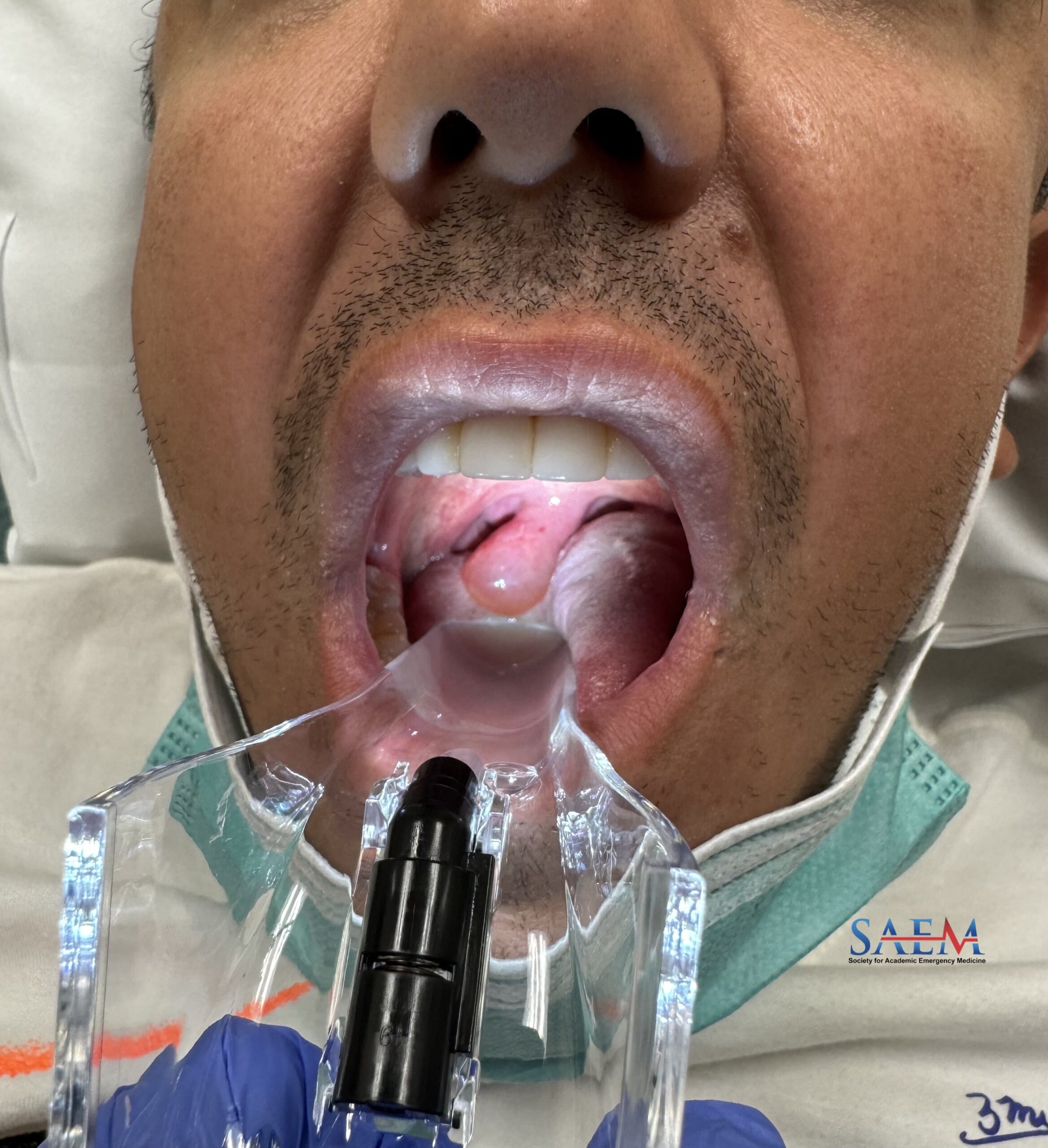
The patient is a 38-year-old male with no past medical history who presents to the Emergency Department with chief complaint of “swollen uvula” that started 4 hours ago. The patient reports that he woke up this morning with pain in his throat and associated shortness of breath secondary to swelling. States he looked in his mouth in the mirror and saw that his uvula was swollen, prompting his visit to the ED. He states that he took Benadryl and Tylenol at onset of symptoms with no relief. The patient denies fever, cough, runny nose, nausea, vomiting, or drooling and has had no known sick contacts, changes in diet, or new medications. He denies smoking or any illicit drug use. He reports that this happened to him once before years ago when he was in his 20s, when he had similar presentation with edema of his uvula that was treated with Benadryl and a “shot” that he received 1 time in the emergency department with significant improvement and resolution of symptoms. He has no other complaints at this time.
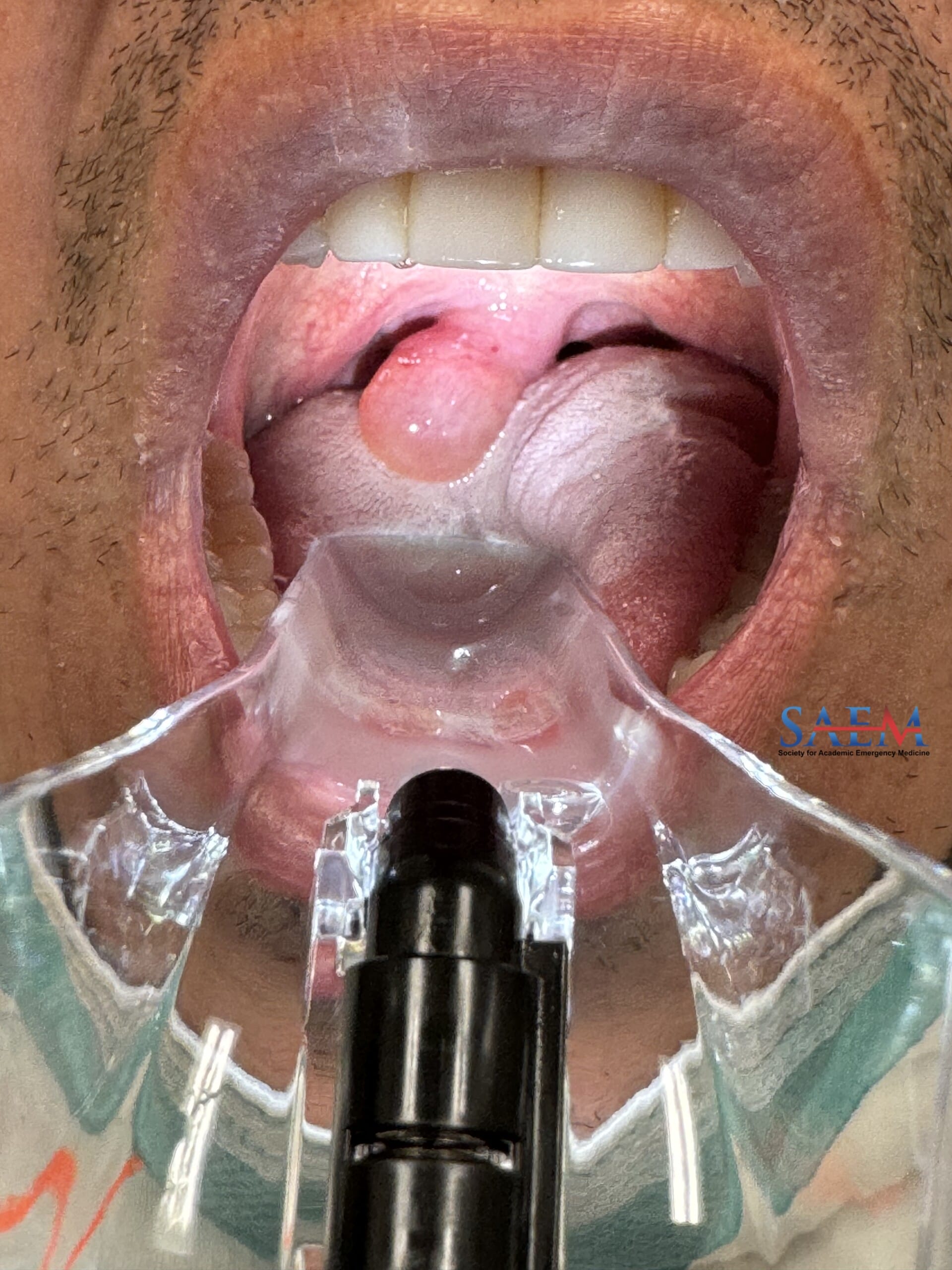
Vitals: BP 115/69 HR 86 R 17 T 98.2 O2sat 100% room air.
General: Well appearing, no acute distress, normal voice.
HEENT: Relevant findings as shown. There is no drooling, pooling of secretions, muffled voice, lip swelling, or trismus. No signs of
peritonsillar abscess.
Neck: Non-tender to palpation. No swelling or adenopathy present.
Respiratory: Clear to auscultation bilaterally, breathing comfortably.
Influenza, COVID, Rapid Strep: negative
Quincke’s Disease (isolated angioedema of the uvula)
Quincke’s disease is an uncommon clinical diagnosis with unknown incidence; there are multiple causes reported in the literature. The most commonly reported cause is Type 1 hypersensitivity reaction. Other reported causes include hereditary angioedema, inhalation exposure, thermal injuries, and infections. In our particular case, we suspect hereditary angioedema given the patient’s prior history of the same issue. The ED management of uvular angioedema should include treatment with antihistamines, corticosteroids, NSAIDs and/or epinephrine in severe cases. Antibiotics are indicated if infection suspected. In cases of hereditary angioedema, patients may benefit from recombinant C1 esterase inhibitors. Patients with uvular angioedema should be closely monitored for signs of worsening respiratory compromise. If the patient worsens, admission for close observation should be considered or in severe cases, intubation for airway protection may be necessary. If the edema is not progressing, mild or uncomplicated, and/or resolved after treatment, patients can be safely discharged home. Our patient was monitored in the ED for over 2 hours without worsening and was discharged home with close follow up.
Take-Home Points
- Quincke’s disease is an uncommon phenomenon of isolated uvular edema with multiple possible etiologies.
- Airway patency is the primary concern when managing uvular angioedema.
- Gabriel Atan Sanchez, Madison Boot, Abdul Lathif, Quincke’s disease: an unusual pathology, Journal of Surgical Case Reports, Volume 2023, Issue 3, March 2023, rjad085, https://doi.org/10.1093/jscr/rjad085
- Mohammadi, Ladan1,; Miller, Anthony2; Ashurst, John V.3. Quincke’s disease. Journal of Family Medicine and Primary Care 5(3):p 677-679, Jul–Sep 2016. | DOI: 10.4103/2249-4863.197308
- Gonçalves FMF, Costa M, Campos AL, Cotter J. Quincke’s Disease Presenting After Cocaine Exposure. Cureus. 2022 Oct 21;14(10):e30536. doi: 10.7759/cureus.30536. PMID: 36415441; PMCID: PMC9675901.