


SAEM Clinical Images Series: A Case of Sudden Right Arm Pain and Deformity
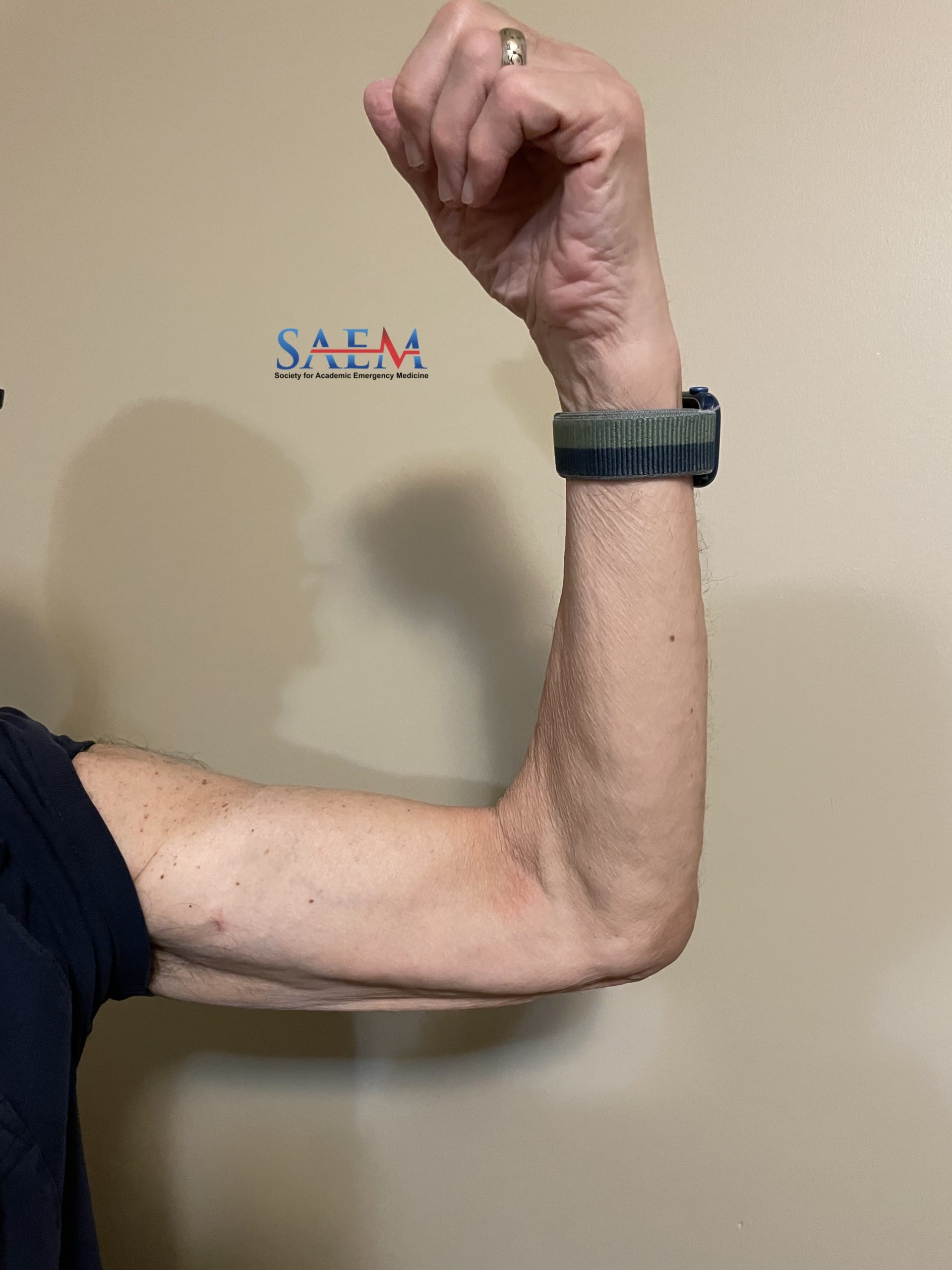
A 73-year-old male presented to the Emergency Department with acute pain in his upper right arm. The pain began suddenly upon attempting to lift a 30-lb box that had been delivered to his house. He stated that as he began to lift the box, he felt a sudden pop coupled with the acute onset of pain. Since the injury, he had difficulty with flexion of his right upper extremity. He denied any other complaints.
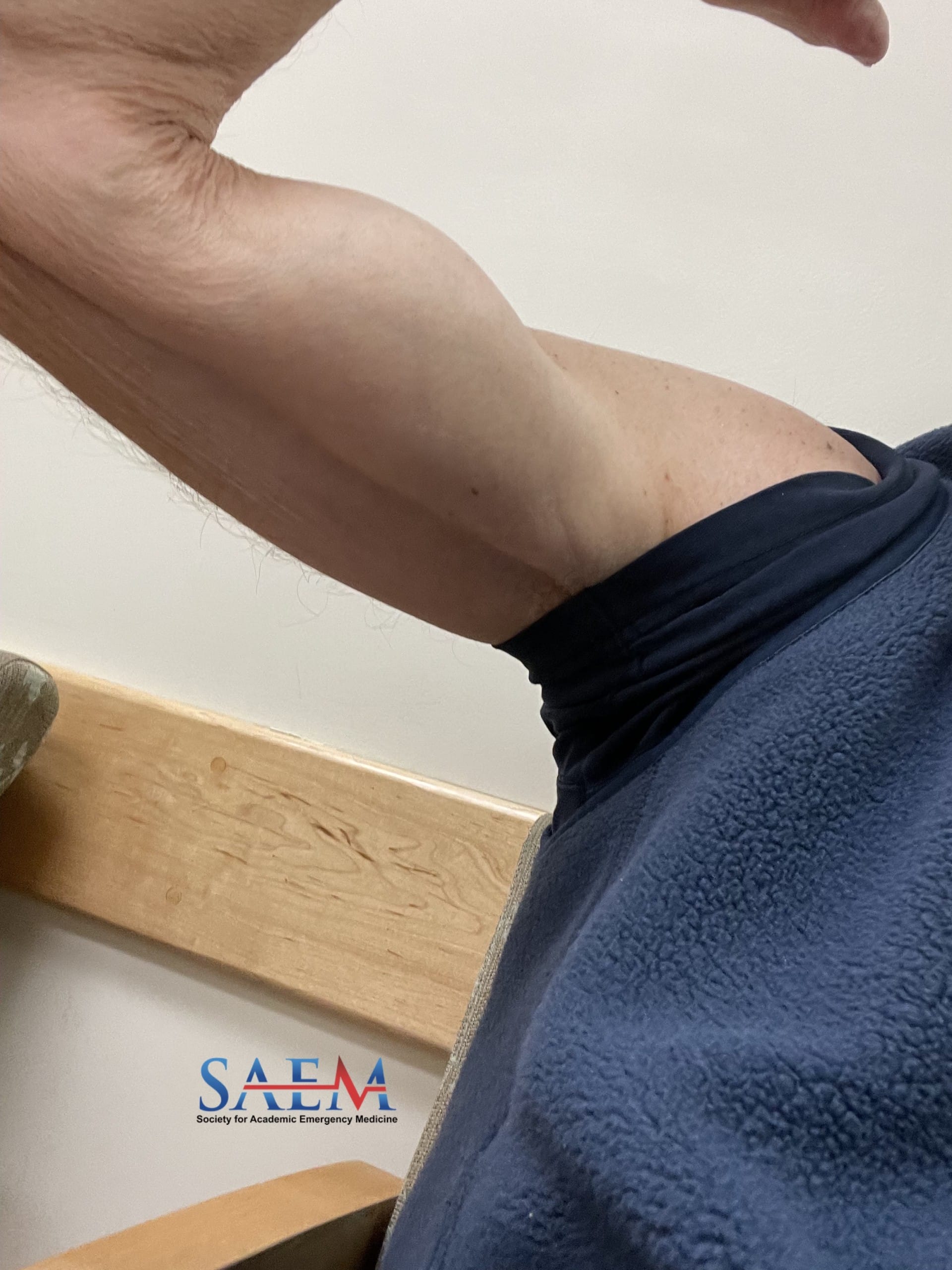
Vitals: All vital signs are normal.
General: Alert and oriented, well appearing.
Chest: Heart and lung sounds are normal. Chest palpation is unremarkable.
Musculoskeletal: See provided images comparing right versus left upper arm appearance. The patient reports pain with right elbow range of motion. No bony tenderness is present. Flexion of the right upper extremity is limited on exam.
Neurologic: Sensation is intact throughout. The patient has weakness of right elbow flexion, but other tests of strength are preserved.
Non-contributory
The patient has a “Popeye sign” – a proximal biceps bulge at the anterior mid-arm level of his right arm.
The patient has a biceps tendon rupture of his right arm.
Patients with biceps tendon ruptures present with anterior upper arm pain, often after contraction against resistance. Ruptures of the proximal tendon are more common than distal ruptures. Risk factors include advanced age, male gender, chronic biceps tendinopathy, tobacco use, and obesity. Acute ecchymosis and swelling are common. Proximal ruptures such as in this case demonstrate a proximal muscular bulge at the anterior mid-arm level (known as the Popeye sign). Distal rupture can be examined with several maneuvers such as the hook test, supination pronation test,biceps squeeze test, and distal biceps provocation test, which overall have high sensitivity and specificity for diagnosing distal biceps tendon rupture. Proximal ruptures may be treated conservatively, though surgical repair options exist. For distal ruptures, definitive treatment is surgical intervention. Factors affecting recommendations for surgery include the location and severity of the tear (complete vs. partial), and the patient’s medical fitness. Though rare, rhabdomyolysis and compartment syndrome are possible complications.
Take-Home Points
-
Biceps tendon ruptures are usually due to forcible contraction against significant resistance.
-
Initial treatment can be conservative in the ED, though all biceps tendon ruptures require urgent outpatient orthopedic referral.
- Kelly, Mick P., et al. “Distal Biceps Tendon Ruptures: An Epidemiological Analysis Using a Large Population Database.” The American Journal of Sports Medicine, vol. 43, no. 8, 2015, pp. 2012–17, https://doi.org/10.1177/0363546515587738.
- Vishwanathan K, Soni K. Distal biceps rupture: Evaluation and management. J Clin Orthop Trauma. 2021 May 20;19:132-138. doi: 10.1016/j.jcot.2021.05.012. PMID: 34099972; PMCID: PMC8167284.