


SAEM Clinical Images Series: Wake-up Call
The patient is a 53-year-old anuric female with a history of kidney/liver transplant, ESRD on hemodialysis, diabetes mellitus, and atrial fibrillation with recent failed cardioversion who presents to the Emergency Department with one week of worsening generalized weakness. She reports dyspnea on exertion which improves with rest, generalized abdominal pain, and mild vomiting. Her medications include escitalopram 20 mg daily, flecainide 100 mg twice daily, magnesium oxide 400 mg daily, metoprolol 50 mg 3 times daily, pregabalin 50 mg daily, risperidone 0.5 mg twice daily, sevelamer 800 mg three times daily, tacrolimus 1.5 mg twice daily, ursodiol 300 mg 3 times daily, warfarin 5 mg daily, and tramadol 25 mg PRN. She denies any other complaints at this time.
Vitals: All vital signs are normal.
General: Mildly confused, speaking short phrases, appears chronically ill.
HEENT: Dry mucous membranes present, Moderate JVD present.
Respiratory: Bilateral crackles auscultated.
Cardiovascular: Regular rate and rhythm without murmurs, rubs, gallops.
Abdomen: Mild diffuse lower abdominal tenderness present.
Neurologic: Oriented times two, moves all extremities, asterixis present.
CMP: Na 123, K 4.8, Cl 85, BUN 53, Creat 6.6
LFT’s unremarkable, Ammonia 73, BNP 1508
Flecainide toxicity.
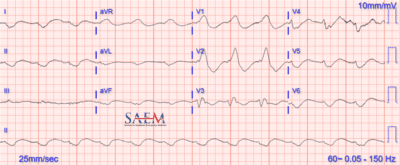
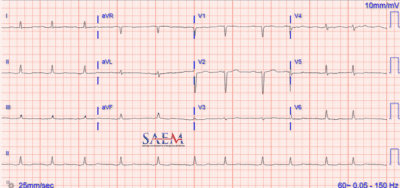
The cause of this abnormal EKG is flecainide toxicity. Flecainide is a class IC antiarrhythmic and a sodium channel blocking drug used mainly for the treatment of supraventricular dysrhythmias. The initial EKG shows a widened QRS and prolonged QT, nearing a sinusoidal pattern. Lengthening of the PR interval is also seen. This EKG could be consistent with severe hyperkalemia, but this patient’s potassium was normal. Sodium bicarbonate boluses were administered, but this treatment was limited due to ESRD and inability to buffer the bicarbonate, leading to rapid alkalosis. She received 3% saline as she could not tolerate larger fluid volumes. Magnesium sulfate was administered for the prolonged QT interval. Ultimately, the patient was stabilized and a repeat EKG (now shown) demonstrated marked improvement. ECMO and intralipid therapy were considered, but the patient’s blood pressure was stable, and both therapies were considered particularly high risk for this patient. A send-out flecainide level measured 4.57 mcg/mL (therapeutic range 0.2-0.99). The flecainide dosing may have been excessive in this patient, as the risk of flecainide toxicity increases with renal and hepatic impairment.
Take-Home Points
- Flecainide toxicity may mimic severe hyperkalemia on EKG, as Class IC antiarrhythmics can cause QRS and QT prolongation.
- QRS and QT prolongation is treated with sodium bicarbonate and magnesium, respectively, along with optimization of electrolytes.
- Patients with impaired renal function are at high risk for the development of flecainide toxicity.
- Flecainide Acetate: Dosing and Indications, Toxicology. (2024). In Micromedex (WellSpan Health.) [Electronic version]. Greenwood Village, CO: Truven Health Analytics. Retrieved Dec 12, 2024, from http://www.micromedexsolutions.com/
- McCabe DJ, Walsh RD, Georgakakos PK, Radke JB, Wilson BZ. Flecainide poisoning and prolongation of elimination due to alkalinization. Am J Emerg Med. 2022 Jun;56:394.e1-394.e4. doi: 10.1016/j.ajem.2022.03.006. Epub 2022 Mar 9. PMID: 35287973.