Video: Caution about patient hand-offs in the ED
Kudos to Dr. Vineet Arora (Univ of Chicago) on creating a great video on the importance of clear, concise, and updated hand-off information on patients. This is especially important in the Emergency Department where patients are constantly being “signed out” to other residents for continued acute care. Whatever hand-off process you are using now, we can always do better.
Women in Academic EM video
As a joint project between Clerkship Directors in EM (CDEM) and the Academy for Women in Academic EM (AWAEM), there is a great 11 minute video about life in academic EM. For more information, check out AWAEM’s website.
Article Review: Evaluating students using RIME method
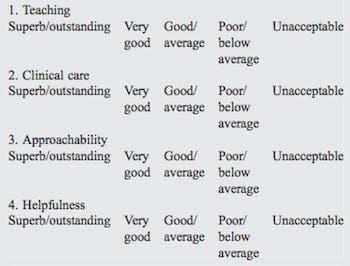
How do evaluate medical students and residents, who are rotating through your Emergency Department? Do you have a structured framework for assessing their competencies?
Have you heard of the RIME method of evaluating learners on their clinical rotation? Dr. Lou Pangaro (Vice Chair for Educational Programs in the Dept of Medicine at the Uniformed Services University) published a landmark article in 1999 on his simple yet effective approach in evaluating medical students and residents. I had the pleasure of briefly meeting Dr. Pangaro when he gave CDEM’s keynote speech in 2008.
(more…)
Hot off the press: Journal of Graduate Medical Education
In 2009, ACGME has launched a new journal focused on graduate medical education, called the Journal of Graduate Medical Education (JGME). For those of you with education manuscripts in need of a “home”, consider this peer-reviewed journal. It publishes quarterly.
Article Review: Impact of family presence in a code
Family presence in the ED resuscitation of a dying patient is a controversial topic. Some surveys suggest that families favor this practice and would repeat it again in a similar situation.
An article in Critical Care Medicine examines the impact of family presence on the ED personnel’s actions, rather than the impact on the families themselves. Second and third-year EM residents were randomized into paired teams in simulation exercises. All resuscitations involved a cardiac arrest patient. Each team was exposed to one of three types of resuscitation groups:
- No family witness
- Non-obstructive family witness (quiet person) – quiet crying and conversation with social worker
- Overtly grieving family witness – loud crying, attempts to hug patient during resuscitation
(more…)
Article Review: Conceptual Model on Learner Reflection
Reflective journals and electronic portfolios are becoming increasingly popular within undergraduate and graduate medical education. I’m starting to be a believer in this learning approach, which teaches learners about professional development and life-long learning principles. Academic Medicine just published a great qualitative paper proposing a conceptual model for reflection.