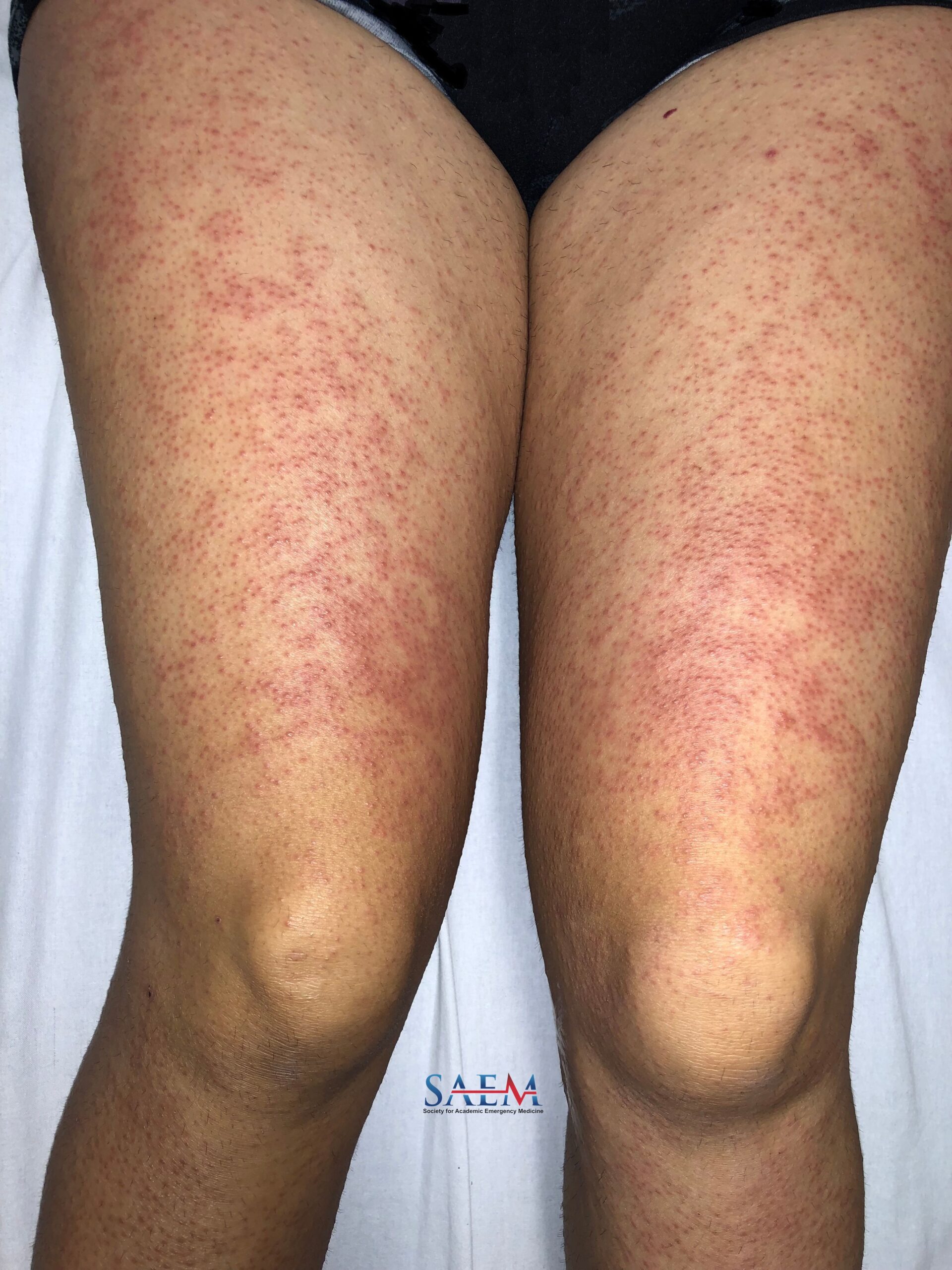
A 23-year-old female with no known past medical history presented with a rash concentrated on her legs, with a few areas on her arms and chest. The rash began the day before presentation when she became overheated while wearing sweatpants in 104°F weather. The rash was mildly pruritic but not painful. She denied any prior reaction to her sweatpants that she has had for several months. She denied any new soap or cosmetic use, prior rash, allergy, or medication use. Her review of systems and past medical history were negative.
Vitals: Normal
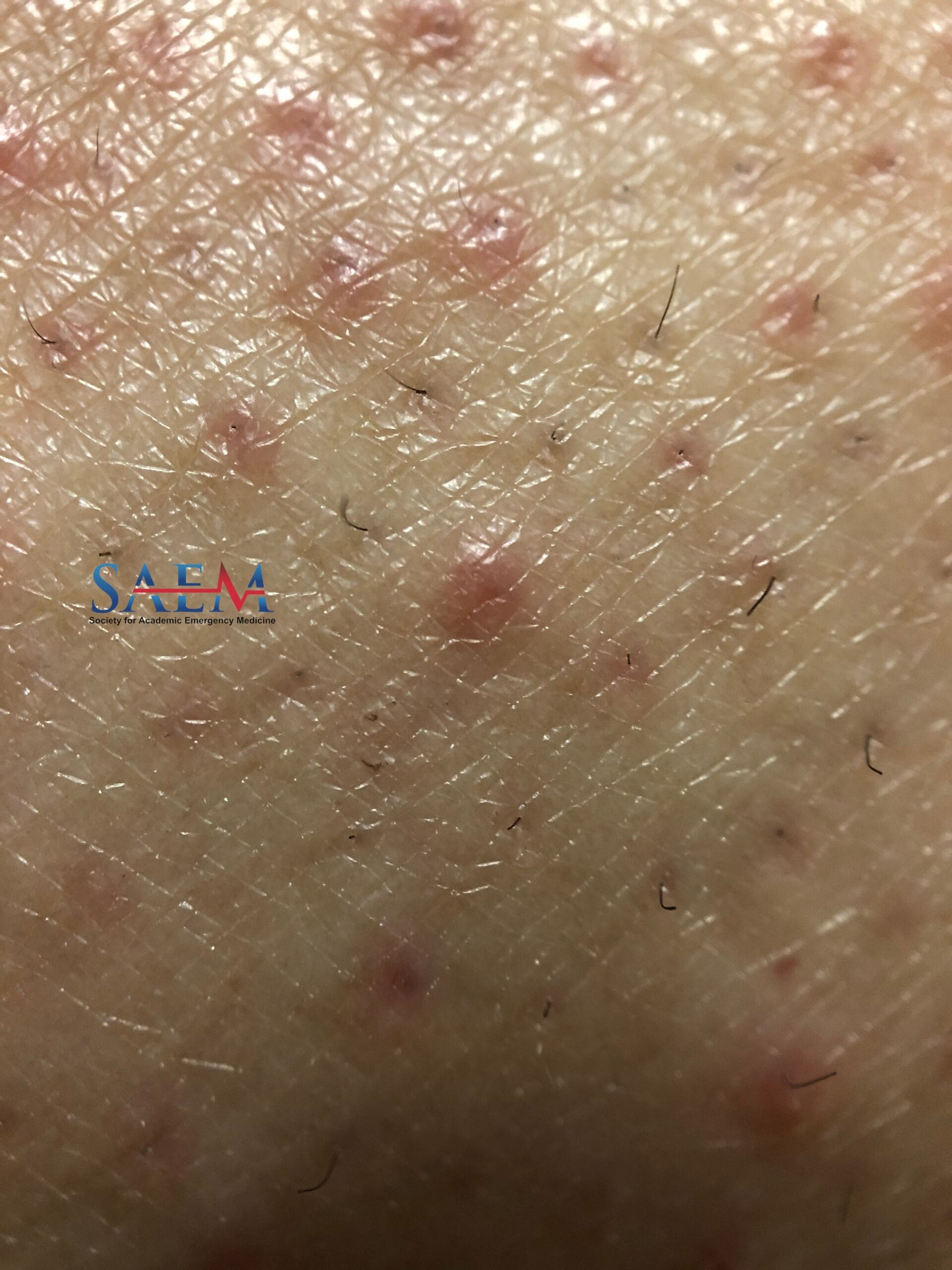
Skin: An erythematous papular rash is concentrated and symmetric on her lower extremities. There are a few sparse lesions on her arms, thorax, and abdomen with sparing of the palms, soles, and face. No pustules or vesicles are noted. There is no scale or crust. No other skin lesions are present. The rest of the examination is normal.
Non-contributory
Miliaria, or prickly heat (heat rash).
Miliaria, also known as prickly heat or heat rash, is caused by blocked eccrine sweat glands and ducts. Exposure to heat with sweating causes eccrine sweat to pass into the dermis or epidermis causing a rash. It is common in warm and humid climates during the summer months. It can affect up to 30% of adults living in hot and humid conditions. It may present as vesicles, papules, or pustules depending on the depth of the eccrine gland obstruction. In adults the rash is most likely seen where clothes rub on the skin. Infants and children typically have lesions on the upper trunk, neck, and head. Miliaria is a clinical diagnosis. Treatment involves measures to reduce sweating and exposure to hot and humid conditions. Air conditioning and the reduced humidity of indoor environments are helpful. If significant inflammation is present with pruritis, some improvement can be seen with 0.1% triamcinolone topically, though ointment should be avoided and only cream or lotion applied.
Take-Home Points
- Miliaria, or prickly heat, is caused by sweating and blocked eccrine sweat glands.
- Treatment involves retreating to cool, indoor environments.
- Triamcinolone 0.1% cream or lotion may reduce pruritis.
- Guerra KC, Toncar A, Krishnamurthy K. Miliaria. 2023 Aug 8. In: StatPearls [Internet]. Treasure Island (FL): StatPearls Publishing; 2024 Jan–. PMID: 30725861.

Walter L Green, MD
Emergency Medicine
University of Texas Southwestern
Latest posts by Walter L Green, MD (see all)
- SAEM Clinical Images Series: Painful Great Toe - April 25, 2025
- SAEM Clinical Images Series: Red Rash on My Legs - April 1, 2024
- SAEM Clinical Images Series: Back Lesion - February 2, 2024

Samuel Parnell, MD
Assistant Program Director for the Emergency Medicine Residency Program
University of Texas Southwestern
Latest posts by Samuel Parnell, MD (see all)
- SAEM Clinical Images Series: Snake it Off - February 3, 2025
- SAEM Clinical Images Series: Red Rash on My Legs - April 1, 2024
- SAEM Clinical Images Series: Back Lesion - February 2, 2024

Jedidiah Leaf, MD
Emergency Medicine
University of Texas Southwestern
Latest posts by Jedidiah Leaf, MD (see all)
- SAEM Clinical Images Series: Red Rash on My Legs - April 1, 2024
- SAEM Clinical Images Series: Back Lesion - February 2, 2024
- SAEM Clinical Images Series: Face and Chest Rash - December 1, 2023