

About Anna Fang, MD

Resident Physician
Department of Emergency Medicine
Boston Medical Center

SAEM Clinical Images Series: A Blistery Mystery
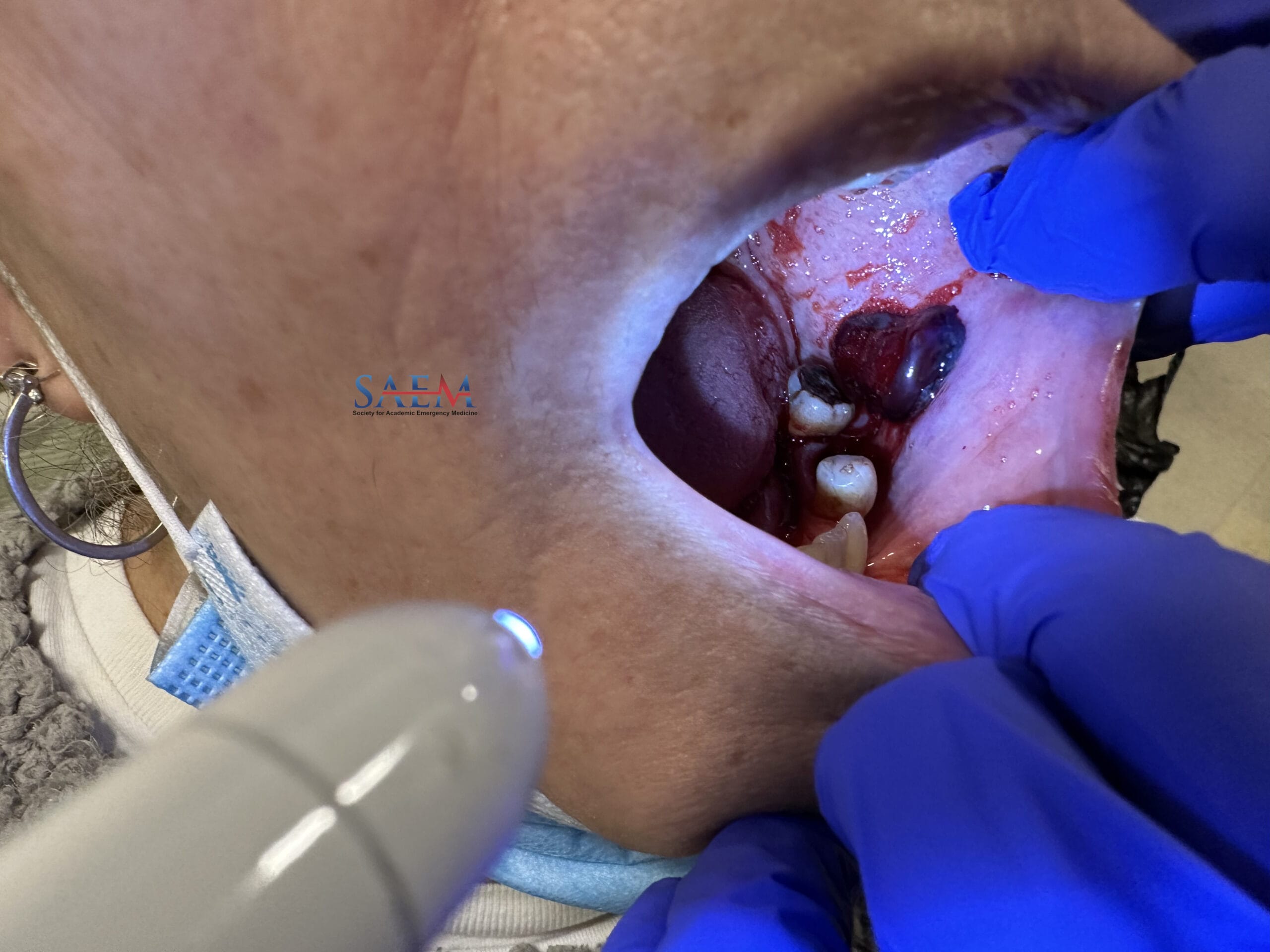
blister

A 76-year-old female presented with a lingering cough and an oral lesion to the left lower cheek. She reported ten days of improving flu-like symptoms but had a persistent cough and nasal congestion. On the day of presentation, she developed a painful, intermittently bleeding “blood blister” to the left lower cheek that had increased in size, as well as new red spots on her arms and legs. She reported no recent trauma or history of similar lesions in the past.

Vitals: 98.3°F; HR 85; BP 178/89; RR 16; SpO2 98% on RA

HENT: Blood-filled pocket to the left lower vestibule

Skin: Diffuse petechial rash to extremities

CBC: Hb 13.6, Plt 6, WBC 10.3

PT: 12.2

INR: 1.05

PTT: 33

Immune thrombocytopenia (ITP) is an acquired autoimmune disorder caused by autoantibodies against platelet antigens. It is thought to be due to IgG directed against platelet membrane glycoprotein GPIIb/IIIa, leading to platelet destruction. Common inciting events include viral infections, autoimmune diseases, or immunodeficiency syndromes [1]. Patients typically present with bleeding or nonspecific symptoms such as fatigue or generalized weakness. The severity of bleeding can range from petechiae, purpura, and epistaxis, to (very rarely) life-threatening hemorrhage. It is important to perform a thorough skin and oral exam to evaluate for petechial rashes or mucosal bleeding. Initial diagnostics include a CBC which will show isolated thrombocytopenia, as well as hemolysis labs to exclude alternative etiologies.

Patients with life-threatening bleeding should be treated emergently with platelet transfusions, IVIG, and steroids. In all other cases, management decisions should be made in conjunction with Hematology. In general, those with mild/moderate bleeding and platelets <20,000/μL should be treated with a steroid course, with IVIG or platelet transfusions in special circumstances only [3]. Patients who receive any treatment or have diagnostic uncertainty should be admitted.

Take-Home Points

  • Immune thrombocytopenia is an acquired isolated thrombocytopenia that can be a primary disorder or secondary to viral illness, autoimmune syndrome, or immunodeficiency disease.
  • Patients typically present with minor bleeding and nonspecific symptoms such as fatigue, or, rarely, severe hemorrhage. Perform a thorough skin and oral exam to evaluate for petechial rashes or mucosal bleeds.
  • Life-threatening bleeding should be treated immediately with platelet transfusions, IVIG, and steroids. Treatment for mild/moderate bleeding is more nuanced. Consult Hematology early to guide management.

  • Cines DB, Bussel JB, Liebman HA, Luning Prak ET. The ITP syndrome: pathogenic and clinical diversity. Blood. 2009 Jun 25;113(26):6511-21. doi: 10.1182/blood-2009-01-129155. Epub 2009 Apr 24. PMID: 19395674; PMCID: PMC2710913.
  • Neunert C, Terrell DR, Arnold DM, Buchanan G, Cines DB, Cooper N, Cuker A, Despotovic JM, George JN, Grace RF, Kühne T, Kuter DJ, Lim W, McCrae KR, Pruitt B, Shimanek H, Vesely SK. American Society of Hematology 2019 guidelines for immune thrombocytopenia. Blood Adv. 2019 Dec 10;3(23):3829-3866. doi: 10.1182/bloodadvances.2019000966. Erratum in: Blood Adv. 2020 Jan 28;4(2):252. PMID: 31794604; PMCID: PMC6963252.
  • Provan D, Arnold DM, Bussel JB, et al. Updated international consensus report on the investigation and management of primary immune thrombocytopenia. Blood Adv. 2019;3(22):3780-3817. doi:10.1182/bloodadvances.2019000812

By |2024-09-28T21:40:15-07:00Oct 11, 2024|Heme-Oncology, SAEM Clinical Images|

SAEM Clinical Images Series: A Painful Swollen Digit

finger

A 50-year-old male with a history of polysubstance use disorder and poorly-controlled type 2 diabetes mellitus presents with left hand pain. One week ago, the patient sustained a macerating injury of the left distal middle digit. Since that time he has experienced worsening pain throughout the digit, now associated with diffuse swelling and discoloration. The patient also reports reduction in range of motion.

Vitals: Temp 97.6°F (36.4°C); BP 134/89; HR 87; Resp 16

General: Uncomfortable appearing male.

Musculoskeletal: Left hand third digit with fusiform edema, diffuse erythema, and warmth. Held in passive flexion at rest. Skin breakdown noted at distal fingertip with scant serous drainage. Tender to palpation, most markedly over the volar surface of the PIP joint. Patient reports severe pain with passive extension at the MCP, PIP, and DIP joints.

Glucose: 296

White Blood Cell (WBC) Count: 8,000/μl

ESR: 54 mm/hr

Infectious flexor tenosynovitis is an infection of the flexor tendon and synovial sheath with a significant risk of complications (e.g., tendon rupture, loss of function, amputation) if not promptly treated. Patients classically present 2-4 days after penetrating trauma to the hand (e.g., bite/scratch, puncture wound, laceration, injection).

This diagnosis is suggested clinically by four cardinal findings, the Kanavel signs:

1) diffuse “fusiform” swelling of the digit (most common)

2) digit held in passive flexion

3) tenderness to percussion over the flexor sheath

4) pain with passive extension

Although fundamentally a clinical diagnosis, the initial evaluation for infectious flexor tenosynovitis should include laboratory studies including complete blood count (CBC) and inflammatory markers (ESR/CRP). Radiographs may be performed to evaluate for occult traumatic injury or foreign body. Treatment includes emergent consultation of orthopedics or hand surgery, initiation of intravenous (IV) antibiotics, and hospital admission. Antibiotics should target gram-positive organisms (Staphylococcus, including MRSA, and Streptococcus). In immunocompromised patients, additional coverage against gram-negative organisms and anaerobes may be needed. Risk factors for poor outcomes include immunocompromise (HIV, diabetes, immunosuppression), intravenous drug use, peripheral vascular disease, and polymicrobial infection.

Take-Home Points

  • Infectious flexor tenosynovitis is a surgical emergency that is diagnosed clinically by the presence of one or more of the four Kanavel signs on physical exam.
  • History of trauma or penetrating injury and immunocompromised status should raise suspicion for infectious flexor tenosynovitis; common pathogens include Staphylococcus and Streptococcus species.
  • Treatment includes emergent consultation with orthopedics or hand surgery as well as early initiation of IV antibiotics.

  • Ritter K, Fitch R. Tenosynovitis. In: Knoop KJ, Stack LB, Storrow AB, Thurman R. eds. The Atlas of Emergency Medicine, 5e. McGraw Hill; 2021. Accessed November 30, 2022. https://accessmedicine-mhmedical-com.ezproxy.bu.edu/content.aspx?bookid=2969&sectionid=250459435.
  • Hyatt MT, Bagg MR. Flexor Tenosynovitis. OrthopClin N Am 2017;48:217-27.
  • Pang HN, Teoh LC, Yam AKT, Lee JYL, Puhaindran ME, Tan ABH. Factors affecting the prognosis of pyogenic flexor tenosynovitis. Journal of Bone and Joint Surgery. 2007;89(8):1742-1748.

Go to Top