

SAEM Clinical Images Series: Snorkeling Gone Wrong!
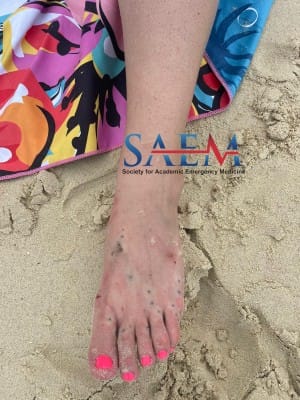
sting

The patient is a 30-year-old female who presents to the Emergency Department with severe left foot pain after snorkeling in shallow water off the coast of Phuket, Thailand. She reports a sudden onset of pain as she was kicking her legs while swimming. She describes the pain as burning in nature across the top of her foot, which worsens with weight bearing, though she can bear weight. She also complaints of multiple discolorations on the dorsum of her left foot since the pain began.

Vitals: All vital signs are normal.

General: Awake and alert in some distress from pain.

Respiratory: Clear to auscultation.

Extremities: As shown in the image provided. Sensation is intact to light touch. There is a full range of motion about the ankle. Flexion and extension are preserved in the toes. The dorsalis pedis pulse is bounding and there is no significant bleeding.

Warm water immersion to neutralize the toxin.

This patient has suffered a sea urchin envenomation after accidental contact with its spines. Sea urchins are capable of causing envenomation when accidentally stepped on or bumped into by divers and marine workers alike, especially in shallow and rocky waters where sea urchins tend to dwell. Their hollow spines, which contain toxins, easily embed in the soft tissues. They can cause significant local inflammation, including tenosynovitis and granuloma formation, or systemic effects such as nausea, vomiting, fatigue, syncope, and respiratory distress. Diving gear may offer some protection, but sharp spines may still penetrate protective gear such as flippers or water shoes. Sea urchin toxins are heat-labile, and warm water immersion (40-46°C) can rapidly reduce pain by neutralizing toxins. Other treatments, such as surgical debridement, antibiotics, and tetanus prophylaxis should be sought as necessary when returning to more resource-rich environments. Some species of sea urchins contain dye in their spines, which can give the appearance of retained spines, as seen in this case.

Take-Home Points

  • Beware sea urchin contact when diving, swimming, or snorkeling in shallow, rocky waters.
  • Significant pain relief can be achieved with hot water immersion in sea urchin stings, as the toxins are heat labile.

  • Gelman Y, Kong EL, Murphy-Lavoie HM. Sea Urchin Toxicity. [Updated 2023 Aug 7]. In: StatPearls [Internet]. Treasure Island (FL): StatPearls Publishing; 2024 Jan-. Available from: https://www.ncbi.nlm.nih.gov/sites/books/NBK536934/
  • Zafren K, Thurman R, Jones ID. Sea Urchin Envenomation. In: Knoop KJ, Stack LB, Storrow AB, Thurman R. eds. The Atlas of Emergency Medicine, 5e. McGraw-Hill; 2021. Accessed December 27, 2024. https://accessemergencymedicine.mhmedical.com/content.aspx?bookid=2969&sectionid=250461114