SAEM Clinical Images Series: Snorkeling Gone Wrong!

sting

The patient is a 30-year-old female who presents to the Emergency Department with severe left foot pain after snorkeling in shallow water off the coast of Phuket, Thailand. She reports a sudden onset of pain as she was kicking her legs while swimming. She describes the pain as burning in nature across the top of her foot, which worsens with weight bearing, though she can bear weight. She also complaints of multiple discolorations on the dorsum of her left foot since the pain began.

Vitals: All vital signs are normal.

General: Awake and alert in some distress from pain.

Respiratory: Clear to auscultation.

Extremities: As shown in the image provided. Sensation is intact to light touch. There is a full range of motion about the ankle. Flexion and extension are preserved in the toes. The dorsalis pedis pulse is bounding and there is no significant bleeding.

Warm water immersion to neutralize the toxin.

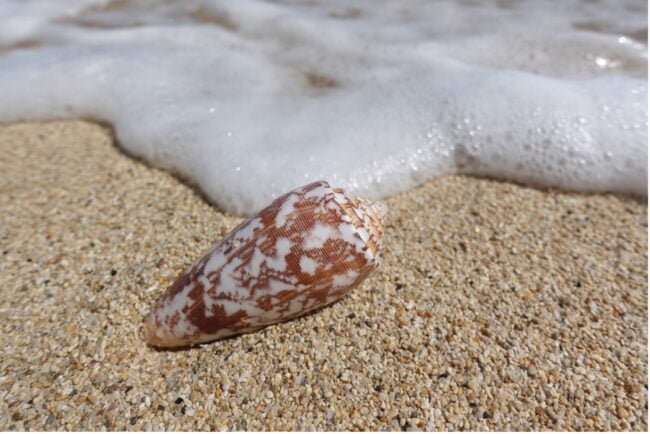
This patient has suffered a sea urchin envenomation after accidental contact with its spines. Sea urchins are capable of causing envenomation when accidentally stepped on or bumped into by divers and marine workers alike, especially in shallow and rocky waters where sea urchins tend to dwell. Their hollow spines, which contain toxins, easily embed in the soft tissues. They can cause significant local inflammation, including tenosynovitis and granuloma formation, or systemic effects such as nausea, vomiting, fatigue, syncope, and respiratory distress. Diving gear may offer some protection, but sharp spines may still penetrate protective gear such as flippers or water shoes. Sea urchin toxins are heat-labile, and warm water immersion (40-46°C) can rapidly reduce pain by neutralizing toxins. Other treatments, such as surgical debridement, antibiotics, and tetanus prophylaxis should be sought as necessary when returning to more resource-rich environments. Some species of sea urchins contain dye in their spines, which can give the appearance of retained spines, as seen in this case.

Take-Home Points

  • Beware sea urchin contact when diving, swimming, or snorkeling in shallow, rocky waters.
  • Significant pain relief can be achieved with hot water immersion in sea urchin stings, as the toxins are heat labile.

  • Gelman Y, Kong EL, Murphy-Lavoie HM. Sea Urchin Toxicity. [Updated 2023 Aug 7]. In: StatPearls [Internet]. Treasure Island (FL): StatPearls Publishing; 2024 Jan-. Available from: https://www.ncbi.nlm.nih.gov/sites/books/NBK536934/
  • Zafren K, Thurman R, Jones ID. Sea Urchin Envenomation. In: Knoop KJ, Stack LB, Storrow AB, Thurman R. eds. The Atlas of Emergency Medicine, 5e. McGraw-Hill; 2021. Accessed December 27, 2024. https://accessemergencymedicine.mhmedical.com/content.aspx?bookid=2969&sectionid=250461114

By |2025-11-10T14:40:56-08:00Dec 1, 2025|Environmental, SAEM Clinical Images|

ALiEM AIR Series | Environmental Module (2025)

Welcome to the AIR Environmental Module! After carefully reviewing all relevant posts in the past 12 months from the top 50 sites of the Digital Impact Factor [1], the ALiEM AIR Team is proud to present the highest quality online content related to related to Environmental emergencies in the Emergency Department. 5 blog posts met our standard of online excellence and were approved for residency training by the AIR Series Board. More specifically, we identified 1 AIR and 4 Honorable Mentions. We recommend programs give 3 hours of III credit for this module.


AIR Stamp of Approval and Honorable Mentions


In an effort to truly emphasize the highest quality posts, we have 2 subsets of recommended resources. The AIR stamp of approval is awarded only to posts scoring above a strict scoring cut-off of ≥30 points (out of 35 total), based on our scoring instrument. The other subset is for “Honorable Mention” posts. These posts have been flagged by and agreed upon by AIR Board members as worthwhile, accurate, unbiased, and appropriately referenced despite an average score.


Take the Environmental Module at ALiEMU


Interested in taking the AIR quiz for fun or asynchronous (Individualized Interactive Instruction) credit? Please go to the above link. You will need to create a free, 1-time login account.


Highlighted Quality Posts: Environmental 2025


SiteArticleAuthorDateLabel
EM OttawaThe Deep Freeze: A Review of Frostbite ManagementDr. Maria Doubova and Dr. Amanda MatticeNovember 2, 2023AIR
EM OttowaDon’t Sweat It! Heat Related IllnessDr. Steven SandersJuly 6, 2023HM
EMDocsToxCard: Crotalid Envenomation Part 2 – CroFab vs. AnaVip: What’s the Difference?Dr. Sean TrostelAugust 31, 2023HM
Taming the SRUMastering Minor Care: Dog BitesDr. Melanie YatesJuly 12, 2023HM
Kings CountyIt’s Getting Hot in Here: Exertional Heat StrokeDr. Esteban DavilaFebruary 27, 2024HM


(AIR = Approved Instructional Resource; HM = Honorable Mention)


If you have any questions or comments on the AIR series, or this AIR module, please contact us!

Reference

    1. Lin M, Phipps M, Chan TM, et al. Digital Impact Factor: A Quality Index for Educational Blogs and Podcasts in Emergency Medicine and Critical Care. Ann Emerg Med. 2023;82(1):55-65. doi:10.1016/j.annemergmed.2023.02.011, PMID 36967275

Trick of the Trade: Chest tube rewarming with Foley tubing connector

You have a pulseless hypothermic patient requiring aggressive internal rewarming. ECMO is not available, and you’ve made the decision to initiate thoracic lavage. After placing your chest tubes, you step back triumphantly, but in short order, the nurse hands you large diameter IV tubing with warmed fluids so that you can connect it to the chest tube. You are left with the IV tubing in one hand and a chest tube in the other with no time to waste, but no elegant or straightforward solution to interface the two.

Trick of the Trade

Using Foley bag tubing

The tube from a standard Foley bag, available in all emergency departments, contains a Luer lock near the tapered nozzle. This unique connector setup allows you to instill warm fluids into the thoracic space with minimal spillage.

rewarming hypothermia IV tubing chest tube foley tubing

Technique for Rewarming

  1. Attach the warmed IV fluids to the Luer lock port on the Foley bag tubing.
  2. Insert the tapered nozzle on the Foley bag tubing (typically interfaces with the urine drainage port of the Foley catheter) into the chest tube.
  3. Clamp the remainder of the Foley bag tubing just proximal to the Luer lock to minimize backflow of IV fluids into the bag.
  4. Optional: Cut the tubing proximal to the clamp to declutter the space around the interface.
  5. Instill warm fluid through one chest tube and drain it from the adjacent chest tube.
  6. Continue rewarming resuscitation protocols.
Chest tube connected to IV tubing via Foley bag tubing

IV tubing connected to chest tube via Foley bag tube (left photo is a closeup view with arrow designating IV fluid flow)

Read other Tricks of the Trade posts.

Free Comprehensive Curriculum: Climate Change and Emergency Medicine

During the COVID-19 pandemic, a few of us interested in climate change science met through the Society for Academic Emergency Medicine (SAEM), and our group slowly expanded with the virtual world. We discussed the ever-growing number of climate publications and scholarship opportunities available. Some of us did research, education, or policy work, and all of us practiced clinically.

Negative climate-related impacts that we see in the Emergency Department

We discussed how climate-related impacts negatively affected our patients, and brainstormed how we could tackle the problem now. For us in Rhode Island, Pennsylvania, Wisconsin, Colorado, and California, the climate crisis was pathology and interrupted treatment regimens, but also an opportunity to transform current care systems. At all of our hospitals, patients were brought in by ambulance with empty inhalers and non-functioning medical devices after losing electrical power. Monitors beeped from abnormal vital signs of patients impacted by extreme heat, inland and coastal flooding, or wildfires. We recognized the dangers related to place of residence and structural drivers that exacerbated existing health disparities. We agreed that open access education was the next step to action and striving for justice across our nation together.

How to start your climate change learning and advocacy journey?

More and more colleagues asked us where they could begin their own climate and emergency medicine journeys. We used our varied local and global experiences to curate content that could be used for journal clubs, medical simulation, quality improvement projects, grant applications, and other educational tracks or electives. Our goal was to provide a starting place for individuals who may not have dedicated faculty at their institutions.

Get caught up: Comprehensive 10-module curriculum

Climate change and emergency medicine 10-module curriclum

We are proud to announce a comprehensive 10-module curriculum on Climate Change and Emergency Medicine (EM) worth 56 hours of ALiEMU learning credits. Each module encompasses a broad range of reading materials and is followed by a brief quiz on ALiEMU. All of this is available for free. Get learning now.

Be a climate changemaker

We hope the material reminds all of us of what actions are needed yet: authentic partnerships, clear communication of the robust evidence that we know, inclusivity, and leadership. Like emergency medicine, climate change and health work is truly life-long learning. Yet, knowledge is only as good as its use. We look forward to years of innovative solutions that move beyond dialogue and meaningfully address some of the greatest barriers to well-being for our patients and global community.

climate change and EM ALiEMU mega badge climate changer

By |2022-12-13T14:27:20-08:00Dec 14, 2022|ALiEMU, Environmental, Medical Education|

SAEM Clinical Image Series: Red, White, & Blue

bite

A 29-year-old female presented to the emergency department for a rash on her right calf. 5 days prior, at her home in Alabama, the patient developed pain and swelling of her right calf following a spider bite while putting on her pants. The patient felt a “burning pain” and found a spider which she then killed. She went to a hospital and received cephalexin, trimethoprim/sulfamethoxazole, and oxycodone. Despite taking these medications she continued having aching pain rated 10/10 in her right calf along with generalized pruritus. The patient stated that the bite evolved from an initial generalized redness into a blue/black lesion with blistering and extensive redness along her leg and torso. She denied fever, chills, lightheadedness, abdominal pain, nausea, vomiting, and hematuria.

(more…)

Go to Top