


Trick of the Trade: Improvised Collar and Cuff Sling Using Soft Limb Holders

A 69-year-old woman presents to the emergency department (ED) after 2 falls at home. She tripped on a rug overnight, felt dizzy as she tried to get up, and fell again. She struck her head but has no pain from it. Her chief complaint is right shoulder pain, and she reports frequent shoulder dislocations in the past. An x-ray shows an acute comminuted, non-displaced fracture of the humeral neck with involvement of the greater tuberosity.
Initial management is immobilization in a sling for 1-3 weeks, and the evidence supports nonoperative treatment for most proximal humerus fractures [1,2]. A collar and cuff sling is an appropriate management plan to allow the elbow to hang free, so gravity applies gentle traction that helps maintain fracture alignment. However, what if your ED does not stock such a sling?
Trick of the Trade
Build a collar and cuff sling from 2 Posey soft limb holders, the padded wrist restraints most EDs already stock. In our case, this improvised collar and cuff sling provided adequate support to the wrist and a cushion for the patient’s neck.
Materials
2 Posey soft limb holders:
- Use one complete holder.
- Use only the padding from the second holder.
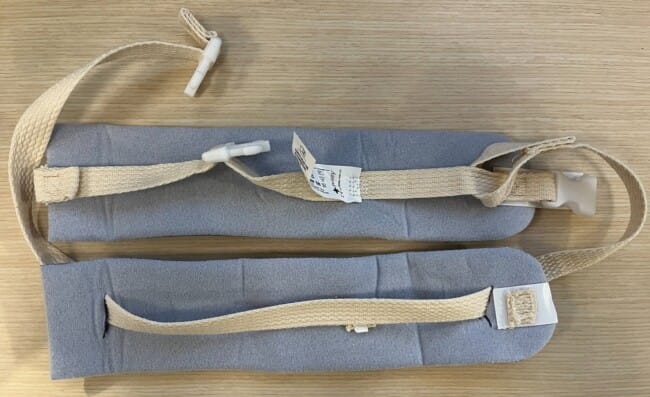
Top padding from full Posey holder for the wrist; bottom padding from second Posey holder for neck collar
Steps
- Wrap one cuff around the wrist of the injured arm.
- Remove the padding from the second cuff, and thread that padding onto the long strap of the first cuff.
- Pass the strap behind the patient’s neck. Slide the padding along the strap until it cushions the back of the neck. This is the collar.
- Adjust the strap length so the elbow rests at 90 degrees with the wrist slightly above the elbow, and secure the buckle.
- Improvised collar and cuff sling made from a Posey soft limb holder, worn with the elbow at 90 degrees and the wrist supported
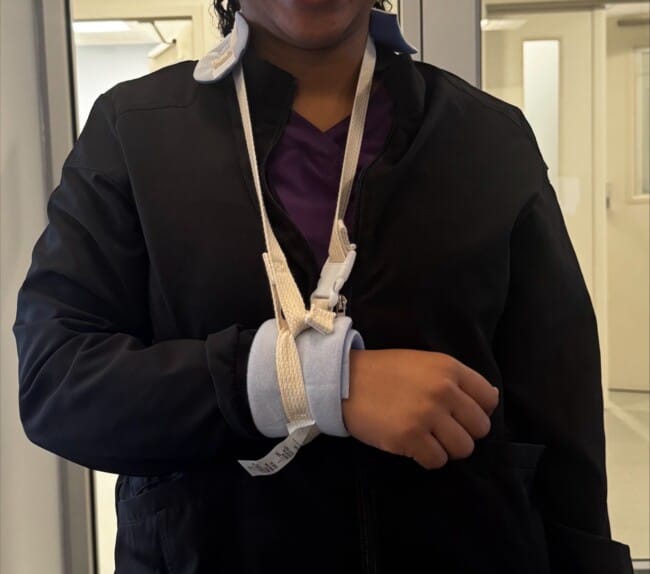
Improvised collar and cuff setup
Tips
- Application of the padded neck collar is important, because the Posey strap is often thin, flat, and coarse. It can dig into the neck once it carries the weight of an arm over the next 1-3 weeks.
- Support the wrist only and allow the elbow to hang to gravity. This axial traction helps to maintain fracture alignment.
Interested in More?
For a collar and cuff improvised with the neck strap from a shoulder immobilizer, plus other common ED splinting techniques, see SplintER Series: Common ED Splint Techniques 104.
References
- Handoll HH, Elliott J, Thillemann TM, Aluko P, Brorson S. Interventions for treating proximal humeral fractures in adults. Cochrane Database Syst Rev. 2022;6(6):CD000434. doi: 10.1002/14651858.CD000434.pub5
- Rangan A, Handoll H, Brealey S, et al. Surgical vs nonsurgical treatment of adults with displaced fractures of the proximal humerus: the PROFHER randomized clinical trial. JAMA. 2015;313(10):1037-1047. doi: 10.1001/jama.2015.1629