


SAEM Clinical Images Series: Tangled in the Toilet
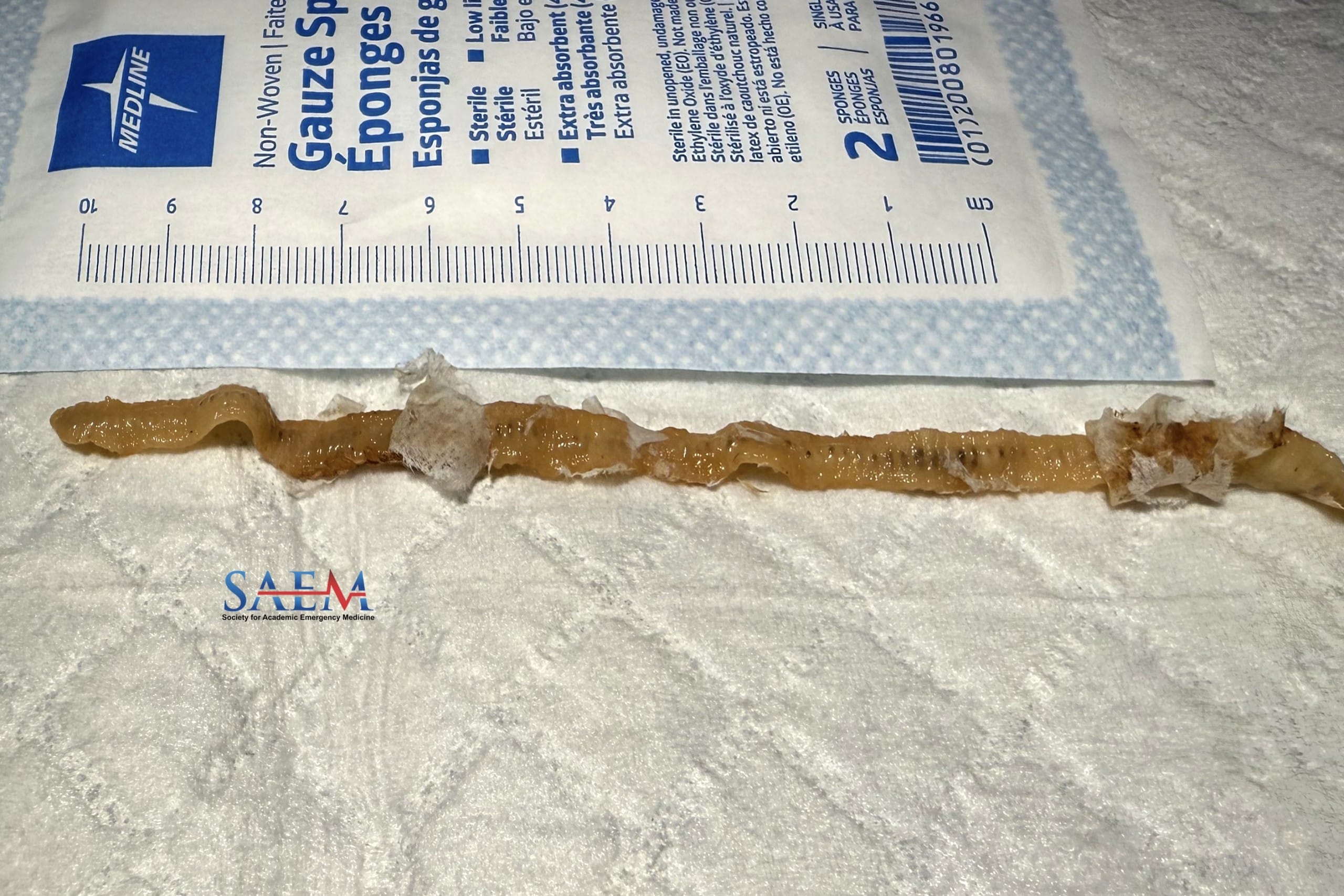
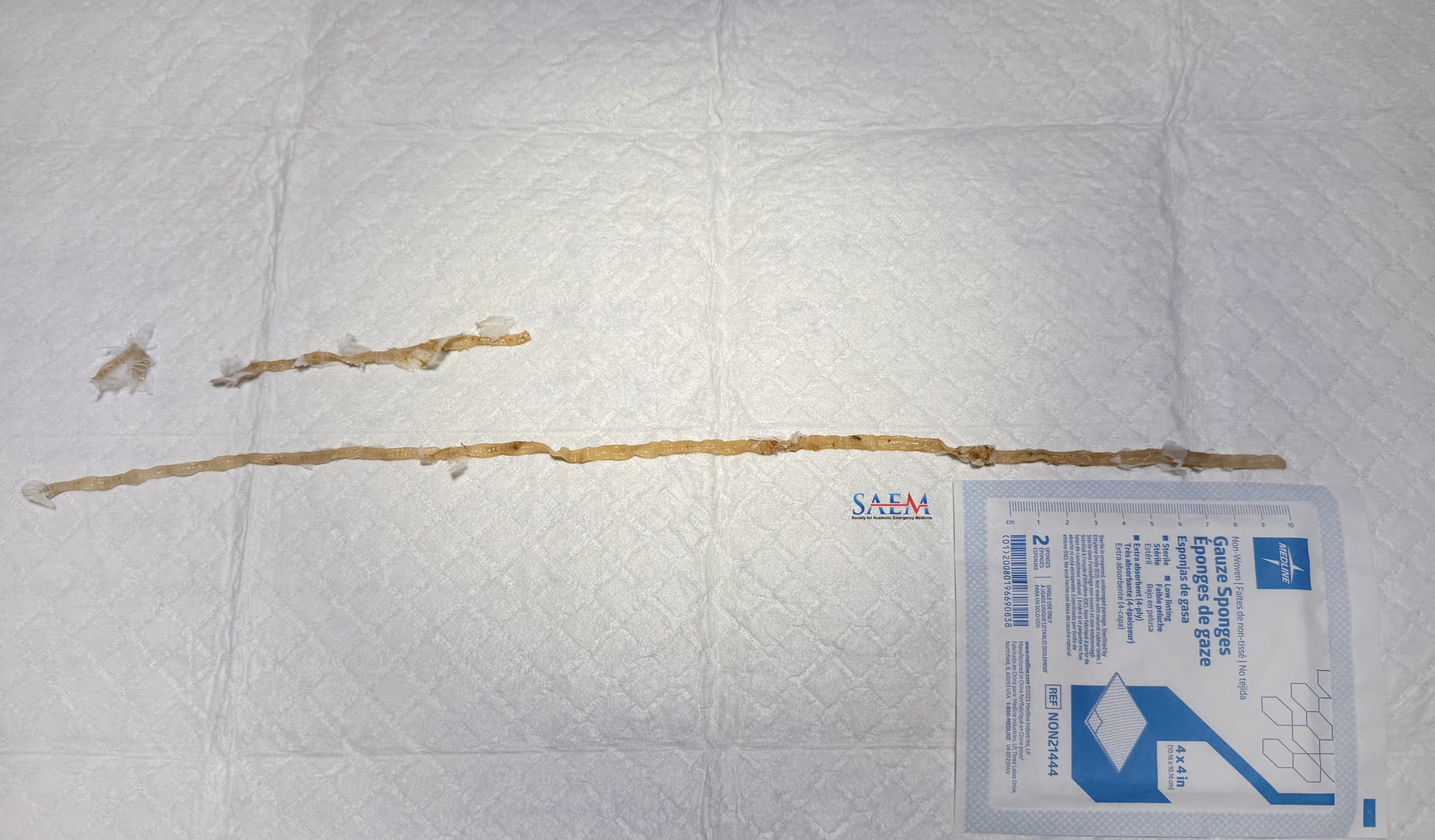
An otherwise healthy 46-year-old male presented to the Emergency Department with 18 months of diarrhea and intermittent abdominal cramping that has acutely worsened in the past week. On the morning of presentation, he noticed a worm-like object in his stool, which he brought to the ED (See images), prompting his visit. Throughout these 18 months, he experienced 4-10 loose bowel movements per day. He tried dietary modifications, including the removal of dairy, gluten, and soy, all without relief. The patient frequently travels for work, mainly to the US, Europe, and intermittently to Asia. His diet includes all forms of meat, fish, and shellfish. He denied fevers, chills, headaches, chest pain, shortness of breath, unexpected weight loss or gain, nausea, vomiting, or changes in his urinary habits. His stool has been non- greasy and has not contained any blood or mucous.
Vitals: BP 136/85; HR 70; R 18; T 98.2°F; O2 sat; 97% room air.
General: Well appearing, no acute distress.
Abdomen: There is mild tenderness to palpation in bilateral lower quadrants. Bowel sounds present in all quadrants. No rebound tenderness or guarding. No organomegaly.
Lymph: No lymphadenopathy present.
Skin: No rashes.
WBC: 5.4
Hgb: 14.4
Dibothriocephalus (Diphyllobothrium) latus: a tapeworm.
Stool ova and parasites.
This patient is infected with Dibothriocephalus (Diphyllobothrium) latus, a tapeworm distinctive for its proglottids with central hyperpigmented reproductive organs, as shown in the images. Patients rarely visualize the tapeworm in their stool, so diagnosis is usually made with a stool ova and parasite study. Diphyllobothrium latus infection is commonly caused by eating raw, undercooked, or lightly pickled seafood contaminated with tapeworm eggs. Tapeworm eggs are also occasionally used as weight loss supplements. The market for these supplements is not regulated; thus, the eggs may be from other parasites, leading to more severe manifestations of infection in different body areas, such as the brain, lungs, or muscles. Diphyllobothrium latus infection can cause pernicious anemia, as 80% of Vitamin B12 intake may be absorbed by the worm. Treatment for Diphyllobothrium latus is a single dose of praziquantel. Due to fecal-oral transmission, patients who engage in high risk transmission-prone behaviors should consider having their partners tested and treated as well.
Take-Home Points
-
Diphyllobothrium latus infection may cause Vitamin B12 deficiency and resultant anemia as the worm may absorb up to 80% of B12 intake.
-
A single dose of praziquantel is generally sufficient to eradicate tapeworm infection.
- Schantz, P. M. (1996). Tapeworms (cestodiasis). Gastroenterology Clinics of North America., 25(3), 637–653. https://doi.org/10.1016/s0889-8553(05)70267-3
- Craig P, Ito A. Intestinal cestodes. Curr Opin Infect Dis. 2007 Oct;20(5):524-32. doi: 10.1097/QCO.0b013e3282ef579e. PMID: 17762788
- Scholz T, Garcia HH, Kuchta R, Wicht B. Update on the human broad tapeworm (genus Diphyllobothrium), including clinical relevance. Clin Microbiol Rev. 2009; 22:146–160