


SAEM Clinical Images Series: Caught by the Cuff
A 74-year-old male with a history of hypertension and moderate alcohol use presented to the Emergency Department with generalized weakness. He was started on low dose furosemide once a day for mild ankle swelling 3 days prior. He reported good oral intake but noted that he had been urinating more than usual. He denied any fever, chest pain, shortness of breath, or any other problems but due to worsening weakness he came in for evaluation.
Vitals: BP 185/94; HR 90; R 18; T 97.4°F; O2 sat 98% room air.
General: Well appearing, no acute distress.
Respiratory: Clear to auscultation.
Cardiovascular: Regular rate and rhythm, no murmur.
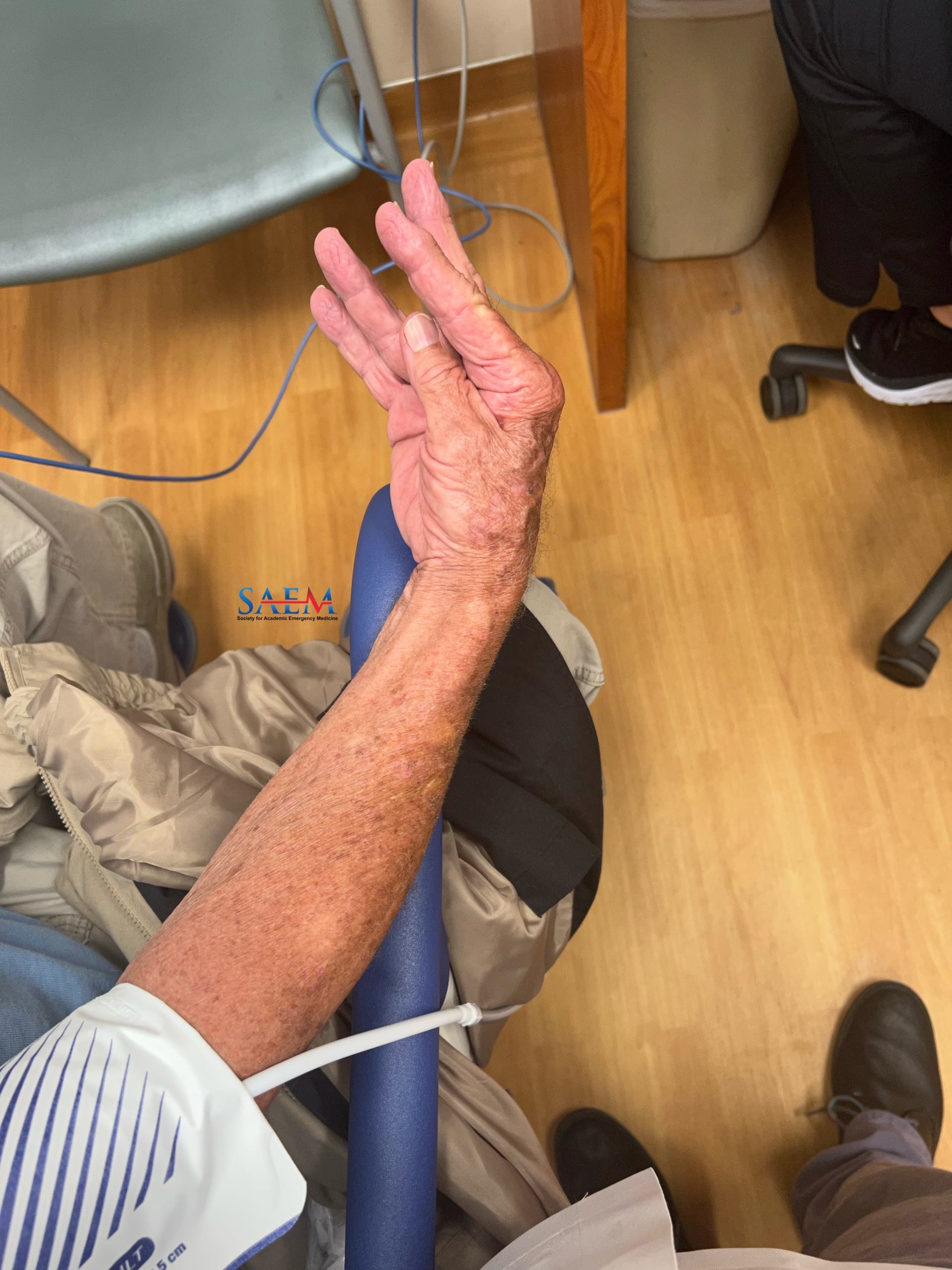
Extremities: Mild trace pedal edema bilaterally. While resting, the patient suddenly called out to the nurse for arm pain. Image 1 was taken at this time, during which his blood pressure was being measured.
CBC and BMP normal
Ca:8.4
Mg: 1.2
Trousseau’s sign of latent tetany (carpopedal spasm)
Hypomagnesemia
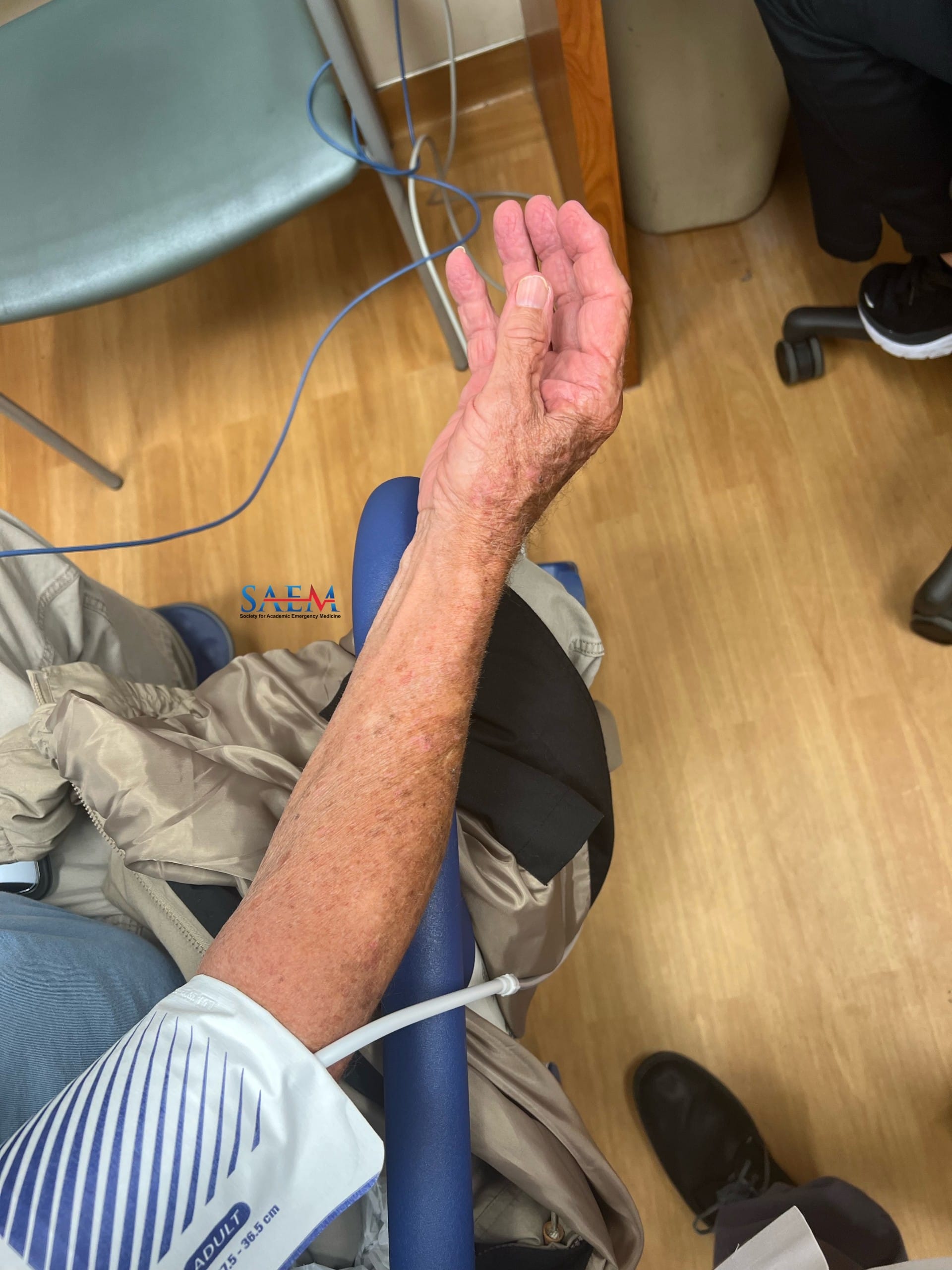
Trousseau’s sign is an involuntary, inducible carpopedal spasm that occurs when circumferential compression is applied to the limb, inhibiting blood flow (such as done by an inflated blood pressure cuff). Classically described, the metacarpophalangeal joints are flexed, the interphalangeal joints of the fingers and thumb are extended, and the thumb adopts a posture of opposition as seen in Image 1. Image 2 was taken with the blood pressure cuff deflated. Trousseau’s sign is primarily seen with hypocalcemia and hypomagnesemia, with hypocalcemia being the more common cause. Trousseau’s sign is seen most frequently in patients with disease states causing hypocalcemia and/or hypomagnesemia such as hypoparathyroidism, vitamin D deficiency, pancreatitis, renal disease, metabolic alkalosis, alcohol use disorders, and restrictive diets. The likely cause in this case is hypomagnesemia caused by furosemide diuresis and increased excretion of magnesium.
Take-Home Points
-
Trousseau’s sign is most commonly caused by hypocalcemia, but may also be less commonly associated with hypomagnesemia.
-
Trousseau’s sign of latent tetany resolves when the underlying electrolyte abnormality is corrected.
- Trousseau A. Lectures on clinical medicine, delivered at the Hôtel-Dieu, Paris. 3rd ed [Translated by Cormack Sir John.]. London (UK): New Sydenham Society; 1872
- Rehman HU, Wunder S. Trousseau sign in hypocalcemia. CMAJ. 2011 May 17;183(8):E498. doi: 10.1503/cmaj.100613. Epub 2011 Feb 28. PMID: 21398222; PMCID: PMC3091937.
- Jesus JE, Landry A. Images in clinical medicine. Chvostek’s and Trousseau’s signs. N Engl J Med. 2012 Sep 13;367(11):e15. doi: 10.1056/NEJMicm1110569. Erratum in: N Engl J Med. 2012 Dec 6;367(23):2262. PMID: 22970971.