

SAEM Clinical Images Series: There’s a Bird Stuck in Your Throat
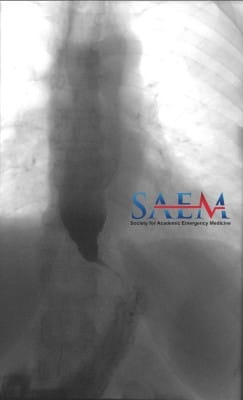
esophagram

The patient is a 61-year-old female with a past medical history of hypertension who presents to the Emergency Department for dysphagia. She states that for the past couple of months, she has experienced some discomfort in her chest as well as progressively worsening pain with swallowing. She was initially able to swallow thoroughly macerated solids and liquids, however over the past several days, she has been unable to tolerate either. She states whenever she eats or drinks something, she feels like the food gets stuck in her chest, causing her to regurgitate it. She denies any other complaints at this time.

[/fusion_text]

 No additional images

Vitals: All vital signs are normal.

General: Patient is in no acute distress.

HEENT: Mucous membranes are moist, no signs of mass or foreign body.

Respiratory: Clear to auscultation, no increased work of breathing.

Cardiovascular: Regular rate and rhythm, no murmurs.

Abdomen: Normal.

The esophagram shows the classic “bird’s beak” finding associated with Achalasia.

Dysphagia can be broken down into two categories, transfer dysphagia and transport dysphagia. Transfer dysphagia involves the oropharynx. The differential includes stroke, Parkinson’s disease, degenerative diseases such as multiple sclerosis, brain stem tumors, post-infectious causes due to polio and syphilis, peripheral neuropathy, myasthenia gravis, polymyositis, dermatomyositis, and muscular dystrophy. Transport dysphagia, as this patient has, involves the esophagus. The differential includes achalasia, diffuse esophageal spasm, ingested foreign body, esophageal web, malignancy, Schatzki ring, scleroderma, strictures, vascular compression, and Zenker’s diverticulum. The classic finding of Achalasia is a “bird’s beak” appearance on XR esophagram, as seen in the image. The esophagus tapers smoothly into a narrow gastroesophageal junction due to a hypertensive lower esophageal sphincter. There may also be dilation of the proximal esophagus, reduced or absent peristalsis on fluoroscopy, air-fluid levels in the esophagus, absence of intra-gastric air, and/or a sigmoid-like appearance of the esophagus.

Take-Home Points

  • Gastroenterology consultation is warranted if a diagnosis of achalasia is suspected, as esophagogastroduodenoscopy (EGD) is the next step in diagnosis and management.
  • The timing of EGD depends on the degree of dysphagia at presentation and speed of symptom progression.

Momodu II, Wallen JM. Achalasia. StatPearls [Internet]. Treasure Island (FL): StatPearls Publishing; 2024 Jan. Spieker MR. Evaluating dysphagia. Am Fam Physician. 2000 Jun 15;61(12):3639-48. PMID: 10892635.

[/fusion_builder_column][/fusion_builder_row][/fusion_builder_container]