About Sara M. Krzyzaniak, MD, FACEP

Podcast Host, EM Match Advice;
Program Director, Emergency Medicine Residency
Stanford University

EM Match Advice 51: 2026 EM Match by the Numbers

em match advice 51: 2026 by the numbers

The Emergency Medicine (EM) Match process continues to evolve, with 2026 bringing a mix of growth, new variables, and some familiar uncertainties. In this 51st installment of the EM Match Advice podcast series, Dr. Sara Krzyzaniak (Stanford EM PD) hosts the annual program director reflection on the Match with Dr. Abra Fant (Northwestern EM PD), now returning for her sixth consecutive year to share insights on the NRMP match trends and data.

Podcast Episode: EM Match by the Numbers

EM Match by the Numbers
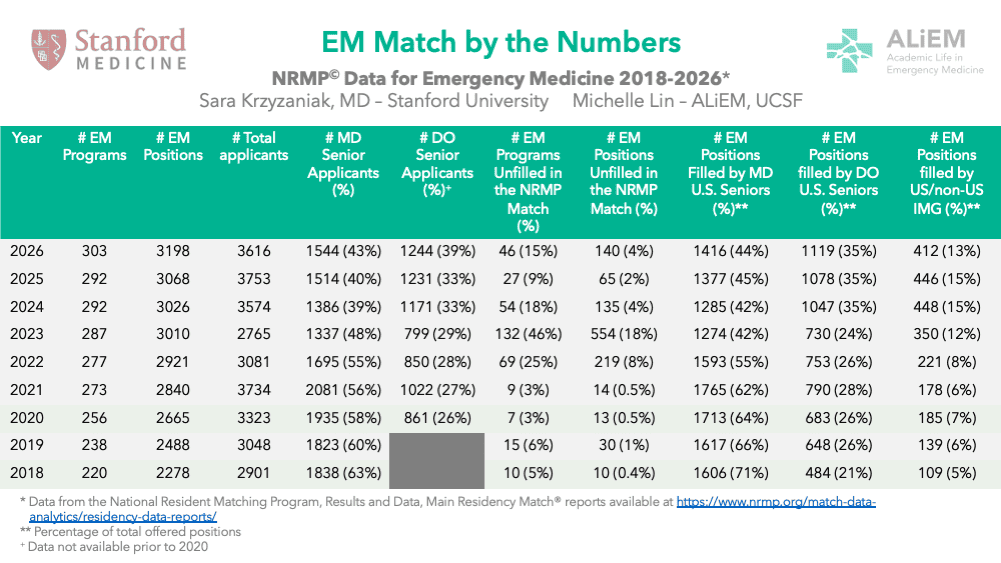
EM Match Advice: 2026 EM Match numbers master table

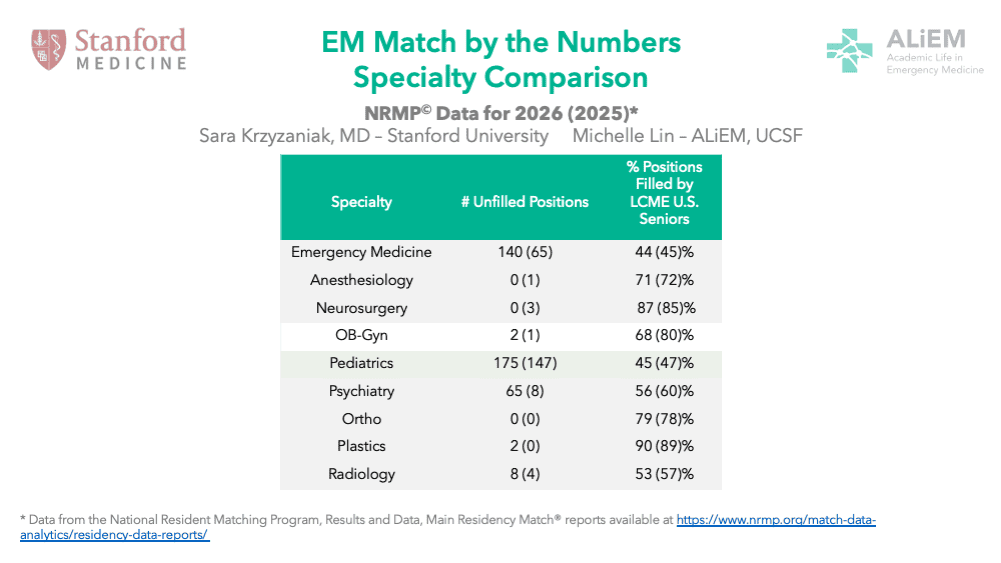
EM Match Advice: 2026 Match Comparisons


Key 2026 Match Statistics: A Mixed Picture

Growth in Programs and Positions

  • 11 new EM programs entered the Match in 2026
  • 130 additional positions were offered

Applicant Numbers Dipped Slightly

  • Total applicants dropped by 137 (from 3,753 to 3,616).
  • MD and DO senior applicants actually increased slightly, suggesting sustained interest.
  • The overall drop may be driven by the switch from ERAS to Residency CAS (ResCAS). Dual-applying across 2 platforms created enough friction that applicants not fully committed to EM may have opted out.

Unfilled Positions Ticked Back Up

  • 46 programs (15%) had at least one unfilled spot, up from 27 (9%) in 2025.
  • 140 positions went unfilled, compared to 65 last year.
  • Dr. Fant notes that a large share of unfilled spots were concentrated in a few programs, suggesting that this is NOT a specialty-wide crisis.
  • However, the math is worth watching: 130 new positions were added while applicants dropped by 137. If position growth continues to outpace applicant interest, unfilled spots will persist.

Who Filled the Spots?

  • 92% of filled positions went to US MD/DO seniors and IMGs, down from 95% in 2025.
  • The remaining positions were filled by graduates transitioning from other specialties.

The Specialty Comparison

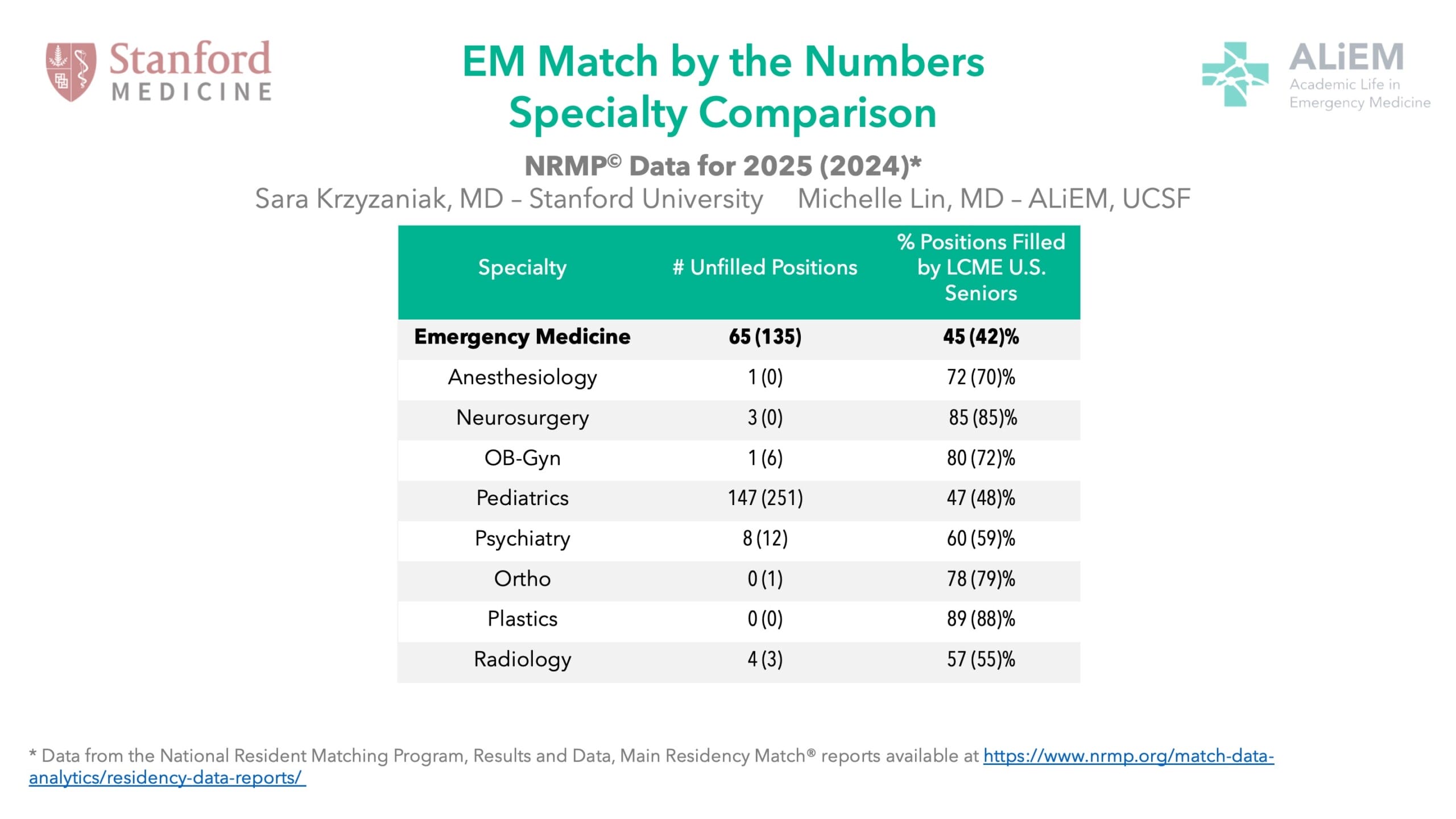
  • Pediatrics continues a similar trajectory to EM, with unfilled spots jumping from 147 to 175.
  • Psychiatry was a surprise, going from 8 to 65 unfilled positions despite perceived popularity for work-life balance.
  • Anesthesiology and neurosurgery, which had unusual open spots in 2025, fully filled this year.

Will “The Pitt” Boost EM Applicants?

  • The hit TV show The Pitt has drawn attention to emergency medicine, but it’s too early to see an applicant effect — most 2026 applicants had already committed before the show gained traction.
  • Historical precedent (the ER era) suggests it could boost interest, but the show also highlights the difficult realities of EM, which may self-select applicants more appropriately.

Advice for Future Applicants

  • Be authentic in applications and interviews — programs want to match with who you actually are.
  • Use preference signals strategically, not as lottery tickets to “reach” programs. Align signals with programs whose mission fits your goals.
  • Every moment on an away rotation is an audition. SLOEs are getting more honest, and negative comments are making it through.
  • Expect more guidance from CORD’s Application Process Improvement Committee (APIC) on how geographic connections and signals interact in future cycles.


Read and Listen to the Other EM Match Advice Episodes

Blog posts: https://www.aliem.com/em-match-advice-series/


EM Match Advice 50: Making Your Rank List | Program Directors Share Their Best Advice

EM Match Advice 50: Making Rank List

With interview season behind you, it’s time for one of the most important decisions of your medical career: creating your rank list. In this episode of ALiEM Match Advice, host Dr. Sara Krzyzaniak (Stanford EM Program Director) sits down with Dr. Elaine Rabin (Mount Sinai Hospital, Elmhurst Program) and Dr. Miriam Kulkarni (St. John’s Riverside Hospital) to discuss what really matters when ranking programs—and what doesn’t.

Key Dates to Remember

  • February 2, 2026: Rank list entry opens on NRMP
  • March 4, 2026: Rank list certification deadline (same for programs and applicants)
  • March 16, 2026: Match status notification
  • March 20, 2026: Match Day

Behind the Scenes: What Are Programs Doing Right Now?

While you’re making your rank list, program directors are finalizing theirs too. Dr. Kulkarni and Dr. Rabin pull back the curtain on what’s happening on their end—and share an important perspective about what your rank position actually means once you match.

What Should Drive Your Decisions?

The 3 program directors discuss the factors that truly matter:

  • Why you should “wipe the slate clean” from your pre-interview expectations
  • The one question Dr. Kulkarni says is most important: “What do you need to get through something really hard?”
  • Why “County vs. Academic vs. Community” labels might be misleading you
  • How to think about imperfection—because no program has everything

Plus: Dr. Krzyzaniak introduces her “brown patches of grass” framework for evaluating programs.

What Doesn’t Matter (But Feels Like It Does)

Learn why you should be skeptical of:

  • Anonymous online forums and match spreadsheets
  • Flashy interview day presentations
  • Minor perks and small salary differences

Dr. Rabin shares a personal story about getting “wooed” during her own rank list process—and what she learned from it.

Practical Tips for the Next Few Weeks

The episode includes concrete advice on:

  • Where to post your rank list (yes, literally post it somewhere!)
  • Who to talk to—and when recent graduate advice might be outdated
  • How to know if you’re overthinking two programs
  • What to do if your gut keeps pulling you toward a different choice

The Letter of Intent Question

Do letters of intent actually matter? All 3 program directors weigh in with surprisingly consistent advice—including the one absolute rule you must follow if you decide to send one.

Ready for Match Day

Whether you’re confident about your top choice or still sorting through your options, this episode offers honest insights from program directors who want you to succeed. Listen for the full conversation, including personal stories and nuanced advice that goes beyond what we can capture in a blog post.

Podcast: Making Your Rank List

Read and Listen to the Other EM Match Advice Episodes

Blog posts: https://www.aliem.com/em-match-advice-series/


EM Match Advice 49: 5 Keys to Crush Your EM Residency Interview

EM residency interview match advice 49

It’s fall, which means goofy costumes, crisp apples, pumpkin spice latte, and the official start of the Residency Recruitment Season! Programs are furiously reviewing your applications right now, and this is a perfect time for you to start thinking about interviews. In this episode, Dr. Sara Krzyzaniak (Stanford University EM Program Director) provides insider tips on 5 things that you can do now to be prepared to crush your interviews!

1. Consider Your Strategy

  • Do your homework and review programs’ social media and websites.
  • Prioritize your program list. You will likely have more interview offers than you can accept, so make your list now and refer back to it to avoid overcommitment.
  • Decide on the number of interviews you need to maximize your chances at matching. Your advisor can help you choose your target number.

2. Plan Your Interview Schedule

  • Keep a record of invite decisions on your priority list to keep track of what you’ve heard from each program.
  • Programs will use various platforms for scheduling – make sure you have all of these in one calendar to avoid double-scheduling.
  • Write down dates of socials for your top programs. Many programs hold these separately from interviews, so you can reserve these times in advance.
  • As interview invites start to come in, refer back frequently to your priority list. Drop interviews once you’ve reached your goal. Don’t hoard interviews!

3. Prepare for Interview Day

  • Basics: Ensure you have good lighting, a simple background, solid wi-fi signal, and minimal distractions.
  • Check out the CORD Webinar on interviewing in ResidencyCAS, but be ready for many programs to stick with trusty ole’ Zoom.
  • Consider your response to common questions and jot some notes down (but make them invisible on interview day!)

4. Interview Day!

  • Be early! Anticipate that Zoom will need to re-load or that your computer will take extra time to boot up. 
  • Plan to keep your camera on at all times. If it’s a longer interview day, there should be an opportunity for a brief break.
  • Have water/beverage and snacks nearby.
  • Come with questions, but choose these wisely based on your audience.

5. After the Interview

  • Congrats! Take a deep breath and decompress.
  • Immediately jot down some quick notes: Take an inventory of your emotions – how do you feel? What are your initial impressions?

This is an exciting time of year for both students and programs! Enjoy the ride as you explore programs and meet your future colleagues in Emergency Medicine.

Podcast: 5 Keys to Crushing Your EM Residency Interview

Read and Listen to the Other EM Match Advice Episodes

Blog posts: https://www.aliem.com/em-match-advice-series/


EM Match Advice 48: Transitioning from ERAS to ResidencyCAS – Platform Features and Essential Resources

ResidencyCAS - transitioning out of ERAS application

In this episode of EM Match Advice, Dr. Sara Krzyzaniak (Stanford University EM Program Director) speaks with Dr. Liza Smith (Clerkship Director/Associate Program Director at UMass Baystate and past Chair of the CORD Application Process Improvement Committee, and Dr. Tim Fallon (Associate Program Director at Maine Medical Center and the committee’s current Chair), about the historic transition from ERAS to ResidencyCAS for EM residency applications. This marks the first year that EM is using ResidencyCAS as an application service, moving away from the ERAS platform used in previous years. The discussion focuses on essential resources and new platform features that applicants need to understand for successful applications.

Podcast: Transitioning from ERAS to ResidencyCAS


Critical Updates for the 2025-2026 Application Cycle

  • Do NOT apply to EM programs through ERAS for 2025-2026 – All EM applications go through ResidencyCAS.
  • ALL EM combined programs also use ResidencyCAS: EM-IM, EM-Peds, EM-Anesthesia, EM-FM, etc. are all on ResidencyCAS, not ERAS
    • Exception: If applying to separate specialties (e.g., both EM and IM as separate applications), you’ll need both ResidencyCAS for EM and ERAS for other specialties

Major Application Changes

  • Geographic preferences redesigned: The traditional regional geographic preference ranking has been eliminated. The new approach focuses on listing specific city-state locations where you’d feel supported (such as a hometown), rather than broad regional preferences
  • Hobbies section returns: The hobbies section is being reintroduced to ResidencyCAS applications
  • Non-work experience section added: Applicants can now include experiences outside of traditional work or medical activities

Key Dates for 2025-2026 EM ResidencyCAS Applications

  • June 4, 2025: ResidencyCAS application opens for data entry and initial application work
  • August 25, 2025: First date to officially request transcripts (USMLE/COMLEX) and Dean’s letters (MSPE) from schools
  • September 24, 2025: Application submission deadline
  • October 1, 2025: Programs can begin reviewing applications

Caution: These dates are specific to ResidencyCAS for Emergency Medicine applications. Always verify dates directly with official sources as they may be subject to change.

Featured Resources

1. ResidencyCAS Official Website

  • What it is: Official platform and information hub for ResidencyCAS applications
  • Access: ResidencyCAS.com

2. EMRA Advising Guide (Updated 2024)

3. Applicant Sandbox

4. CORD Homepage Resources

Read and Listen to the Other EM Match Advice Episodes

Blog posts: https://www.aliem.com/em-match-advice-series/


EM Match Advice 47: 2025 EM Match By The Numbers

EM Match Advice 2025 Match by the numbers

The Emergency Medicine (EM) Match process continues to evolve, with the specialty experiencing significant shifts in recent years. In this 47th installment of the EM Match Advice podcast series, Dr. Sara Krzyzaniak (Stanford EM PD) hosts the annual program director reflection on the Match with Dr. Abra Fant (Northwestern EM PD), who returns for her fourth consecutive year to share insights on the NRMP Match trends and data. 

Podcast Episode: EM Match by the Numbers


Tables: EM Match by the Numbers

EM Match Advice by the Numbers


EM Match by the Numbers by specialty
 

Key 2025 Match Statistics: A Clear Improvement

Significant Reduction in Unfilled Positions

The most notable trend in the 2025 EM match is the continued reduction in unfilled positions:

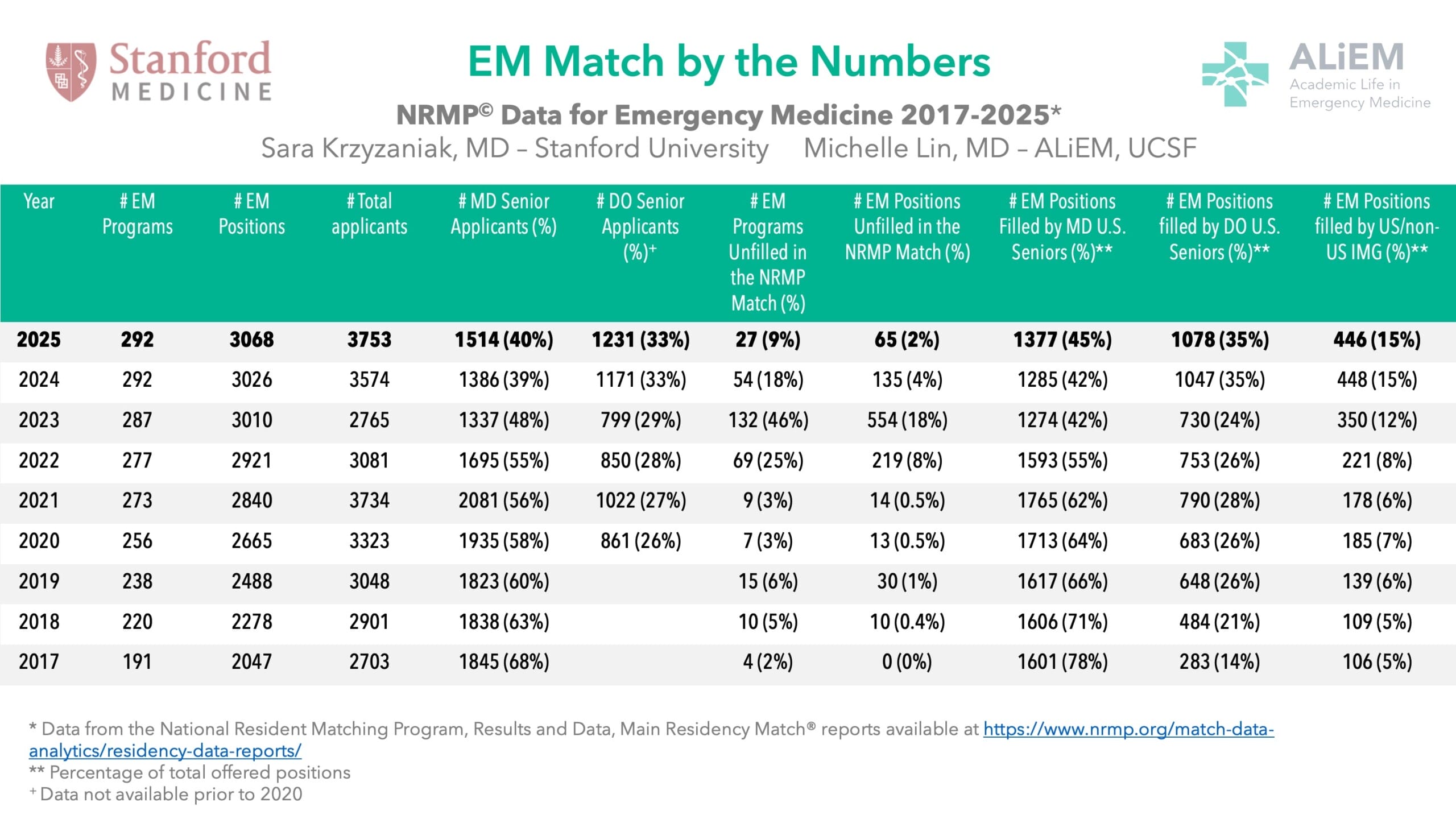
  • 65 (2%) unfilled positions in 2025, down from 135 (4%) unfilled positions in 2024
  • This continues the positive trend from the peak of 554 (18%) unfilled positions in 2023

Dr. Fant notes this represents a faster-than-expected recovery: “I think we all suspected we would recover as a specialty, but looking at other specialties that have gone through similar roller coasters, I think this recovery has been more rapid than potentially others anticipated.”

Program and Position Growth

The 2025 match showed stable program numbers with modest growth in positions:

  • 292 EM programs in 2025, unchanged from 2024
  • 3,068 total positions offered, up slightly from 3,026 in 2024
  • 3,753 total applicants to EM in 2025, up slightly from 3,574 in 2024

Applicant Demographics Remain Stable

The composition of the EM applicant pool remained relatively consistent year-over-year:

  • 1,514 US MD seniors (40% of applicants)
  • 1,231 DO seniors (33% of applicants)
  • The remaining 27% comprised IMGs and other applicant types

Fill Rates by Applicant Type

The distribution of positions filled by different applicant types remained stable:

  • 1,377 positions filled by US MD seniors (45% of filled positions)
  • 1,078 positions filled by DO seniors (35% of filled positions)
  • 446 positions filled by US IMGs (15% of filled positions)
  • The fill rate for EM positions was 98% overall

Factors Driving Success in the EM Match

Several key factors contribute to the improved Match results and program director priorities:

  1. Realistic interview and ranking practices
  2. Effective use of preference signals
  3. Better distribution of interviews 
  4. Geographic considerations
  5. Demonstrated interest in Emergency Medicine

Looking Ahead: Changes on the Horizon

Several significant changes are coming to EM education and the application process:

  • Proposed Resident Review Committee (RRC) program requirements: New RRC requirements were announced right around rank list certification day, which could significantly impact the upcoming match cycle.
  • Transition to ResidencyCAS system: The specialty is moving from ERAS to ResidencyCAS, representing substantial shift to an entirely new platform to manage applications, interviews, and communications.

Despite these upcoming changes, Dr. Fant remains optimistic: “Overall this is a really positive outlook for applicants to emergency medicine in the upcoming 2025-26 Match cycle.”

“EM is one of the best specialties. It has been for many years and we have overcome plenty of roadblocks. We hope that you will join our ranks.”

Read and Listen to the Other EM Match Advice Episodes

Blog posts: https://www.aliem.com/em-match-advice-series/
 

EM Match Advice 46 | Program Directors Share Match Season Insights

EM Match Advice 46 podcast match season

As interview season wraps up, medical students across the country are preparing their rank lists for the upcoming Match. EM Match Advice podcast host, Dr. Sara Krzyzaniak (Stanford EM Program Director) recently sat down with Dr. Melissa Parsons (University of Florida College of Medicine – Jacksonville EM Program Director), to discuss the match process from both program and applicant perspectives.

Podcast: Match Season Insights

Podcast Sound Engineer: Dr. Kaitlin Bowers 

What’s Happening on the Program Side?

Programs are busy finalizing their rank lists through comprehensive meetings with their teams. Many programs, including UF Jacksonville, are intentionally completing their rank lists before hosting second looks in February. This approach ensures that second look attendance doesn’t influence ranking decisions.

Do Letters of Intent Matter?

The impact of post-interview communication varies by program. While some program directors may give slight consideration to genuine letters of intent, there’s a consensus that “ranking you highly” letters carry little weight. Dr. Parsons notes that programs can verify the authenticity of “#1” declarations on Match Day, making honesty crucial in these communications.

Creating Your Rank List: What Really Matters

Focus on these key factors:

  • Mentorship opportunities
  • Program reputation and graduate outcomes
  • Geographic location
  • Support systems and work-life balance
  • Clinical training environment
  • Fellowship and career opportunities
  • Your gut feeling about the program

What to avoid:

  • Overvaluing others’ opinions on programs
  • Putting too much stock in online forums/spreadsheets
  • Making decisions based on minor perks or small salary differences

Strategic Advice for Applicants

  1. Make Your List Early: Write down your rankings and display them somewhere visible. Live with the list for a few weeks before certification.
  2. Consider Location: Think beyond the hospital – where do you want to live for the next 3-4 years?
  3. Be Thorough: While top and bottom choices might be clear, pay special attention to middle-ranked programs. Given recent Match unpredictability, thorough consideration of all ranked programs is crucial.
  4. Attend Second Looks Strategically: Use these opportunities to gather information for your decision-making, understanding that programs should have their lists finalized beforehand.

Important Dates

  • February 3, 2025: Rank list entry opens
  • March 5, 2025: Rank list certification deadline
  • March 21, 2025: Match Day

Final Thoughts

Remember that the Match algorithm favors applicant preferences. Focus on creating a rank list that reflects your true preferences rather than trying to predict where programs might rank you. Trust your instincts and prioritize what matters most to you in your training journey.

Read and Listen to the Other EM Match Advice Episodes

Blog posts: https://www.aliem.com/em-match-advice-series/


By |2025-01-25T12:55:15-08:00Jan 29, 2025|EM Match Advice, Podcasts|

EM Match Advice 45: 2025 ERAS Updates– What EM Applicants Need to Know

em match advice 2025 eras updates

Dr. Sara Krzyzaniak, EM Match Advice Podcast Host and Stanford University PD, discusses key changes in the 2025 ERAS (Electronic Residency Application Service) application that all EM applicants should know about. Take a listen to this short 14-minute, high-yield episode before submitting your application.

Podcast 45: Key 2025 ERAS updates

Highlights

  • Hometown preferences are now limited to 3 (no longer 5).
  • A new section allows you to explaining any unplanned training extensions and interruptions.
  • A PD-perspective on what to put in the Impactful Experiences section
  • Program signals are now limited to 5 (no longer 7).
    • KEY: Do NOT signal home or away rotations.
  • A separate hobbies section is back!
  • Geographic preferencing remains limited to 3 areas.
    • KEY: If you have no preference, then be sure to select “No Preference”. A blank selection conveys something different to the residencies.
  • Tips for the personal statement

Mentioned Resources

CORD website: New MyERAS® Application: Guidance for Emergency Medicine

Read and Listen to the Other EM Match Advice Episodes

Blog posts: https://www.aliem.com/em-match-advice-series/


Go to Top