A 25-year-old right-handed female with a longstanding history of right wrist pain presents with wrist pain. Her chronic pain had worsened over the past 2-3 weeks. She did not recall a specific recent injury, but did recall that she had a painful injury to the same wrist in the past when she fell on her outstretched hand. She was seen several weeks prior for the injury, but did not seek follow-up care after her initial evaluation. She had pain with any movement and complained of tenderness around the wrist, but denied any fever, redness, swelling, or any other complaints.
Vitals: All vital signs are normal.
General: No acute distress.
Musculoskeletal: Right upper extremity: Normal shoulder and elbow range of motion without tenderness. The right wrist is tender over the proximal carpal row and thenar eminence, with mild snuffbox tenderness. Radial and ulnar pulses are intact. Radial, median, and ulnar nerve motor and sensory function intact. The patient can fully flex and extend at the wrist, but has pain with motion. There is no obvious visual deformity and no ecchymosis. Capillary refill in all digits <2 seconds. Can flex and extend all digits without difficulty. There is no warmth or erythema over the joint.
Non-contributory
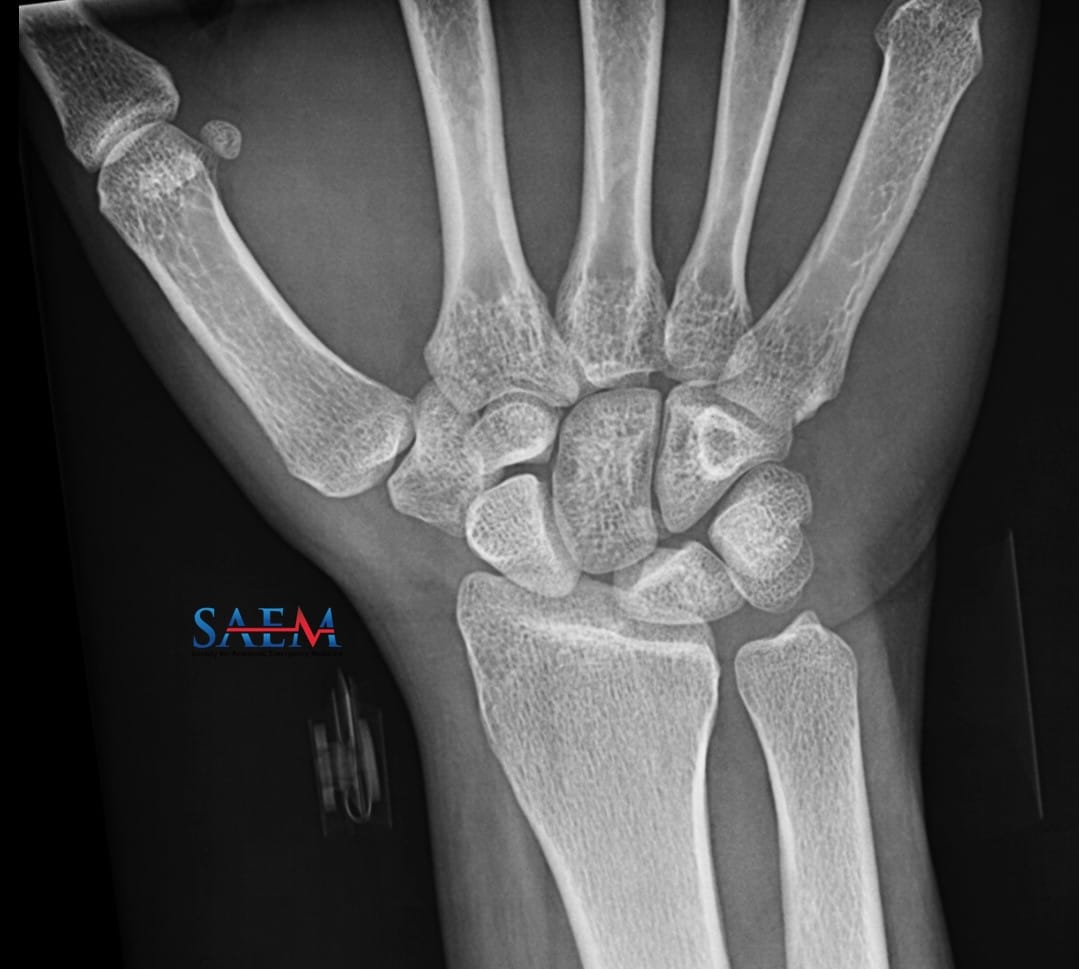
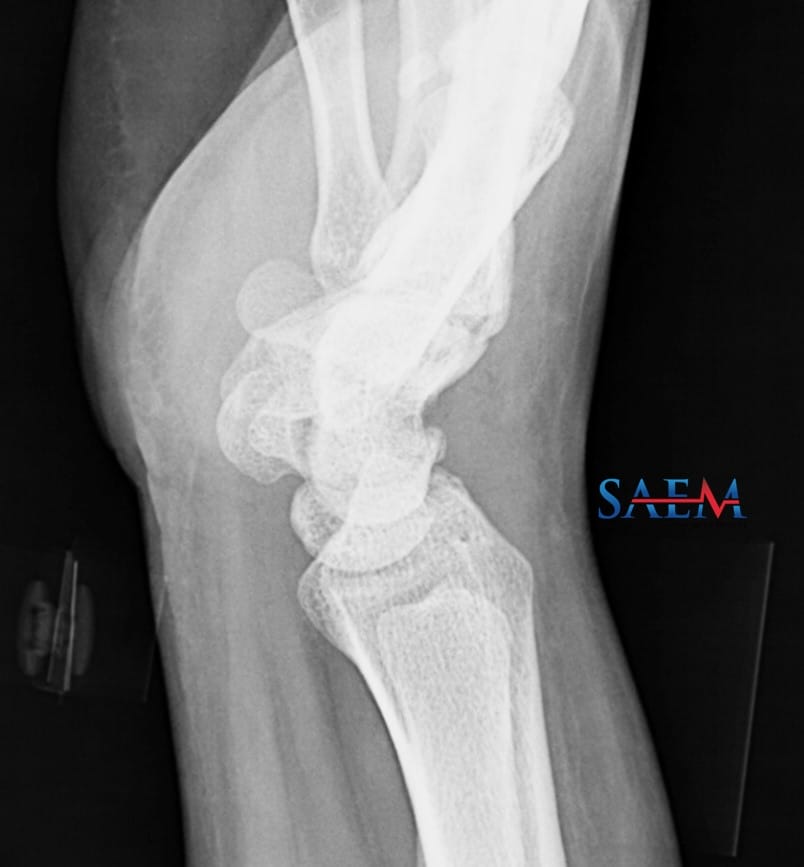
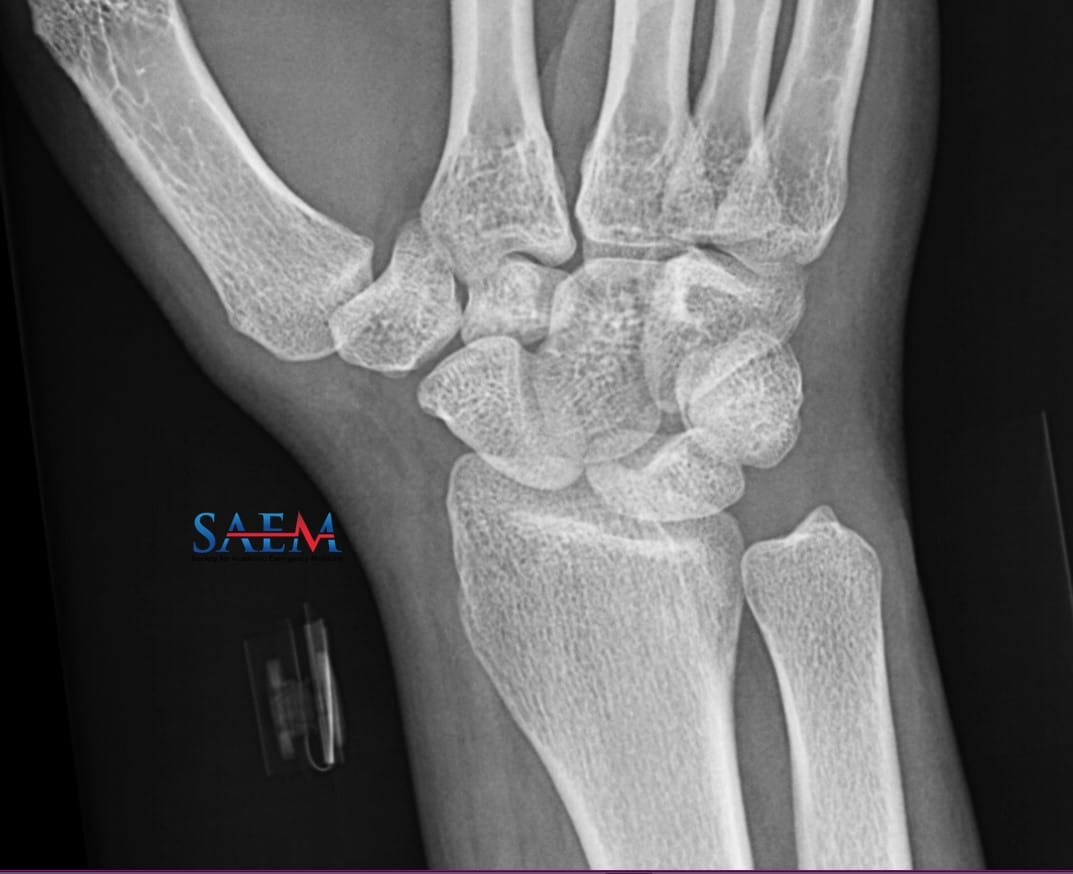
Terry Thomas sign (widening of the scapholunate space)
The scapholunate ligament is disrupted.
Scapholunate advanced collapse (SLAC)
A fall on an outstretched hand (FOOSH) injury can result in not only fractures, but also ligamentous disruptions. Scapholunate Advanced Collapse (SLAC) injury is a progressive form of degenerative osteoarthritis of the wrist, often resulting from untreated disruption of the scapholunate ligament (SLL). SLAC is the most common form of post-traumatic osteoarthritis of the wrist. Injury to the SLL may be identified by intra-articular space widening between the scaphoid and lunate bones of the proximal row of the carpal bones on radiographs. This classic x-ray finding is also known as the “Terry Thomas” sign, referring to the famous gap in the upper dental incisors of the late British comedian. The SLL is responsible for stabilizing the scapholunate joint, and this x-ray finding indicates disruption of the ligament. Patients with this degree of joint space widening will often require surgical repair to ensure best functional outcome, and in the short term the injury is managed with NSAIDS, splinting, and orthopedic hand referral.
Take-Home Points
-
Scapholunate ligament disruption can lead to long term arthritis and impaired wrist function. Early identification and treatment helps improve outcomes.
-
MRI may be needed to identify disruption of the scapholunate ligament. X-ray is approximately 63% sensitive in identifying the injury by demonstrating scapholunate space widening.
- Kompoliti E, Prodromou M, Karantanas AH. SLAC and SNAC Wrist: The Top Five Things That General Radiologists Need to Know. Tomography. 2021 Sep 23;7(4):488-503. doi: 10.3390/tomography7040042. PMID: 34698283; PMCID: PMC8544666.
- Wessel LE, Wolfe SW. Scapholunate Instability: Diagnosis and Management – Anatomy, Kinematics, and Clinical Assessment – Part I. J Hand Surg Am. 2023 Nov;48(11):1139-1149. doi: 10.1016/j.jhsa.2023.05.013. Epub 2023 Jul 14. PMID: 37452815.

Dave Caro, MD
University of Florida - Jacksonville
Latest posts by Dave Caro, MD (see all)
- SAEM Clinical Images Series: Mind the Gap - November 17, 2025