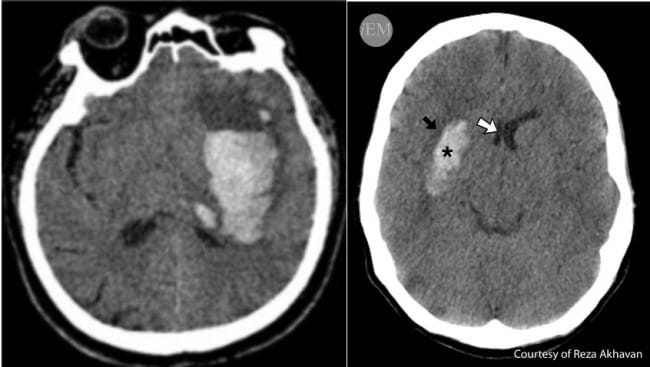
Which toxic alcohol can cause a basal ganglia hemorrhage?
- Ethanol
- Isopropanol
- Methanol
- Propylene glycol
[Left image from Wikimedia Commons]

The American College of Medical Toxicology hosts this Toxicology Visual Pearls series. The post was peer reviewed on behalf of ACMT by Drs. Howard Greller, Louise Kao, and Sage Wiener.
References
- Blanco M, Casado R, Vázquez F, Pumar JM. CT and MR imaging findings in methanol intoxication. AJNR Am J Neuroradiol. 2006;27(2):452-454. PMID: 16484428.
- Yang CS, Tsai WJ, Lirng JF. Ocular manifestations and MRI findings in a case of methanol poisoning. Eye (Lond). 2005;19(7):806-809. PMID: 15389282.
- Kraut JA, Mullins ME. Toxic Alcohols. N Engl J Med. 2018;378(3):270-280. PMID: 29342392.
- Sharma R, Carroll D, Knipe H, et al. Methanol poisoning. Reference article, Radiopaedia.org (Accessed on 29 July 2023) https://doi.org/10.53347/rID-51680
- Caparros-Lefebvre D, Policard J, Sengler C, et al. Bipallidal haemorrhage after ethylene glycol intoxication. Neuroradiology. 2005 Feb;47(2):105-7. doi: 10.1007/s00234-005-1347-y. PMID: 15714272.
- Jacobsen D, McMartin KE. Methanol and ethylene glycol poisonings. Mechanism of toxicity, clinical course, diagnosis and treatment. Med Toxicol. 1986;1(5):309-334. PMID: 3537623.
- Röe O. Species differences in methanol poisoning. Crit Rev Toxicol. 1982;10(4):275-286. PMID: 6756793.
- Beauchamp GA, Valento M. Toxic Alcohol Ingestion: Prompt Recognition And Management In The Emergency Department. Emerg Med Pract. 2016;18(9):1-20. PMID: 27538060.
- Wiener S. Toxic Alcohols. In: Nelson LS, Howland M, Lewin NA, Smith SW, Goldfrank LR, Hoffman RS. eds. Goldfrank’s Toxicologic Emergencies, 11e. McGraw-Hill Education; 2019.
- Roberts DM et al. (2015) Recommendations for the Role of Extracorporeal Treatments in the Management of Acute Methanol Poisoning: A Systematic Review and Consensus Statement. Critical Care Medicine 43(2): 461-472. PMID: 25493973.

Fernanda Calienes-Cerpa, MD
Emergency Medicine Faculty
Wake Forest Emergency Providers
Wake Forest Emergency Providers
Latest posts by Fernanda Calienes-Cerpa, MD (see all)
- ACMT Visual Pearl: Basal Ganglia Hemorrhage - November 18, 2025

Erik Fisher, MD
Associate Program Director, Medical Toxicology Fellowship
Atrium Health Carolinas Medical Center and Levine Children's Hospital
Clinical Assistant Professor of Emergency Medicine
Wake Forest School of Medicine
Atrium Health Carolinas Medical Center and Levine Children's Hospital
Clinical Assistant Professor of Emergency Medicine
Wake Forest School of Medicine
Latest posts by Erik Fisher, MD (see all)
- ACMT Toxicology Visual Pearl – The Fang and the Furious - June 30, 2026
- ACMT Toxicology Visual Pearl: Delayed Skin Burn - May 5, 2026
- ACMT Toxicology Visual Pearl: Sleeping with the Fishes - February 24, 2026