The patient is an 85-year-old male with a history of anxiety/depression, hypertension, hyperlipidemia, and hearing loss who presents to the Emergency Department after having transient painful swallowing. He states he took several of his pills at once in one swallow this morning as prescribed, then shortly afterwards felt a sharp discomfort moving down his esophageal region. The pain seemed to migrate down to his stomach, then his pain resolved. He has since been pain free and is tolerating his secretions well, but he has not eaten or drank anything since the incident. He denies chest pain, abdominal pain, nausea, or vomiting and has no other complaints at this time.
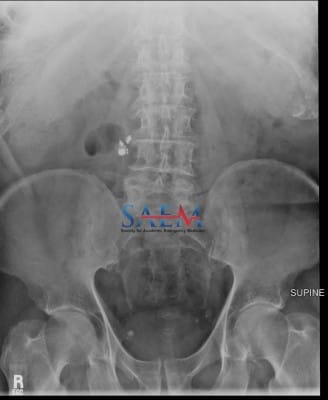
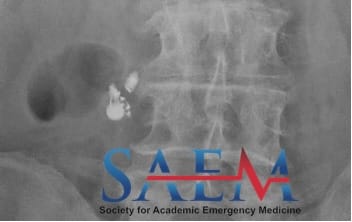
[/fusion_text] Vitals: BP 138/70 HR 68 R 18 T 98.7 O2sat 98% room air. HEENT: Mouth- unremarkable. Pharynx: mild posterior erythema without tonsillar swelling or exudates. Neck: normal thyroid gland, no lymphadenopathy or swelling. Respiratory: Clear to auscultation bilaterally. Cardiovascular: Regular rate and rhythm, no murmurs. Abdomen: Soft and non-tender, bowel sounds present. CBC: WBC 7.5, Hgb 14.1, Plt 244,000 CMP: normal The X-ray shows an ingested hearing aid containing a battery. Gastrointestinal perforation. The abdominal X-ray reveals a swallowed hearing aid containing a battery. X-rays can determine the location of radiopaque ingested objects. While most hearing aid batteries are sealed within a compartment reducing the risk of mucosal erosion, the battery could dislodge and cause damage and perforation. Severe complications can arise if batteries are in the esophagus, where they can cause rapid corrosive injury, perforation, and mediastinitis. Any button battery lodged in the esophagus must be emergently removed for this reason. Button batteries that have cleared the stomach usually pass through the colon within one week without complications. If the object has not passed in 10-14 days, imaging should be completed to verify the location. However, any patient who develops abdominal pain, hematochezia, or fever before battery passage in the stool has been confirmed should seek emergent care, as these symptoms could indicate intestinal perforation or lodging of the battery in the appendix. Litovitz T, Whitaker N, Clark L, et al. Emerging battery-ingestion hazard: clinical implications. Pediatrics 2010; 125:1168. 2. Green SM, Schmidt SP, Rothrock SG. Delayed appendicitis from an ingested foreign body. Am J Emerg Med 1994; 12:53.
Take-Home Points

Jake Figaniak, MD
Emergency Medicine
Thomas Jefferson University
Latest posts by Jake Figaniak, MD (see all)
- SAEM Clinical Images Series: Tuning In - October 10, 2025

Abagayle Bierowski, MD MEHP
Emergency Medicine
Thomas Jefferson University
Latest posts by Abagayle Bierowski, MD MEHP (see all)
- SAEM Clinical Images Series: Tuning In - October 10, 2025