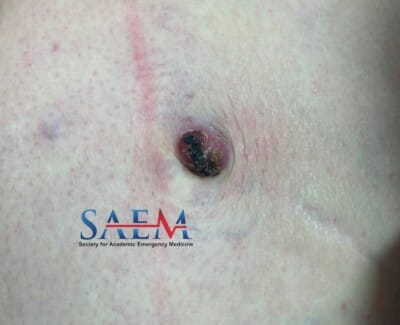
umbilicus

The patient is a 70-year-old female with a remote history of breast cancer who presents to the Emergency Department with family due to frequent falls and disorientation. Her family reports that she previously walked independently. However, over the last several months, she has had worsening weakness and has become wheelchair-bound. Nonetheless, she frequently attempts to walk and loses her balance, leading her to falling. She is brought in today due to another fall along with worsening confusion over the past few weeks. The family does not believe the patient suffered any significant injury today, but brings here in due to her worsening condition. The patient has no complaints at this time.

Vitals: All vital signs are normal.
General: The patient is disheveled, but in no acute distress.
HEENT: No signs of trauma. Normal exam.
Respiratory: Clear to auscultation bilaterally.
Cardiovascular: Regular rate and rhythm without murmur.
Abdomen: Non-tender, moderately distended, bowel sounds present. The umbilicus appears unusual- see image provided.This area in the umbilicus is a firm raised nodular density that appears crusted-over. There is no organomegaly present.
Neurologic: Patient is oriented to person and family. She has diffuse weakness and poor effort, but there are no focal deficits noted.
Skin: Relevant findings as shown.

Underlying malignancy with metastasis to the umbilicus.

This patient’s umbilical abnormality is consistent with Sister Mary Joseph’s nodule, which is a metastatic lesion from an intra-abdominal or pelvic malignancy. This finding is named for Sister Mary Joseph Dempsey, a nurse at St. Mary’s Hospital in Rochester, Minnesota, who first recognized the association between periumbilical nodules and metastatic intra-abdominal malignancies. The most common culprit is gastric malignancy, but Sister Mary Joseph’s nodule may also be seen in ovarian, endometrial, colorectal, and pancreatic cancers. As part of our patient’s traumatic workup, a CT abdomen/pelvis was performed, which revealed a large retroperitoneal mass encasing the aorta and iliac arteries, extensive lymphadenopathy, a markedly enlarged uterus, and multiple soft-tissue implants including the one within the umbilicus. Imaging was also notable for a cirrhotic liver with multiple hypodense lesions. During her hospitalization, she underwent lymph node biopsy, which revealed small cell carcinoma concerning for high-grade neuroendocrine cancer. The prognosis for patients with Sister Mary Joseph’s nodule is generally poor, as this finding indicates advanced cancer that is already metastatic.

Take-Home Points

  • Sister Mary Joseph’s nodule is a rare but serious physical exam finding that is concerning for advanced metastatic cancer.
  • A thorough physical exam is important in all patients presenting to the ED- more may be missed by not looking than by not knowing.

  • Dar IH, Kamili MA, Dar SH, Kuchaai FA. Sister Mary Joseph nodule-A case report with review of literature. J Res Med Sci. 2009 Nov;14(6):385-7. PMID: 21772912; PMCID: PMC3129082.
  • Abu-Hilal M, Newman JS. Sister Mary Joseph and her nodule: historical and clinical perspective. Am J Med Sci. 2009;337(4):271-273. doi:10.1097/MAJ.0b013e3181954187

Louisa Weindruch, DO

Louisa Weindruch, DO

Resident Physician
Emergency Medicine
Baylor University Medical Center
Louisa Weindruch, DO

Latest posts by Louisa Weindruch, DO (see all)

David Bussé, MD

David Bussé, MD

Attending Physician
Department of Emergency Medicine
Baylor University Medical Center
David Bussé, MD

Latest posts by David Bussé, MD (see all)