About Erin Shufflebarger, MD

This author has not yet filled in any details.
So far Erin Shufflebarger, MD has created 2 blog entries.

SAEM Clinical Images Series: Rash and Fever in a Returned Traveler
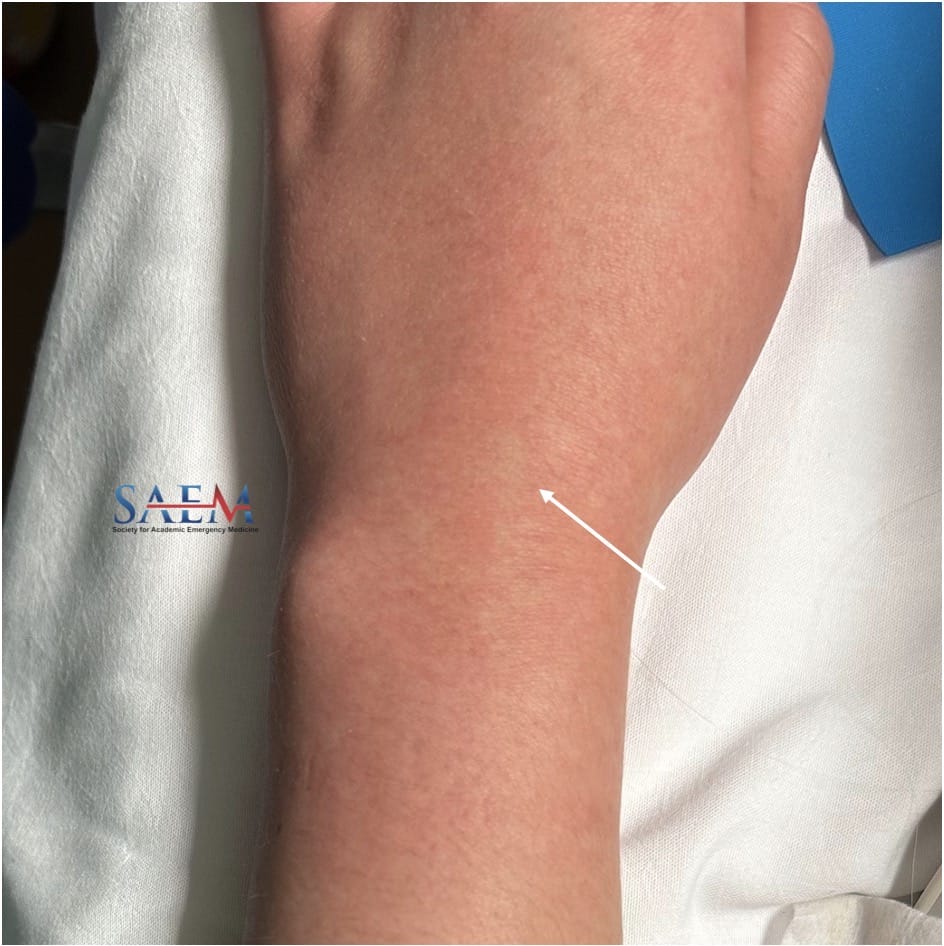
A 21-year-old otherwise healthy female presented to the Emergency Department with a fever after recently returning from Ghana. She reported intermittent fever, headache with photophobia, diarrhea, joint pains, and generalized weakness. She also noticed a diffuse, intermittently pruritic rash on her trunk and extremities. While in Ghana, she volunteered at a refugee hospital, ate street food, and was exposed to local animals. Prior to her stay in Ghana, she spent a week in Bali. She reported receiving vaccines before leaving but was unsure which vaccines she received.
Vitals: Temp 102.9°F; HR 126; BP 114/78; RR 18; O2 sat 98% on room air

General: Uncomfortable-appearing with her eyes closed on initial exam.

HEENT: PERRL, EOMI, Normal conjunctiva without erythema; Full ROM of neck without neck stiffness/rigidity.

GI: Abdomen soft, non-tender, nondistended. No palpable masses, hepatomegaly or splenomegaly.

MSK: No evidence of joint effusion, erythema or tenderness.

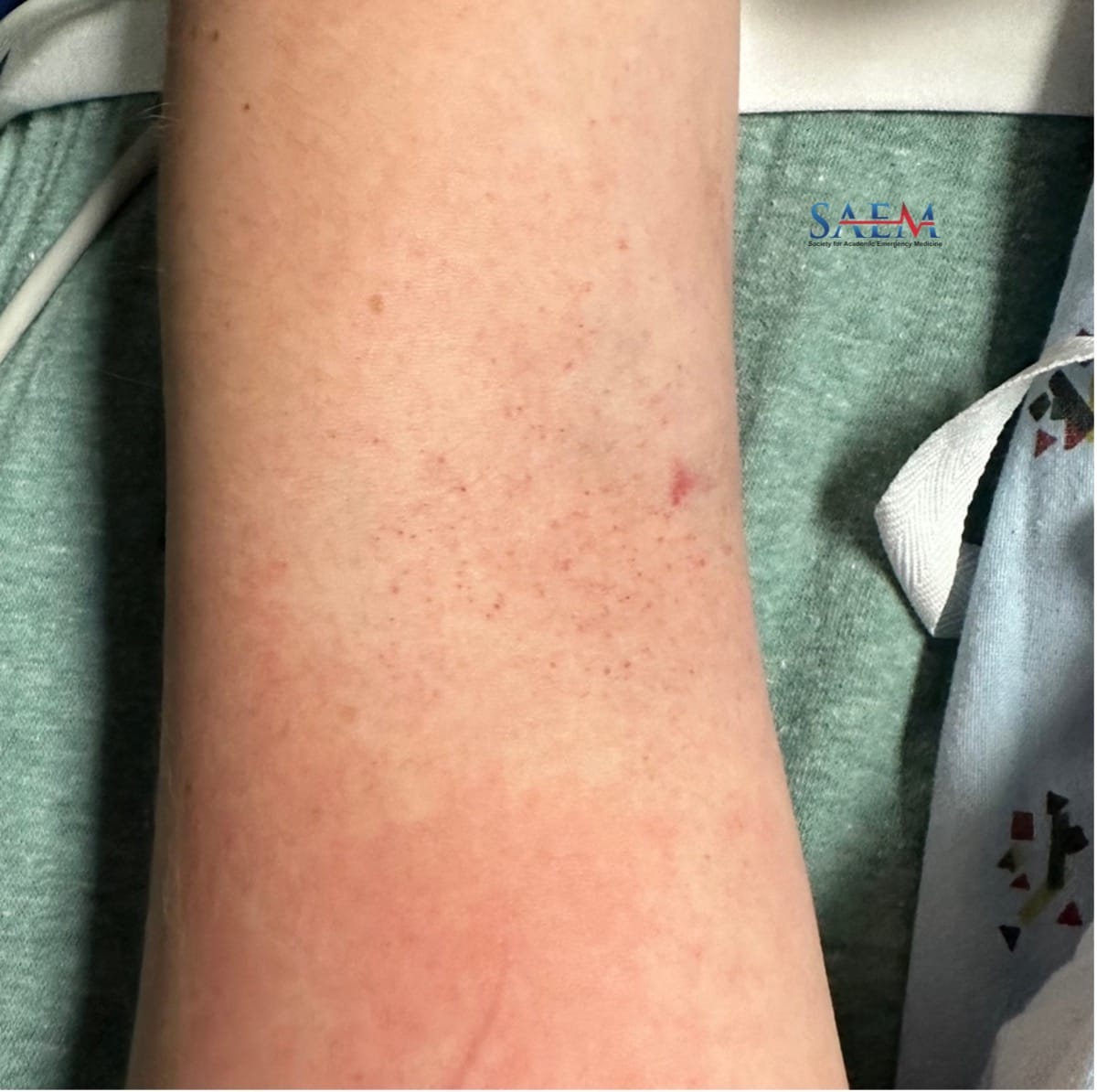
Skin: Diffuse maculopapular rash to all four extremities and chest with confluent erythema noted in some areas intermixed with small areas of spread skin, scattered papules around the ankles consistent with mosquito bites.

White Blood Cell (WBC) Count: 2.78 k/mm3

Hemoglobin: 12.9 gm/dL

Hematocrit: 38 %

Platelets: 125.3/mm3

ESR: 10 mm/hr

CRP: 9.37 mg/L

AST: 42 U/L

ALT: 58 U/L

This is a case of Dengue Fever. This diagnosis should be considered in a returning traveler from an endemic region (i.e., Asia, India, Latin America, Africa) with a fever above 40°C, retro-orbital headache, myalgias, nausea, vomiting, and/or rash. The characteristic rash associated with dengue is described as “islands of white in a sea of red”, with confluent erythema and small areas of spared skin. A bedside tourniquet test can also be performed by inflating a blood pressure cuff around the upper arm for five minutes at a pressure halfway between the patient’s systolic and diastolic blood pressure. This test is deemed positive if more than 10 petechiae are present within a square inch of skin, suggesting capillary fragility.

Although mild cases of dengue can be treated supportively, more severe cases typically require hospitalization. Some warning signs of severe disease include abdominal pain or vomiting, hepatomegaly, signs of volume overload including ascites or pleural effusion, and an increase in hematocrit with rapid thrombocytopenia. Severe dengue can present with shock, volume overload, severe bleeding, encephalopathy, and liver failure. Emergency physicians must keep a broad differential when evaluating fever in return travelers and prioritize history and physical exam findings to help narrow the diagnosis and provide appropriate management and supportive care while awaiting further confirmatory testing.

Take-Home Points

  • Consider Dengue Fever in patients returning from endemic regions with classic symptoms including fever, retro-orbital headache, nausea, vomiting, myalgias, and rash.
  • Gold standard diagnostic testing such as ELISA is often unavailable in resource-limited settings and even when available, this confirmatory result won’t be available in the acute care/emergency setting.
  • In patients for whom a diagnosis of Dengue Fever is suspected based on history and physical exam, the tourniquet test provides a rapid beside analysis to aid in patient diagnosis and management.

  • Schaefer TJ, Panda PK, Wolford RW. Dengue fever. StatPearls. Updated November 14, 2022. Accessed August 5, 2023. https://www.ncbi.nlm.nih.gov/books/NBK430732/? report=reader.
  • Kenzaka T, Kumabe A. Skin rash from dengue fever. BMJ Case Rep. 2013: bcr2013201598.
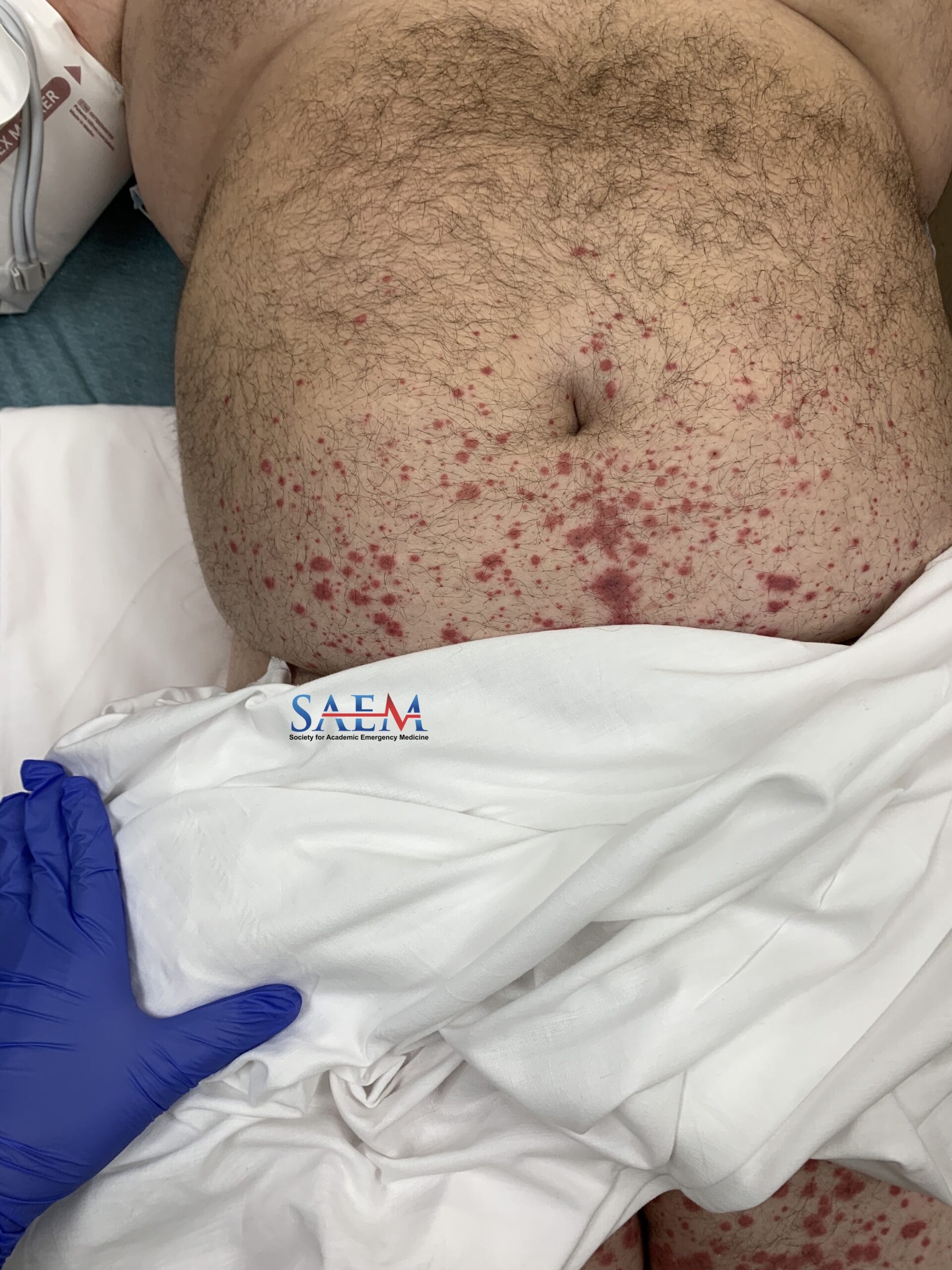
SAEM Clinical Images Series: An Adult with a Lower Extremity Rash

vasculitis

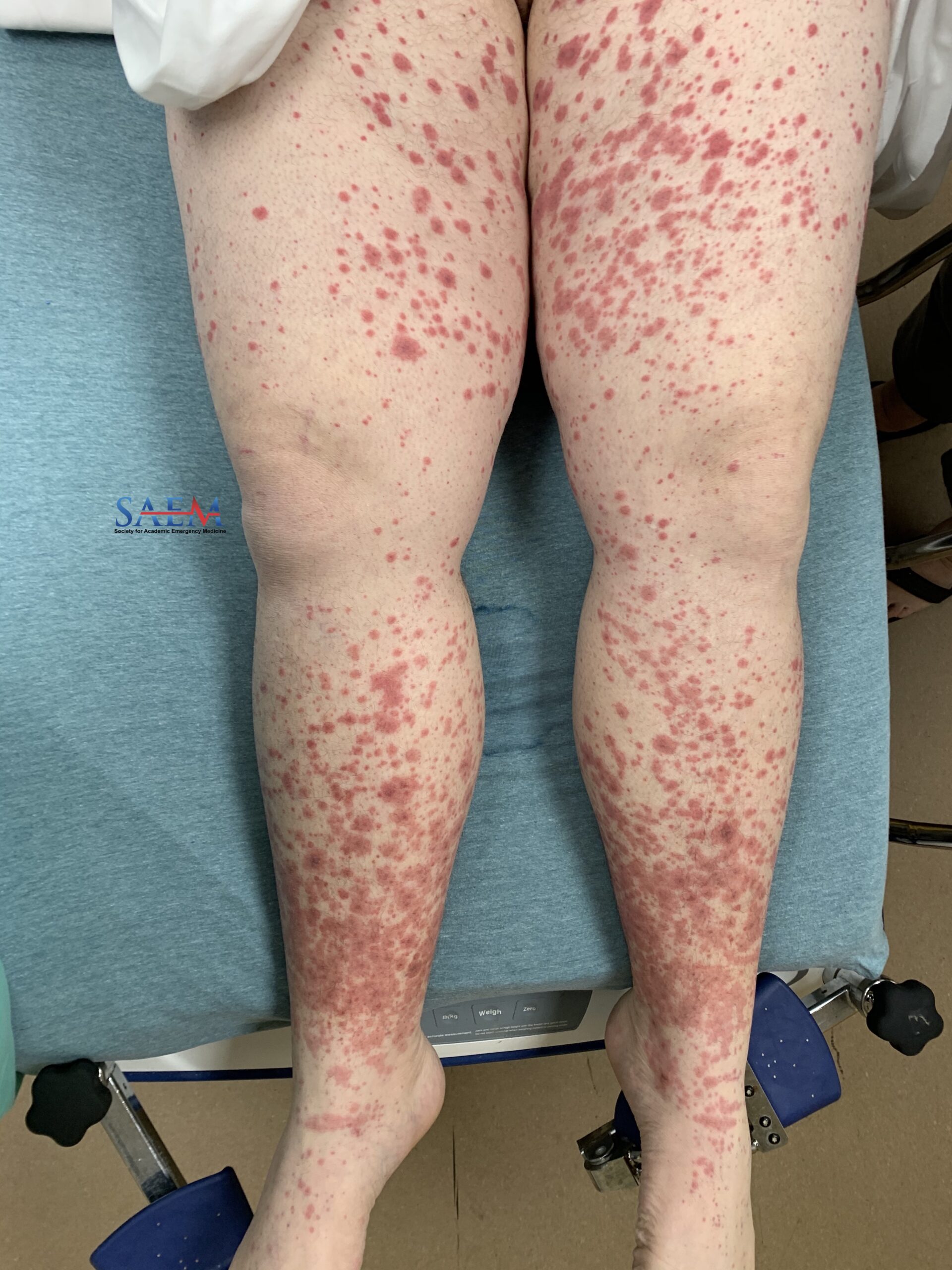
A 37-year-old male with a past medical history of type 2 diabetes presents to the Emergency Department (ED) with a rash. Initial symptoms began one week prior with small spots on the right leg with associated itching and burning. He initially presented to an outside facility where he was diagnosed with an allergic reaction versus scabies and was given a short course of oral steroids and topical permethrin that provided some relief. The rash progressed to bilateral lower extremities prompting re-presentation to the ED. He also reports associated dark urine and nausea.

GI: Abdomen soft, non-tender, non-distended.

MSK: No joint swelling, tenderness, erythema or warmth.

Skin: Numerous scattered bright red palpable purpuric papules and plaques, most concentrated on bilateral lower extremities extending to lower abdomen at the level of the umbilicus.

White blood cell (WBC) count: 14.5 k

Creatinine: 1.1 mg/dL on day of presentation, peaked at 2.2 mg/dL approximately 10 days later.

C-reactive protein (CRP): 32.7 mg/L

Erythrocyte sedimentation rate (ESR): 34 mm/hr

Urinalysis: 3+ protein, 2+ blood, 11-20 RBC, 26-50 WBC, rare bacteria

This is a case of IgA vasculitis, formerly called Henoch-Schonlein purpura or HSP. This diagnosis is suspected when a patient has purpuric skin lesions predominantly on the lower limbs as well as at least one of the following: abdominal pain, joint involvement, renal involvement (proteinuria/hematuria), and biopsy demonstrating IgA deposition. This vasculitis is more commonly seen in children and has a male predominance.

Similar to children with IgA vasculitis, adults presenting with this palpable purpuric rash can have associated joint involvement and GI involvement, though intussusception is less common in the adult population. Renal manifestations are more common in adults with this diagnosis and range from proteinuria and hematuria to renal failure. Our patient initially presented with hematuria/proteinuria and less than two weeks later had a doubled his creatinine. A renal biopsy later confirmed IgA nephropathy.

Take-Home Points

  • Consider IgA vasculitis in patients with lower extremity purpuric skin lesions with associated abdominal pain/GI bleed, arthralgia, renal involvement, and/or biopsy confirming IgA deposition.
  • In adults with IgA vasculitis, renal involvement is more common and often more severe.

  • Ozen S, Pistorio A, Iusan SM, Bakkaloglu A, Herlin T, Brik R, Buoncompagni A, Lazar C, Bilge I, Uziel Y, Rigante D, Cantarini L, Hilario MO, Silva CA, Alegria M, Norambuena X, Belot A, Berkun Y, Estrella AI, Olivieri AN, Alpigiani MG, Rumba I, Sztajnbok F, Tambic-Bukovac L, Breda L, Al-Mayouf S, Mihaylova D, Chasnyk V, Sengler C, Klein-Gitelman M, Djeddi D, Nuno L, Pruunsild C, Brunner J, Kondi A, Pagava K, Pederzoli S, Martini A, Ruperto N; Paediatric Rheumatology International Trials Organisation (PRINTO). EULAR/PRINTO/PRES criteria for Henoch-Schönlein purpura, childhood polyarteritis nodosa, childhood Wegener granulomatosis and childhood Takayasu arteritis: Ankara 2008. Part II: Final classification criteria. Ann Rheum Dis. 2010 May;69(5):798-806. doi: 10.1136/ard.2009.116657. PMID: 20413568.
  • Yaseen K, Herlitz LC, Villa-Forte A. IgA Vasculitis in Adults: a Rare yet Challenging Disease. Curr Rheumatol Rep. 2021 Jul 1;23(7):50. doi: 10.1007/s11926-021-01013-x. PMID: 34196893.

By |2023-01-20T15:48:31-08:00Jan 30, 2023|Dermatology, Renal, SAEM Clinical Images|
Go to Top