SAEM Clinical Images Series: Green Foot
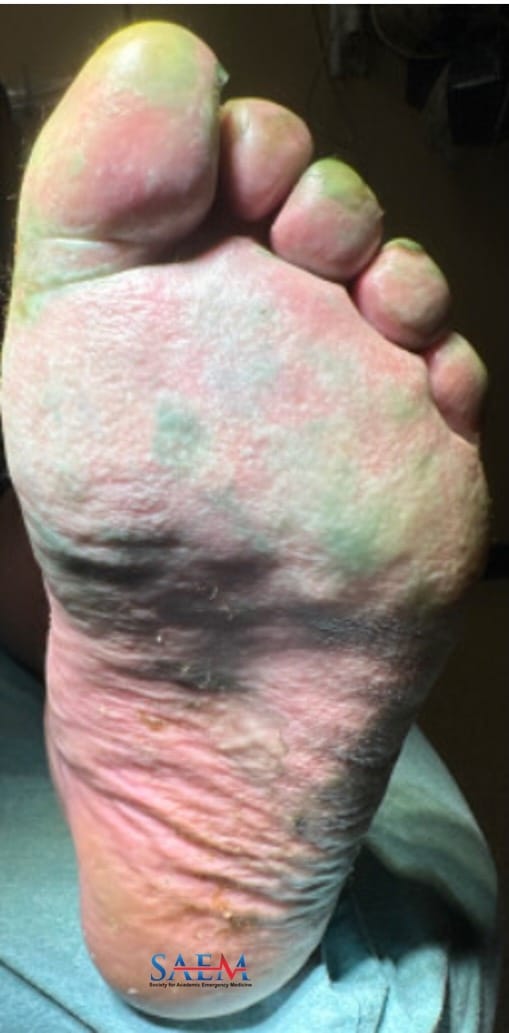
The patient is a 59-year-old male with a history of prior DVT, atrial fibrillation, HTN, alcohol use and COPD who presents to the Emergency Department with chest pain, dyspnea, and left lower extremity swelling and pain. He had a prior hospital admission two weeks ago for leg swelling and cellulitis. He was previously prescribed oral gentamicin and topical mupirocin for concerns of foot infection, which he has been compliant with taking. He has been working long hours as a construction worker, but knows of no chemical exposure to his feet and denies walking barefoot. He has had no fever and denies any other complaints at this time.
Vitals: BP 151/69; HR 93; R 18; T 97.7°F; O2 sat 95% room air.
General: No acute distress.
Respiratory: Mild wheezes bilaterally.
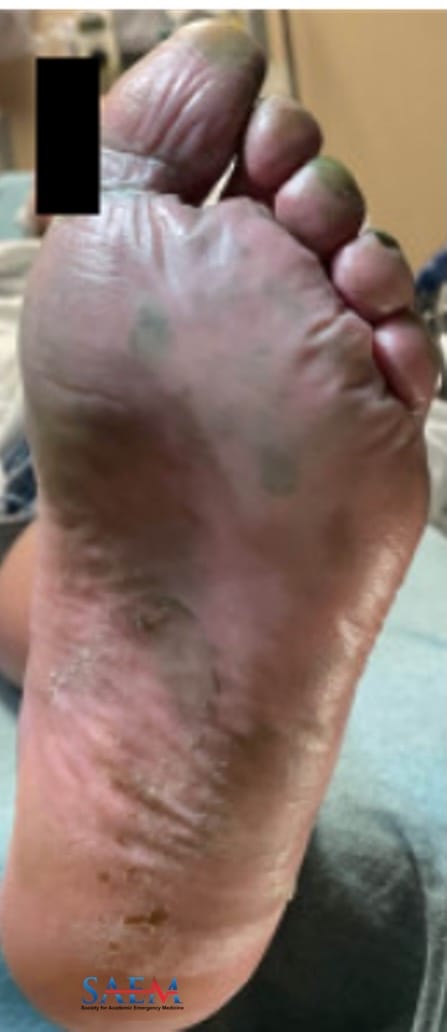
Extremities: Mild bilateral lower extremity swelling, worse on left compared to right. Left foot discolored as shown in the image – when asked, the patient states the discoloration started initially on the great toenail and progressed to the sole of the foot.
CBC: WBC: 10.2; Hgb: 12.7
Na: 130
ESR: 6
CRP: 0.8
CXR: Mild pulmonary edema.
Foot X-ray: No acute findings, old Lisfranc injury.
Ultrasound: Negative for DVT.
The patient has Green Foot Syndrome.
Pseudomonas aeruginosa
Green foot syndrome is a rarely diagnosed Pseudomonas aeruginosa infection secondary to chronic skin moisture of the feet, identified from the greenish discoloration of skin. The green discoloration is due to pyocyanin and pyoverdine, giving the skin a bluish-green color. Symptoms can also include pruritus, pain, malodor, and paresthesias. Our patient was admitted to the hospital with dermatology consultation, who recommended vinegar soaks, gentamicin cream, and 0.3% ciprofloxacin solution. Other case studies have reported successful treatment by removing the inciting agent and keeping skin dry, acidic soaks such as benzoyl peroxide, and/or oral fluoroquinolones. Green foot syndrome has been reported in soldiers wearing combat boots for long hours and in patients during prolonged cast use. The moist environment of damp skin in boots provides an ideal environment for P. aeruginosa to grow. Our patient often wore construction boots with 2 pairs of socks for long hours at work, which made him susceptible to this infection.
Take-Home Points
-
When patients present with lower extremity complaints, always carefully assess the feet; this patient’s initial complaint was not skin discoloration.
-
Pseudomonas aeruginosa infections can cause a greenish discoloration to feet chronically kept in moist conditions, such as frequent and extended shoe or cast use.
- García-Martínez FJ, López-Martín I, Castellanos-González M, Segurado-Rodríguez MA. Green foot ulcers. Enferm Infecc Microbiol Clin. 2017 Oct;35(8):536-537. English, Spanish. doi: 10.1016/j.eimc.2015.10.010. Epub 2015 Nov 26. PMID: 26627144.
- Spernovasilis N, Psichogiou M, Poulakou G. Skin manifestations of Pseudomonas aeruginosa infections. Curr Opin Infect Dis. 2021 Apr 1;34(2):72-79. doi: 10.1097/QCO.0000000000000717. PMID: 33492004.
- Wu DC, Chan WW, Metelitsa AI, Fiorillo L, Lin AN. Pseudomonas skin infection: clinical features, epidemiology, and management. Am J Clin Dermatol. 2011 Jun 1;12(3):157-69. doi: 10.2165/11539770-000000000-00000. PMID: 21469761.
- Sloan B, Meffert JJ. “Boot foot” with pseudomonas colonization. J Am Acad Dermatol. 2005;52(6):1109-1110. doi:10.1016/j.jaad.2005.01.105
- Park, Y., & Bae, J. (2013). Green foot syndrome: A case series of 14 patients from an armed forces hospital. Journal of the American Academy of Dermatology, 69(4), e198-e199. https://doi.org/10.1016/j.jaad.2013.05.012
- Lee SH, Cho SB. Cast-related green foot syndrome. Clin Exp Dermatol. 2009;34(7):2008-2009. doi:10.1111/j.1365-2230.2009.03317.x
- Macgregor DM. An unusual presentation of immersion foot. Br J Sports Med. 2004 Aug;38(4):E11. doi: 10.1136/bjsm.2003.007385. PMID: 15273204; PMCID: PMC1724852.