About Mohamed Elhadi Abdelhameed, MD

Emergency Medicine Physician
Emergency Department
Ibrahim Malik Teaching Hospital

Trick of Trade: Dual Foley catheter to control massive epistaxis

Massive epistaxis is considered a medical emergency that requires immediate attention. Symptoms of massive epistaxis include sudden and heavy bleeding from the nose, difficulty breathing, dizziness, and a rapid heartbeat. If left untreated, it can lead to significant blood loss, shock, airway obstruction, and even death. We report a case of a 50-year-old man with end stage renal disease with massive nasal bleeding from the left nostril, shortness of breath, and confusion.

Initial Management

After a rapid assessment, we inserted an anterior nasal pack, soaked in epinephrine, TXA, and an antibiotic-based lubricant. However, the bleeding continued from his nares and posterior oropharynx. We thus removed the anterior packing and instead inserted a Foley catheter into the posterior nasal space and inflated the balloon. Unfortunately, the bleeding still continued. Because he presumably had uremia-induced thrombasthenia (weak platelets), he received blood transfusions and IV TXA. And still — he continued bleeding heavily.

Trick of the Trade: Dual Catheter Technique

To provide optimal surface area coverage and tamponade effect of the posterior vessels, concurrent anterior packing is usually needed [1]. You can use commercial devices that have a dual balloon setup, but we did not have that available.

dual balloon for massive epistaxis

Illustration by Dr. Abdelhameed with patient-consented photo of dual balloon technique

Technique

  1. Insert the a 14-French Foley catheter into the nares with the patient’s mouth open (balloon 1). Stop when you see the tip of the catheter dangling in the posterior oropharynx.
  2. Inflate the balloon partially with 15-20 cc of air.
  3. Gently pull the catheter anteriorly until you feel resistance such that the balloon is snuggly positioned.
  4. If the bleeding still continues, insert a second Foley catheter until you meet resistance (balloon 2). Inflate this second balloon with 15 cc of air.

For our case, this dual catheter compression technique succeeded in halting the bleed.

Interested in Other Tricks of the Trade?

Reference

  1. Goralnick E. Posterior Epistaxis Nasal Packing. Medscape. Published Dec 9, 2020
Trick of the Trade: Winging It with External Jugular Cannulation

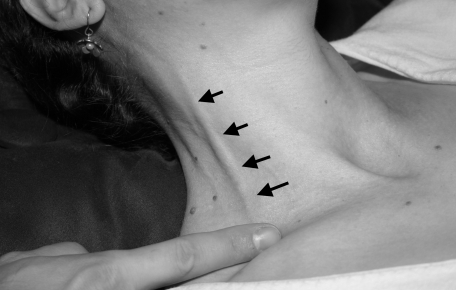
external jugular

Sankoff J, et al. WJEM (2008)

Imagine yourself caring for a patient that needs urgent vascular access, but several attempts at peripheral intravenous (IV) cannulation have been unsuccessful. You aren’t quite at the point where emergent intraosseous or central venous access is indicated. Maybe those options aren’t even available where you’re working. From across the room, though, you can see a very prominent external jugular (EJ) vein. Sadly, you remember the last EJ line you placed falling out almost immediately.

Patients with challenging peripheral intravenous access in the extremities may require and benefit from cannulation of the EJ. Often done in the setting of resuscitation, securing these angiocatheters on the neck can be difficult. Tape and dressings may not stick due to sweat and anatomical limitations. Rotation, flexion, and extension of the neck can displace the catheter.

Trick of the Trade

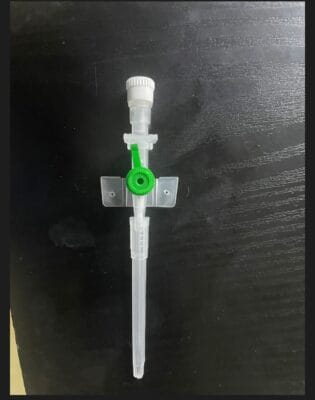
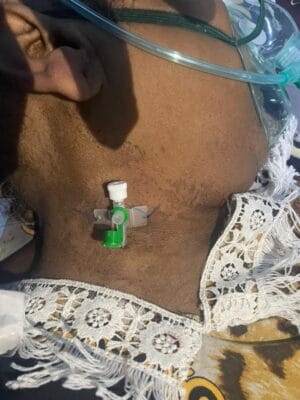
If available, modify a winged angiocatheter to allow suturing to the skin of the neck.

angiocatheter


  • Create two small holes, one on each wing of the angiocatheter, using a sharp instrument such as scissors, scalpel, or needle.
  • Place EJ line and secure to the skin using sutures, similar to stabilization of central or arterial line.

Winged angiocatheters may not be available in all clinical institutions. International readers of ALiEM may be more familiar with their use.

However, this trick introduces the idea of finding creative modifications of available catheters to allow for suturing and securing of alternative IV lines. Modifications similar to this Trick of the Trade can be considered when placing “deep” peripheral IVs or pseudo-midline IVs such as when using extended-length angiocatheters or repurposed arterial catheters where suture can be wrapped around the hub. This approach may also be useful in peripheral cannulation of the internal jugular vein. 

Tip: Be careful not to pierce the catheter or compress it down when suturing.

More from ALiEM on EJ cannulation:

Interest in other tricks?

Read more articles in the Tricks of the Trade series.

By |2022-09-08T15:18:30-07:00Sep 9, 2022|Tricks of the Trade|
Go to Top