

About Peter Alsharif

Ultrasound Fellow
Emergency Medicine
Denver Health

SAEM Clinical Images Series: An Expanding Painful Neck Mass

Mass

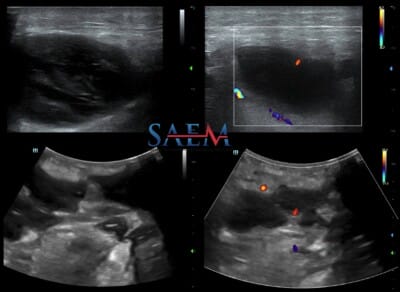
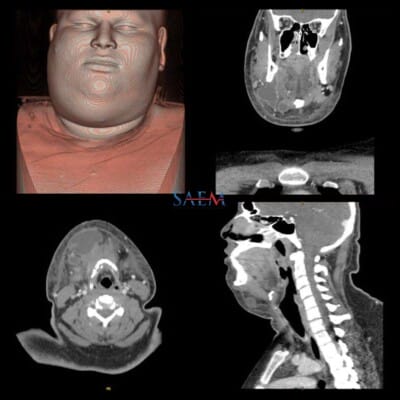
The patient is a 20-year-old male who presents to the Emergency Department complaining of painful and rapidly worsening swelling in the anterior neck over the last three days. The patient reports that he had a similar episode in the past for which he was prescribed antibiotics and underwent a needle aspiration procedure at the base of his mouth, which led to resolution of his symptoms. The patient reports subjective chills, change in voice, sore throat, and painful swallowing. He is able to tolerate oral secretions and denies difficulty breathing. He has no other complaints at this time. A bedside ultrasound exam and CT of the patient’s neck were subsequently performed.
Vitals: BP 147/69, HR 68, RR 18, Temp 100.6, SpO2 98% room air.
General: Nontoxic but in obvious discomfort. Able to tolerate brief
periods in a supine position. Speaking with mild stridor.
HEENT:
Neck as shown. Swollen area is warm with no induration or
crepitus. Neck supple. No mastoid tenderness, normal appearing tympanic
membranes. No trismus. Normal dentition.
Respiratory:
Mild biphasic stridor but normal work of breathing.
Cardiovascular:
Regular rate and rhythm, no murmur.

WBC 18.0
Rapid Group A Strep swab: negative.
Monospot screen: negative
HIV antibody/antigen: negative.

Deep space infection of the neck, Ludwig’s Angina.

The patient has a plunging ranula.

Deep space infections of the neck can be categorized by the fascial layer involved: superficial, middle, and/or deep. Infections in the deep- superficial and deep-middle fascia include Ludwig’s angina, mandibular abscesses, and parotitis. These are most often caused by dental infections, and can cause compression resulting in airway compromise, thrombophlebitis, and narrowing of the great vessels of the neck. Infection of the deep layer of the cervical fascia, such as in retropharyngeal or parapharyngeal abscess, communicates directly with the mediastinum, and can rapidly progress to severe mediastinitis. This patient’s imaging shows cystic structures with no flow seen within or around the structures, and shows the fluid collection extending from the sublingual space, communicating with the submandibular space and base of the mouth. This was determined to be an infected plunging ranula.

Take-Home Points

  • A simple ranula (occurs in 1 out of 5000 individuals) presents as a painless bluish saliva containing cyst visualized below the tongue.
  • A “plunging” (or “diving”) ranula is a rare condition caused by direct leakage of salivary fluid from the sublingual gland at the base of the mouth into the soft tissues of the neck.
  • Treatment involves needle aspiration and surgical excision. About 50% of cases recur without excision of the submandibular gland.

  • Almuqamam M, Gonzalez FJ, Sharma S, et al. Deep Neck Infections. [Updated 2024 Aug 11]. In: StatPearls [Internet]. Treasure Island (FL): StatPearls Publishing; 2024 Jan-.
  • Kalra V, Mirza K, Malhotra A. Plunging ranula. J Radiol Case Rep. 2011;5(6):18-24. doi: 10.3941/jrcr.v5i6.682. Epub 2011 Jun 1. PMID: 22470797; PMCID: PMC3303342.
  • Olojede ACO, Ogundana OM, Emeka CI, et al. Plunging ranula: surgical management of case series and the literature review. Clin Case Rep. 2017;6(1):109-114. Published 2017 Nov 29. doi:10.1002/ccr3.1272
By |2026-01-06T10:03:30-08:00Jan 7, 2026|Uncategorized|

SAEM Clinical Images Series: Dangerous Eye Drainage

orbital abscess

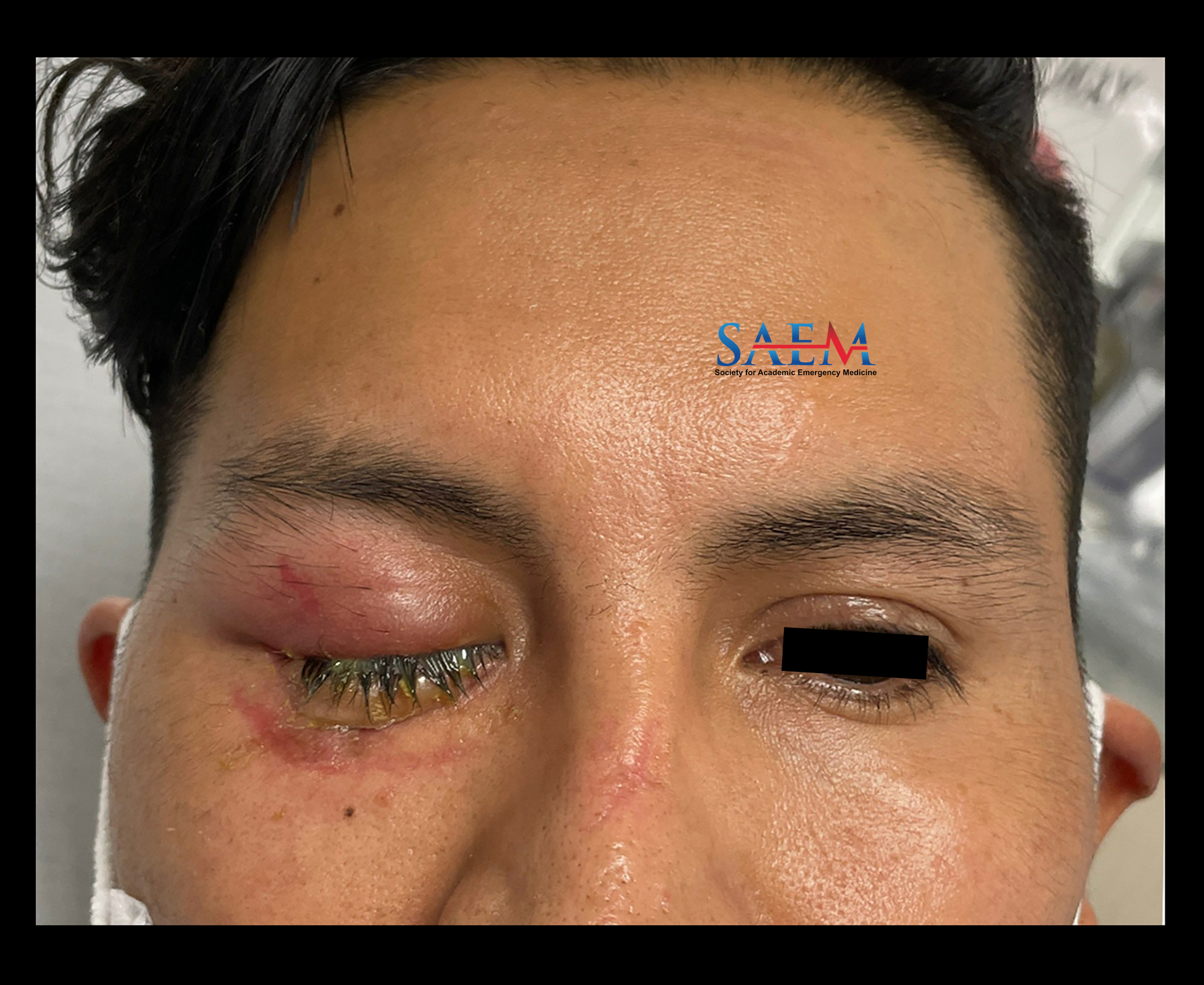
A 32-year-old man with a history of traumatic globe rupture from a stab wound two months ago, status post repair, presented to the emergency department for worsening right eye pain and green malodorous drainage for the past three days. These symptoms started when he got a fleck of sawdust in the right eye about four days prior to presentation, which he was able to brush out with his finger. He described the pain as severe, throbbing, constant, and non-radiating. He had been unable to open the right eyelid for three days, both due to pain and from the thick sticky discharge that adhered his eyelids together. He reported that his vision had been normal before these symptoms started. On review of systems, he reported nausea that started on the day of presentation but otherwise denied any vision loss or pain in the other eye.

General: Nontoxic appearing but seemed quite uncomfortable.

Eye: On inspection, he had substantial right upper and lower eyelid swelling and erythema, with a green discharge dripping from the palpebral fissure. There was a well-healed scar on the bottom eyelid. The lateral canthus appeared inferiorly displaced. The patient was unable to open his right eye actively, and was unable to tolerate passive opening due to severe discomfort, despite pain medication.

White blood cell (WBC) count: 9.1 x 10^3 /uL with 80.4% neutrophils

Complete metabolic panel (CMP): Within normal limits

Procalcitonin:<0.05 ng/mL

Lactate: 1.4 mmol/L

Cultures from the eye revealed penicillin-sensitive Streptococcus pneumoniae.

Pain with extraocular movements should be present in orbital cellulitis due to inflammation of the structures deep within the orbit. Although not sensitive, proptosis, leukocytosis & fever, chemosis, or any visual impairment should raise concern for orbital cellulitis.

In this patient, displacement of the lateral canthus likely represents a mass effect from his orbital abscess. This abscess is seen lateral to the globe on imaging. On ultrasound, it appears as a heterogeneous isoechoic collection that abuts the right globe. A hyperechoic structure between the orbit and this collection with shadowing raises the possibility of a foreign body. Debris is also visible throughout the right globe and within the anterior chamber. On CT scan, the abscess is described as a rim-enhancing fluid collection that adheres to the lateral rectus muscle. The hyperdense foreign body is again seen on CT, as well as a small focus of air within the anterior chamber.

Take-Home Points

  • Orbital abscess is an uncommon but vision-threatening ocular emergency, which can come from traumatic injury to the globe (as with this case), sinus/nasal infections, or as a complication of dental procedures.
  • The most common organisms responsible for orbital abscesses are Streptococci species (including Strep. pneumoniae and Strep. pyogenes), Staphylococcus aureus (including methicillin-resistant Staph. Aureus), and Pseudomonas aeruginosa.
  • Surgical management is necessary in almost all cases of orbital abscess, with just under 50% of all patients achieving complete visual recovery.

  • Krohel GB, Krauss HR, Winnick J. Orbital abscess. Presentation, diagnosis, therapy, and sequelae. Ophthalmology. 1982 May;89(5):492-8. doi: 10.1016/s0161-6420(82)34763-6. PMID: 7099569.
  • Zawadzki T, Komisarek O, Pawłowski J, Wojtera B, Bilska-Stokłosa J, Osmola K. Orbital Abscess-Two Case Reports with Review. Indian J Otolaryngol Head Neck Surg. 2022;74(Suppl 2):1334-1343. doi:10.1007/s12070-021-02486-z

By |2023-10-22T20:48:41-07:00Oct 23, 2023|HEENT, Ophthalmology, SAEM Clinical Images|
Go to Top