

About Samuel Sternberg

Student Researcher
Auburn University College of Science and Mathematics

SAEM Clinical Images Series: Unusual Presentation of an Exophytic Tumor
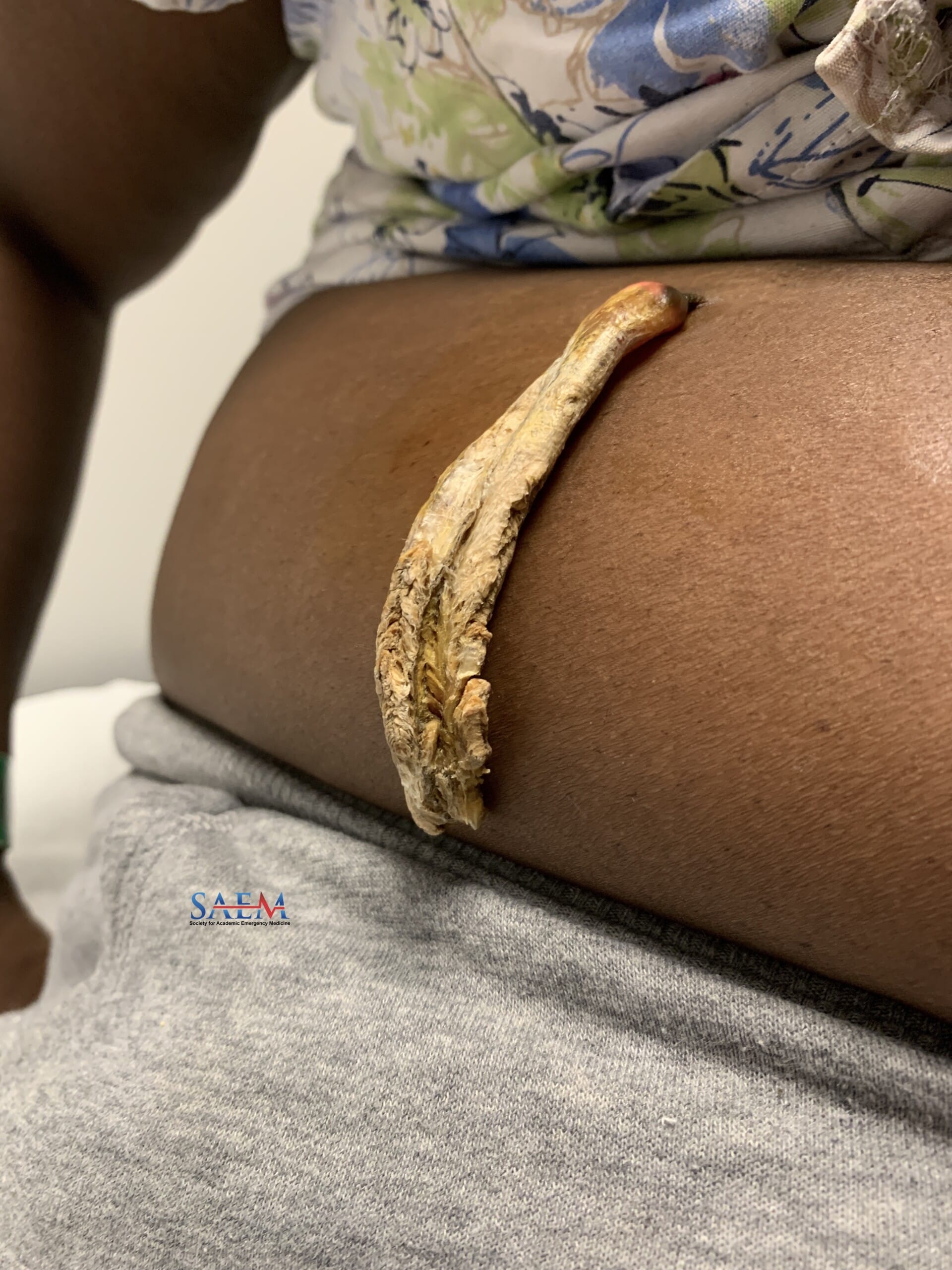
cutaneous horn

A 60-year-old African American female without a past medical history presented to the emergency department with a complaint of a “hard, yellowish brown, growth” on her right upper abdomen. The patient reported that it had been present and slowly enlarging over a two-year period and was now causing pain when it “snags on clothing”.
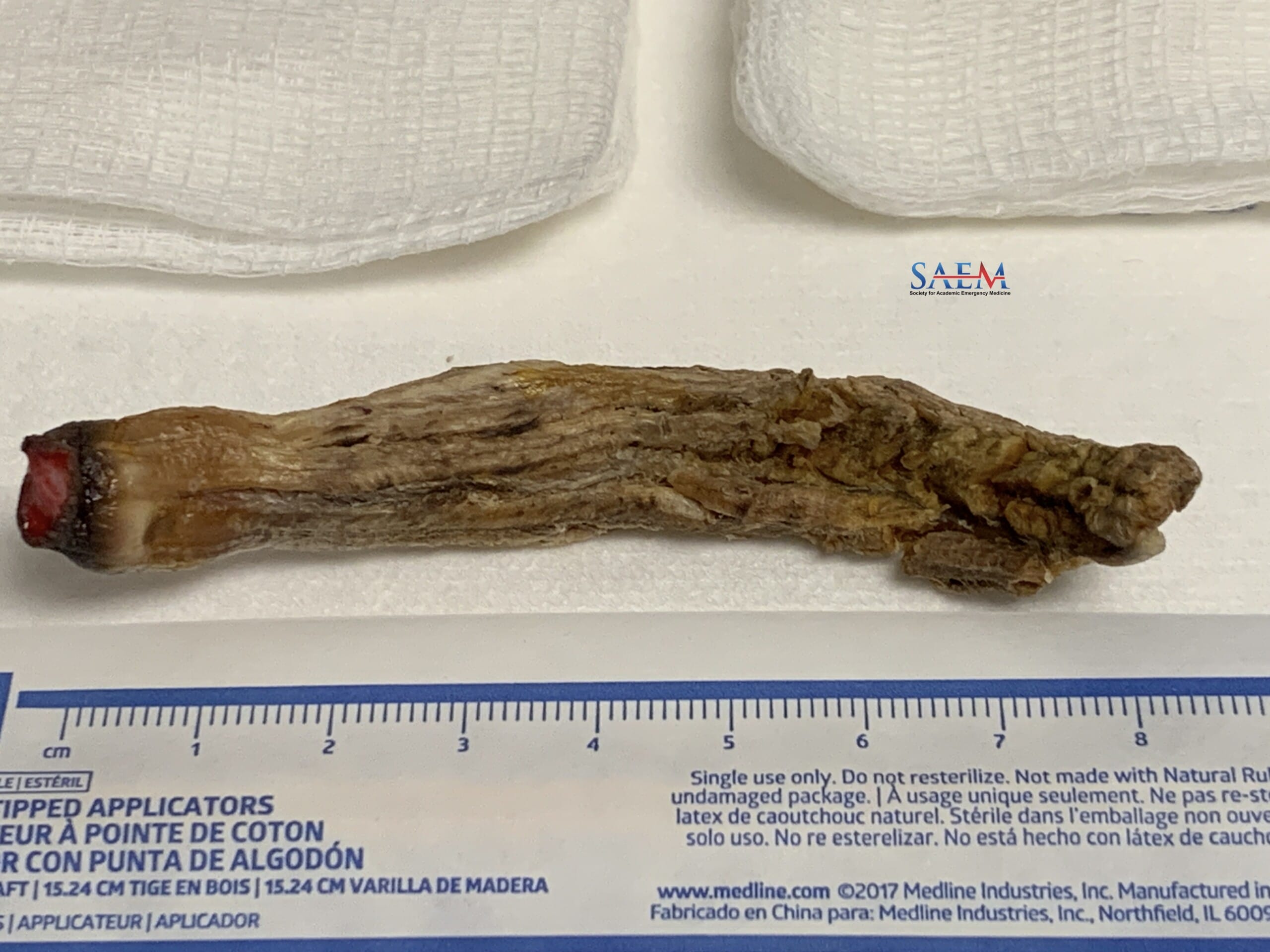
Skin: 9.5 cm, firm, curved, exophytic, keratotic, tumor protruding from the right upper abdominal wall.

Non-contributory

Histopathology confirmed a diagnosis of a benign Cutaneous Horn a.k.a. Cornu Cutaneum (latin). Cutaneous horns are yellow or white exophytic hyperkeratotic projections formed in reaction to a number of physical and disease processes. Defined by having a height more than one-half the size of their base in diameter, they are slow-growing and found in conical, cylindrical, pointed, or curved configurations. Their exact pathogenesis is unknown, they occur equally among genders, are more common in the elderly and fair-skinned individuals, and are predominant in sun-exposed areas of the body.

Cutaneous horns are formed in reaction to a number of underlying conditions and are most commonly (>60%) benign, however underlying premalignant and malignant diseases may exist. Histopathologic evaluation of the skin at the base of the lesion is necessary to establish any associated disease. Benign cutaneous horns may form from chronic irritation and are affiliated with numerous skin conditions, most commonly seborrheic keratosis. Links to multiple other skin diseases including psoriasis, discoid lupus erythematosus, sarcoidosis, molluscum contagiosum, and Bowen’s disease exist. Actinic keratosis is the most common premalignant etiology. Cutaneous horns reflecting a malignancy are predominantly associated with wider and erythematous bases in sun-exposed areas of the body in elderly males. Cutaneous horns arising from malignancy tend to occur from squamous cell carcinoma although associations with at least nine other malignancies including basal cell carcinoma, malignant melanoma, Paget’s disease of the breast, Kaposi’s sarcoma, and renal cell carcinoma exist.

Take-Home Points

  • Cutaneous horns occur most frequently with aging in fair-skinned individuals on areas exposed to ultraviolet radiation.

  • Cutaneous horns are hyperkeratotic epithelial lesions formed in reaction to multiple conditions.

  • Complete excisional biopsy including full thickness skin from the base is the treatment of choice and is required for histopathologic analysis.

  • Cutaneous horns, although most commonly benign, may reflect a premalignant or malignant disease process requiring further evaluation and surveillance.

  • Cohen PR. Cornu Cutaneum: Case Reports of Patients With a Cutaneous Horn Associated With Either a Verruca Vulgaris or an Inverted Follicular Keratosis and a Review of the Etiologies of Cutaneous Horns. Cureus. 2023 Oct 9;15(10):e46747. doi: 10.7759/cureus.46747. PMID: 38022343; PMCID: PMC10631572.

  • Thiers BH, Strat N, Snyder AN, Zito PM. Cutaneous Horn. 2023 Mar 7. In: StatPearls [Internet]. Treasure Island (FL): StatPearls Publishing; 2023 Jan–. PMID: 33085427.

  • Vanik S, Mehta S, Shah R, Trivedi P, Rathod P, Bhatt S. Giant Cutaneous Horn: Is It a Tip of An Iceberg? Two Case Reports and a Review of Literature. Indian J Otolaryngol Head Neck Surg. 2022 Dec;74(Suppl 3):5432-5435. doi: 10.1007/s12070-021-02719-1. Epub 2021 Jul 6. PMID: 36742859; PMCID: PMC9895721.

  • Copcu E, Sivrioglu N, Culhaci N. Cutaneous horns: are these lesions as innocent as they seem to be? World J Surg Oncol. 2004 Jun 3;2:18. doi: 10.1186/1477-7819-2-18. PMID: 15176977; PMCID: PMC421749.

By |2025-01-21T09:36:34-08:00Jan 31, 2025|Dermatology, SAEM Clinical Images|

SAEM Clinical Images Series: A Case of Painful Skin Lesions

necrobiosis

A 50-year-old Caucasian female with a history of hypertension, coronary artery disease, and insulin-dependent diabetes mellitus presents to the emergency department with a complaint of painful sores on the top of her left foot. She notes that ulcerations have formed over the past two weeks and reports a history of multiple recurrent usually non-tender skin lesions to her lower extremities, forearms, and hands over the past twenty years. She is homeless and medically non-compliant secondary to financial issues.

Vitals: T 37.2°C; BP 149/77; HR 94; RR 20

Skin: Multiple yellow-brown and violaceous plaques on the pretibial lower extremities and feet, some exhibiting ulceration with central necrosis and surrounding erythema. Raised reddish-brown well-demarcated plaques with waxy centers were also noted on the dorsal forearms and hands.

Glucose: 539 (with a normal anion gap)

Hemoglobin A1C: 10.9

Necrobiosis Lipoidica – This patient had a previous skin biopsy with histopathologic changes demonstrating a granulomatous dermatitis involving the dermis and subcutaneous tissues with necrobiosis of collagen and inflammatory infiltrates of lymphocytes and plasma cells consistent with a diagnosis of necrobiosis lipoidica.

Necrobiosis lipoidica is a rare, chronic, idiopathic, granulomatous disease of collagen degeneration classically associated with type 1 diabetes (with a prevalence of 0.3 to 1.2%). It may present as the first clinical finding of or a precursor to diabetes, although its course is unaffected by glycemic control and it is unrelated to other diabetic complications including renal, ocular, and vascular problems. It has been associated with thyroid disease, inflammatory bowel disease, rheumatoid arthritis, and sarcoidosis. It may be equally common in patients without diabetes, hence was renamed without the term “diabeticorum”.

Necrobiosis lipoidica typically is asymptomatic and presents in females (average onset at age of 30) as small, well-demarcated papules that expand into waxy-centered plaques with indurated borders that may resolve spontaneously (up to 17%) or may be complicated by ulceration, infection, and occasionally transformation to squamous cell carcinoma. The differential diagnosis includes other granulomatous and inflammatory diseases such as granuloma annulare, sarcoidosis, rheumatoid arthritis, and necrobiotic xanthogranuloma. The diagnosis is suggested by clinical presentation and is proven by biopsy.

Complications of necrobiosis lipoidica include long-term scarring, ulceration (more common in males), infection, and when lesions are chronic they may rarely transform into squamous cell carcinoma. There is no cure for necrobiosis lipoidica, and some skin lesions may resolve spontaneously, therefore, treatment is focused on addressing any complications. Multiple medical and surgical interventions have been tried. Topical and intra-lesional corticosteroids have been used to stabilize rapidly enlarging lesions with limited success, however, have the potential to cause further skin atrophy. Surgical interventions including debridement and skin grafting are discouraged as in necrobiosis lipoidica trauma tends to induce the Koebner phenomenon.

Take-Home Points

  • Necrobiosis lipoidica is an idiopathic rare skin disease classically associated with insulin-dependent diabetes mellitus but may affect otherwise healthy individuals.
  • More common in females but more severe in males, necrobiosis lipoidica usually affects the pretibial lower extremities, may present in various stages, and has no known cure.
  • Non-diabetic patients presenting with necrobiosis lipoidica should be monitored for the development of diabetes mellitus, thyroid and inflammatory diseases, and squamous cell carcinoma.

  • Lepe K, Riley CA, Salazar FJ. Necrobiosis Lipoidica. [Updated 2022 Dec 1]. In: StatPearls [Internet]. Treasure Island (FL): StatPearls Publishing; 2022 Jan-. Available from: https://www.ncbi.nlm.nih.gov/books/NBK459318/ PMID:29083569.
  • Kota SK, Jammula S, Kota SK, Meher LK, Modi KD. Necrobiosis lipoidica diabeticorum: A case-based review of literature. Indian J Endocrinol Metab. 2012 Jul;16(4):614-20. doi: 10.4103/2230-8210.98023. PMID: 22837927; PMCID: PMC3401767.

Go to Top