SAEM Clinical Images Series: Connect the Dots

The patient is a 39-year-old female with past medical history of polysubstance use disorder and seizures who presents to the Emergency Department complaining of bilateral leg pain, primarily in her joints. She states that she was seen by her PCP today and was given a shot of Toradol, but she reports that her pain has continued to worsen to the point that she has difficulty ambulating. She states that two days ago she developed pruritic blisters on her feet and her feet began to swell. She reports the blisters have worsened and have spread to her hands and forearms as well as her calves and thighs. She denies ever having similar symptoms in the past. She reports some subjective fevers and chills as well as cough and congestion, but denies sore throat, chest pain, abdominal pain, vomiting, diarrhea, dysuria, vaginal bleeding, or vaginal discharge. She denies any recent travel and denies any animal exposure other than her mother’s dog but there are no fleas that she knows of. She denies any recent insect bites. She states that she has been sexually active with one male partner over the last six months and that she has tested negative for STIs in the last two months. She has no other complaints at this time.


Vitals: BP 121/77; HR 107; R 22; T 100.8°F; O2 sat 98% room air.
General: Appears mildly uncomfortable but no acute distress.
HEENT: Normal, no signs of pharyngitis.
Respiratory: Clear to auscultation bilaterally.
Cardiovascular: Tachycardia without murmur.
Abdomen: Non-tender, no masses.
Extremities: There are no signs of trauma. Full range of motion but complaints of joint pain with moving her legs and with walking.
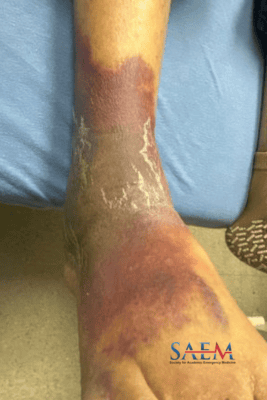
Skin: Relevant findings as shown. Discrete, tender, erythematous macules and vesicles on the bilateral feet, calves, forearms and a singular vesicle of the right1st digit
Urinalysis: Small amount of bacteria
This patient has disseminated gonococcal infection.
Disseminated gonococcal infection (DGI) is a serious complication of untreated gonorrhea, potentially leading to severe complications such as septic arthritis, pustular skin lesions, tenosynovitis, and in rare cases, endocarditis or meningitis. DGI is characterized by fevers, polyarticular joint pain, and skin lesions. The diagnosis of disseminated gonorrhea should be considered in any patient presenting with polyarticular joint pain or swelling in the setting of petechial or pustular skin lesions, especially in high risk populations. The skin lesions of disseminated gonorrhea most commonly appear on the distal extremities, and may involve the palms and soles. Patients may also present with acute septic arthritis without an obvious source. Patients with gonoccocal bacteremia may show signs of perihepatitis, meningitis, endocarditis, or osteomyelitis. Disseminated gonococcal infection results from the hematogenous spread of N gonorrhoeae, and typically develops within 3 weeks of primary mucosal infection. Patients with disseminated gonoccocal infection should be admitted for intravenous antibiotics (ceftriaxone). Any sexual partners should be treated as well.
Take-Home Points
-
Consider disseminated gonorrhea when you have a patient with polyarticular joint pain/swelling with pustular skin lesions.
-
Complications of DGI may be severe; admission and aggressive treatment with intravenous antibiotics is warranted.
- Tang et al. Characterizing the rise of disseminated gonococcal infections in California, July 2020-July 2021. Clin Infect Dis. January 2023;76(2):194-200.
- Wang CH, Lu CW. Images of the month 2: Disseminated gonococcal infection presenting as the arthritis-dermatitis syndrome. Clin Med (Lond). 2019 Jul;19(4):340-341. doi: 10.7861/clinmedicine.19-4-340. PMID: 31308120; PMCID: PMC6752240.