About Zachary Grant, MD

Assistant Professor
Department of Emergency Medicine
The University of Texas Southwestern Medical Center

SAEM Clinical Images Series: There’s a Bird Stuck in Your Throat
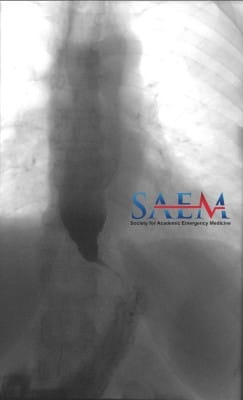
esophagram

The patient is a 61-year-old female with a past medical history of hypertension who presents to the Emergency Department for dysphagia. She states that for the past couple of months, she has experienced some discomfort in her chest as well as progressively worsening pain with swallowing. She was initially able to swallow thoroughly macerated solids and liquids, however over the past several days, she has been unable to tolerate either. She states whenever she eats or drinks something, she feels like the food gets stuck in her chest, causing her to regurgitate it. She denies any other complaints at this time.

[/fusion_text]

 No additional images

Vitals: All vital signs are normal.

General: Patient is in no acute distress.

HEENT: Mucous membranes are moist, no signs of mass or foreign body.

Respiratory: Clear to auscultation, no increased work of breathing.

Cardiovascular: Regular rate and rhythm, no murmurs.

Abdomen: Normal.

The esophagram shows the classic “bird’s beak” finding associated with Achalasia.

Dysphagia can be broken down into two categories, transfer dysphagia and transport dysphagia. Transfer dysphagia involves the oropharynx. The differential includes stroke, Parkinson’s disease, degenerative diseases such as multiple sclerosis, brain stem tumors, post-infectious causes due to polio and syphilis, peripheral neuropathy, myasthenia gravis, polymyositis, dermatomyositis, and muscular dystrophy. Transport dysphagia, as this patient has, involves the esophagus. The differential includes achalasia, diffuse esophageal spasm, ingested foreign body, esophageal web, malignancy, Schatzki ring, scleroderma, strictures, vascular compression, and Zenker’s diverticulum. The classic finding of Achalasia is a “bird’s beak” appearance on XR esophagram, as seen in the image. The esophagus tapers smoothly into a narrow gastroesophageal junction due to a hypertensive lower esophageal sphincter. There may also be dilation of the proximal esophagus, reduced or absent peristalsis on fluoroscopy, air-fluid levels in the esophagus, absence of intra-gastric air, and/or a sigmoid-like appearance of the esophagus.

Take-Home Points

  • Gastroenterology consultation is warranted if a diagnosis of achalasia is suspected, as esophagogastroduodenoscopy (EGD) is the next step in diagnosis and management.
  • The timing of EGD depends on the degree of dysphagia at presentation and speed of symptom progression.

Momodu II, Wallen JM. Achalasia. StatPearls [Internet]. Treasure Island (FL): StatPearls Publishing; 2024 Jan. Spieker MR. Evaluating dysphagia. Am Fam Physician. 2000 Jun 15;61(12):3639-48. PMID: 10892635.

[/fusion_builder_column][/fusion_builder_row][/fusion_builder_container]
By |2025-10-27T08:28:54-07:00Oct 6, 2025|Gastrointestinal, SAEM Clinical Images|

SAEM Clinical Images Series: An Interesting Case of Ocular Trauma

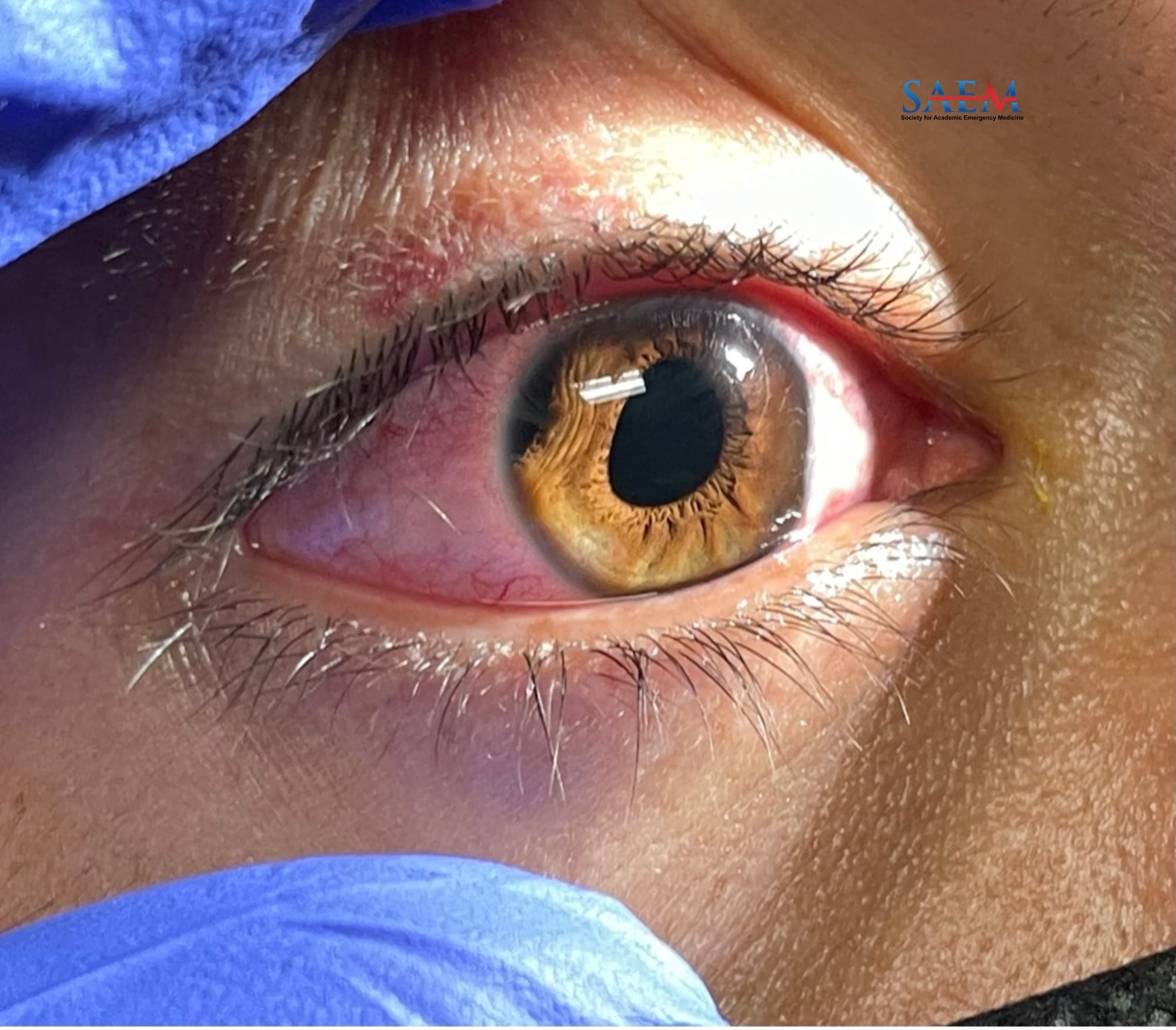
ocular trauma

A 27-year-old male with no past medical history presents to the Emergency Department with right eye pain. He states that approximately one week prior, he was working on a wire fence when he lost hold of a wire under tension, and it subsequently hit him in his right eye. He had immediate pain in his affected eye and was unable to see anything but light for the next three days. His vision slowly improved though it never normalized. He continued to have pain, so he presented for evaluation. He also reported seeing floaters and denied pain with eye movement, increased light sensitivity, or eye discharge.

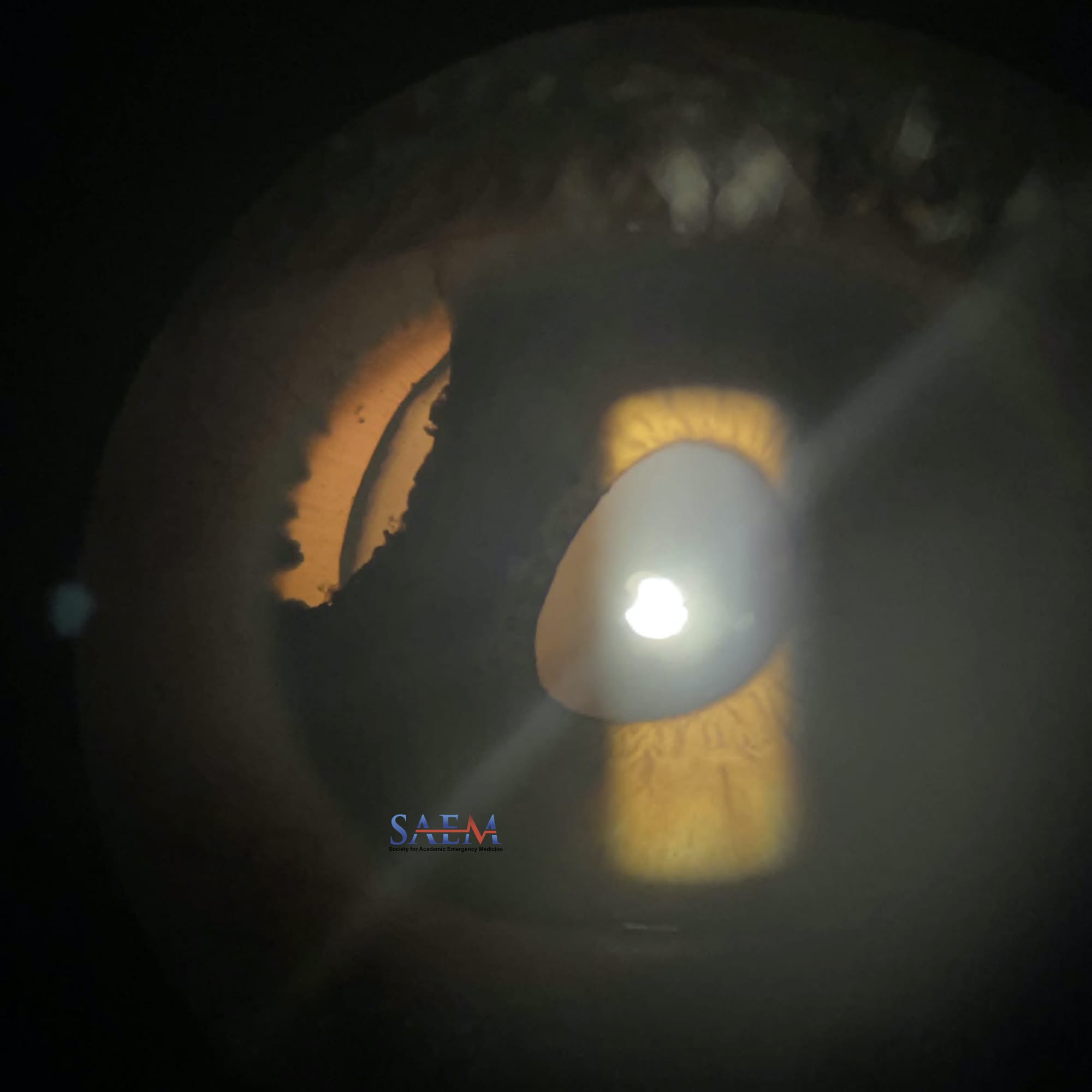
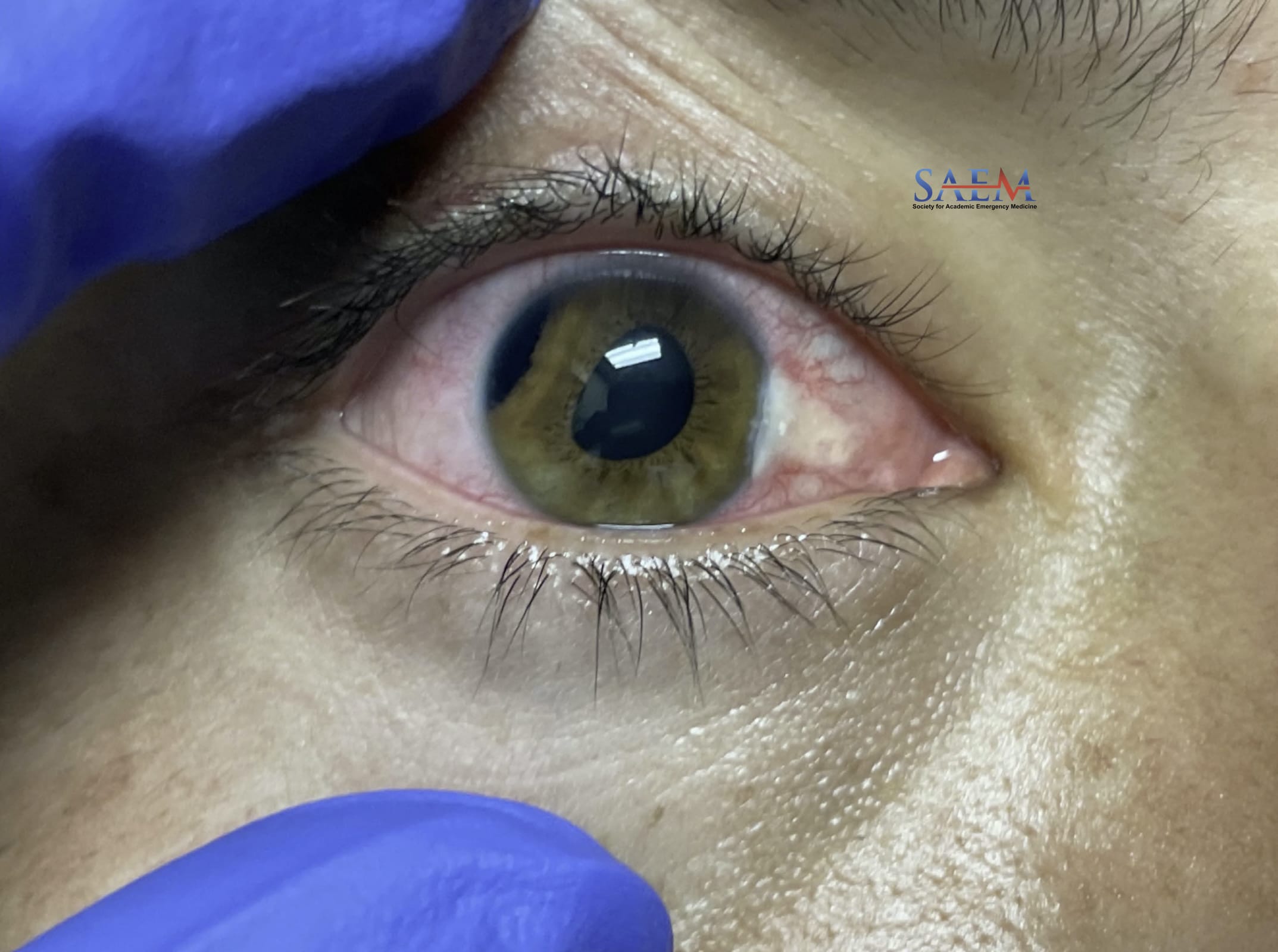
Eyes: Lids without injury. Visual acuity was 20/50 OD, 20/30 OS. Intact visual fields to finger confrontation. Extraocular muscle movements were intact and without pain. Right pupil was oval-shaped and reactive, and an evident defect at the iris from the 9 to 11 o’clock position was noted. On fluorescein stain, there was no uptake, with a negative Seidel sign. Tonometry was normal (13 OD, 12 OS). On slit lamp examination, the patient had a clear cornea, an appropriately deep anterior chamber with no hyphema or hypopyon, and 1+ mixed cells. The lens was clear, with no movement or vibration (phacodonesis) noted. A vitreous hemorrhage OD was also identified on bedside ultrasound.

Non-contributory

Iridodialysis

Traumatic iridodialysis is an uncommon ocular emergency with very distinct findings that we can encounter in the Emergency Department. It is most commonly seen with blunt trauma but can also occur with penetrating injury to the eye. This injury appears as a crescent-shaped defect at the peripheral area of the iris. Blunt trauma causes an acute globe compression, which temporarily increases intraocular pressure. This increased pressure is dissipated throughout the eye, leading to forceful fluid shifts that cause increased tension along the pupillary sphincter muscle. The weaker area of the sphincter muscle can subsequently tear, resulting in separation of the iris from the ciliary body.

Iridodialysis can be managed conservatively if it is asymptomatic and uncomplicated. Complicating factors, which include elevated intraocular pressures refractory to medical therapy, the presence of a large hyphema, rupture from blunt trauma, or the need for exploration secondary to penetrating trauma, require an Ophthalmology consult and may require emergent surgical repair.

Take-Home Points

  • Patients with iridodialysis are at risk for globe rupture, so a fluorescein exam must be performed prior to measuring intraocular pressure.
  • Ophthalmology should be consulted if the patient has complicating factors, which include elevated intraocular pressures refractory to medical therapy, the presence of a large hyphema, rupture from blunt trauma, or the need for exploration secondary to penetrating trauma.
  • Knoop, K. J., Knoop, K. J., & Stack, L. B. (n.d.). Chapter 2: Ophthalmic Conditions. In The Atlas of Emergency Medicine (p. 89). essay, McGraw-Hill Medical.
  • Pujari, A., Agarwal, D., Kumar Behera, A., Bhaskaran, K., & Sharma, N. (2019). Pathomechanism of iris sphincter tear. Medical hypotheses, 122, 147–149. https:// doi.org/10.1016/j.mehy.2018.11.013

By |2024-08-19T10:01:53-07:00Aug 26, 2024|Ophthalmology, SAEM Clinical Images|
Go to Top