The patient is a 46-year-old male with a past medical history of chronic left knee pain, hypertension, and congestive heart failure who presents to the Emergency Department with worsening left knee pain. He had been walking more frequently of late to increase his exercise, but denies any falls or specific trauma. He noticed some swelling to the area over the past few days but there has been no redness, rash, or fever. He also denies calf pain, lower leg swelling, and shortness of breath. He has no other complaints at this time but due to his worsening
pain and mild swelling, he comes in for evaluation.
Vital Signs: All vital signs are normal.
General: Well appearing, no acute distress.
Cardiovascular: No murmurs, 2+ peripheral pulses in all extremities.
Extremities: Left knee exam shows a small suprapatellar effusion and mild tenderness to palpation; there is no erythema, deformity, or crepitus; he has full active and passive range of motion.
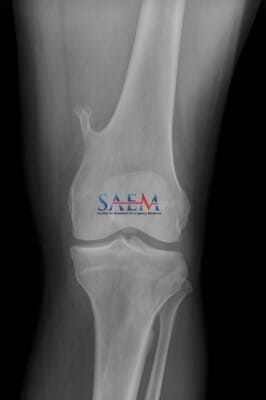
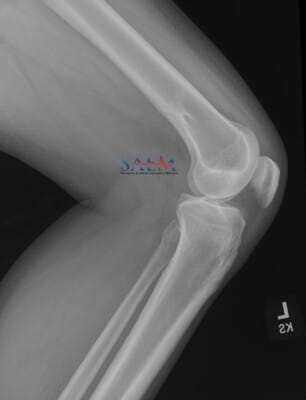
The patient has an osteochondroma.
Asymptomatic growths require no intervention. Symptomatic patients should be referred to orthopedics for consideration of resection.
Osteochondromas are the most common benign bony tumor and occur due to hamartomatous growth of cartilage. The characteristic x-ray appearance is a sessile or pedunculated bony growth located in the metaphysis projecting away from the epiphysis, as seen in this case. These lesions are more commonly seen in males and are typically diagnosed in the first four decades of life, with 75% of diagnoses occurring before the age of twenty. Patients typically present with painless masses close to tendon insertion sites, most commonly near the knee. There is a low risk of malignant transformation. Patients with Multiple Hereditary Exostoses, a rare autosomal dominant genetic condition, may present with numerous osteochondromas with a greater potential for malignant transformation. While the majority of osteochondromas are asymptomatic, symptoms may develop due to impingement on nearby structures or from fractures. If patients have persistent symptoms or cosmetic concerns, they can be referred to orthopedic surgery for consideration of resection. There have been no approved medical therapy options for osteochondroma.
Take-Home Points
- Osteochondromas are benign bony tumors that typically present as painless masses and are also commonly found incidentally on x-ray.
- Treatment is usually supportive; however, orthopedic surgery referral should be considered for persistent or severe symptoms.
- Paras T, O’Donnell P. Osteochondroma & Multiple Hereditary Exostosis. Orthobullets. Rauf A, Gaillard F. Osteochondroma. In: Radiopaedia.Org. Radiopaedia.org; 2005. doi:10.53347/rID-1799
- Tepelenis K, Papathanakos G, Kitsouli A, et al. Osteochondromas: an updated review of epidemiology, pathogenesis, clinical presentation, radiological features and treatment options. In Vivo. 2021;35(2):681-691. doi:10.21873/invivo.12308

Michael Ray, MD
Emergency Medicine
Boston Medical Center
Latest posts by Michael Ray, MD (see all)
- SAEM Clinical Images Series: A Pedunculated Bone to Pick - January 12, 2026

Julia Isaacson, MD
Boston Medical Center
Latest posts by Julia Isaacson, MD (see all)
- SAEM Clinical Images Series: A Pedunculated Bone to Pick - January 12, 2026
- SAEM Clinical Images Series: Weird Flex - April 7, 2025
- SAEM Clinical Images Series: Ptosis? A Don’t Miss Diagnosis! - April 4, 2025

Christopher Russell, MD
Boston Medical Center
Latest posts by Christopher Russell, MD (see all)
- SAEM Clinical Images Series: A Pedunculated Bone to Pick - January 12, 2026
- SAEM Clinical Images Series: An On-Target Diagnosis - December 9, 2024
- SAEM Clinical Images Series: Wolf in Sheep’s Clothing - November 6, 2023

Andrew Mittelman, MD
Latest posts by Andrew Mittelman, MD (see all)
- SAEM Clinical Images Series: A Grain of Sand… or Something More Sinister? - February 27, 2026
- SAEM Clinical Images Series: A Pedunculated Bone to Pick - January 12, 2026
- SAEM Clinical Images Series: Tangled in the Toilet - October 31, 2025