1. Body Packing
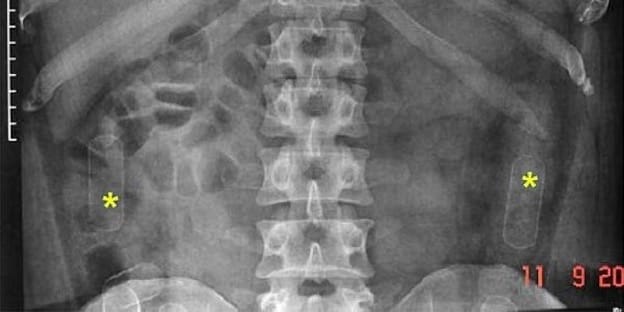
This abdominal radiograph reveals several uniform-appearing foreign bodies consistent with body packing – the internal concealment of well-wrapped drugs for the purpose of smuggling, often across international borders.
What is the difference between body packing, stuffing, and pushing, and why does it matter? [1-3]
- Body packing is the intentional ingestion of well-packaged illicit substances for smuggling, often across international borders. Individuals typically ingest large quantities (often 50–100 packets totaling ~1 kg of drugs).
- Body stuffing refers to the hurried ingestion of poorly packaged or unpackaged drugs—typically during unexpected encounters with law enforcement.
- Body pushing can be considered a subtype of stuffing, and involves inserting drugs into body orifices (e.g., rectum, vagina) for purposes of concealment, or under duress.
- The method of concealment provides important information about drug quantity, packaging integrity, clinical risks, and imaging detectability.
- The most common drugs involved are sympathomimetics (e.g., methamphetamine and cocaine) and opioids.
How do these patients present? [1-5]
- Patients may be asymptomatic.
- Patients may present with toxidromes representing leakage or rupture of packets.
- Sympathomimetic → agitation, tachycardia, hypertension, hyperthermia, seizures, wide complex QRS, and arrhythmia
- Opioids → miosis, respiratory depression, CNS depression, bradycardia, decreased bowel sounds
- Patients engaging in body stuffing are more likely to be symptomatic, as packages are less well wrapped and more likely to leak, but generally involve smaller quantities of drug.
- Patients engaging in body packing have a larger quantity of drugs but may not manifest significant symptoms due to well-wrapped packaging; however, rupture may release life-threatening amounts of drugs.
- Packages outside the gastrointestinal tract may be less likely to rupture due to a less acidic environment.
- Patients may develop mechanical obstruction.
- Patients may develop local bowel necrosis/ischemia, particularly with sympathomimetic packages that leak or rupture.
- The most dangerous complication is packet rupture, which can cause acute toxicity and may lead to fatality.
How can you be alerted to body packing or stuffing in the ED? [1,2,5]
- Patients providing vague or inconsistent history
- Patients are reluctant to be examined
- Patients in the custody of law enforcement, particularly with a change in clinical status while in custody
- History of fleeing law enforcement
- History of recent travel, particularly internationally
- Interviewing the patient in private, when possible, may elicit the history of drug concealment.
What is the appropriate diagnostic evaluation? [5-9]
- Guided by clinical presentation
- May include CBC, Chemistry Panel, Cardiac Markers, EKG, lactate, venous blood gas, and urine drug screening for specific substances.
- Please note that the opioid component of many urine drug screens may not pick up commonly used opioids such as fentanyl, methadone, buprenorphine, and oxycodone.
- Imaging considerations
- Imaging sensitivity is overall poor, and negative imaging cannot rule out the presence of packets.
- Patients engaging in body packing are most likely to have positive radiology.
- CT abdomen (non-contrast) is most likely to detect packets.
- Plain abdominal X-ray is less sensitive but may contain helpful signs, generally in body packing:
- Tic Tac sign – uniform repeating shapes
- Double Condom sign – air rim between condom layers
- Legal considerations
- In the United States, patients may refuse care if competent, including diagnostic testing and therapeutic interventions. However, patients in police custody may not leave or sign out against medical advice.
- Consultation with legal and ethics consultants may be appropriate in selected cases.
What is the appropriate management of patients with body packing or stuffing? [1,2,5,8]
- Symptomatic patients with a toxidrome should be treated according to the toxidrome:
- Sympathomimetic toxicity can be treated with IV benzodiazepines, active cooling for hyperthermia, and sodium bicarbonate for a wide QRS interval.
- For sympathomimetic toxicity in the setting of suspected packet rupture, early surgical consultation is recommended to consider packet removal.
- Opioid toxicity can be treated with naloxone, often requiring high doses or continuous infusion.
- Symptomatic patients with signs of bowel obstruction, perforation, or ischemia require prompt surgical consultation.
- For asymptomatic patients, recommendations vary depending on the number of packets, their contents, and the risk of rupture.
- Activated charcoal is recommended for an alert and cooperative patient.
- Serial radiology can be helpful if packages are visualized.
- Whole bowel irrigation can be considered, particularly in cases of body packing.
- The passage of three packet-free stools has been used as an endpoint in body packing [5]
- Asymptomatic patients with body stuffing who remain asymptomatic after 6 hours are not likely to suffer adverse outcomes. [5,10]
Bedside Pearls
- Maintain a high index of suspicion for illicit concealment of drugs in patients brought in by law enforcement or with a history of fleeing law enforcement.
- Know your toxidromes for sympathomimetic and opioid toxicity.
- Packet rupture can be fatal, and suspected packet rupture should be managed aggressively, particularly with sympathomimetic (e.g., methamphetamine, cocaine) packets.
- Imaging can be helpful, particularly CT, but negative imaging does not rule out concealed packets.
- Involve surgery, ICU, and medical toxicology early in symptomatic patients