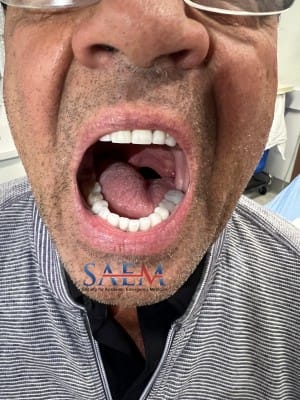
The patient is a 68-year-old male with a past medical history of hypertension who presents to the Emergency Department for evaluation of tongue swelling. The patient reports that his left tongue was swollen 3 weeks ago. He was evaluated, prescribed Levaquin, and was advised to gargle peroxide/salt water per his primary care provider. The swelling resolved after approximately 2 days. This morning, he awoke at 2 AM with swelling in the right side of his tongue. He denies any allergies or prior intubations. He denies any new foods, exposures, any other complaints at this time. He states that his tongue has not increased in size since awakening. The patient has been on no new medications and has taken enalapril daily for the past 10 years.
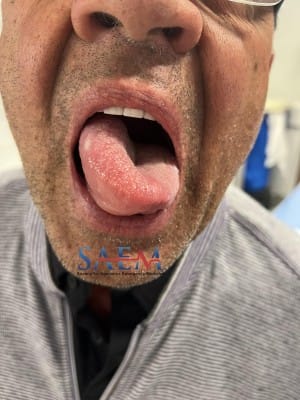
General: Comfortable, no signs of distress, voice tone is clear but he has difficulty articulating his words due to his tongue swelling.
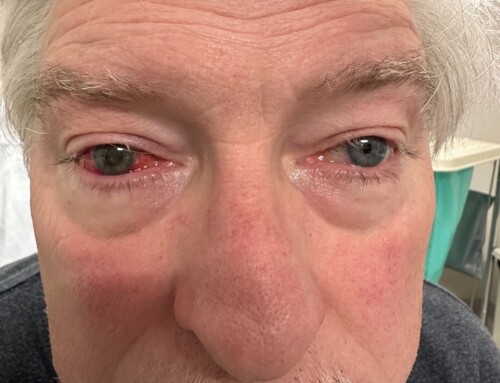
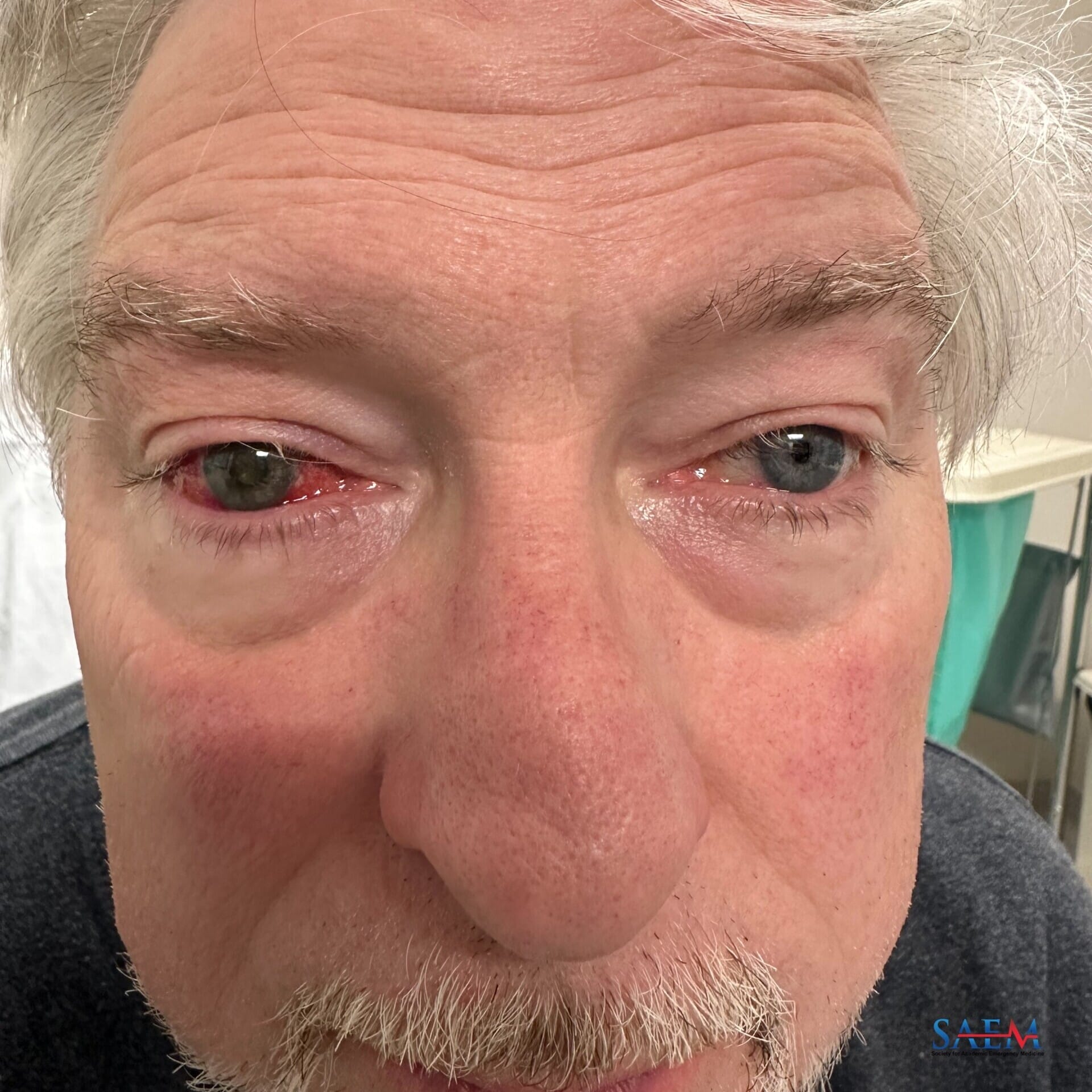
HEENT: Relevant findings are shown in the image provided. Uvula midline. Mallampati class 2 airway.
Neck: Supple, no stridor.
Cardiovascular: Regular rate, rhythm, normal peripheral pulses.
Skin: No rash or urticaria seen.
ACE-inhibitor-induced angioedema.
Our patient presented to the ED complaining of unilateral tongue swelling in the setting of enalapril as his only medication, making ACE-inhibitor- induced angioedema his most likely diagnosis. ACE-inhibitor-induced angioedema can occur at any point during the course of treatment (our patient had been on enalapril for ten years). Non-histaminergic (non- allergic) angioedema is typically a result of elevated bradykinin levels. Classification of angioedema includes four subtypes: Hereditary angioedema with or without C1 esterase inhibitor deficiency, acquired C1 esterase inhibitor deficiency, ACE-inhibitor-induced angioedema, and idiopathic angioedema. ACE-inhibitor induced angioedema has an overall incidence of 0.3% to 0.7% and is 3 to 4 times more likely in African-Americans. Females are at a 50% higher risk than males. Airway compromise is the most feared complication of angioedema. In cases requiring intubation, advanced airway setups and techniques along with surgical backup is advisable.
Take Home Points
1. ACE-inhibitor-induced angioedema does not respond to epinephrine and treatment is mainly supportive.
2. In severe cases requiring intubation, awake fiberoptic intubation is a preferred method when accessible and feasible, and paralytics should be utilized with caution.
- Frank MM, Gelfand JA, Atkinson JP. Hereditary angioedema: the clinical syndrome and its management. Ann Intern Med. 1976;84:580–593. doi: 10.7326/0003-4819-84-5-580.
- Lee JH, Cho JY, Nam DH, Hong CS. A case of hereditary angioedema. Allergy. 1994;14:695–701. Weis M. Clinical review of hereditary angioedema: diagnosis and management. Postgrad Med. 2009;121:113–120. doi: 10.3810/pgm.2009.11.2071.

Brendon Irving, DO
Emergency Medicine
RWJ Barnabas Health
Latest posts by Brendon Irving, DO (see all)
- SAEM Clinical Images Series: Tongue Twisters - October 20, 2025

Corinne Espinosa, DO
RWJ Barnabas Health
Latest posts by Corinne Espinosa, DO (see all)
- SAEM Clinical Images Series: Tongue Twisters - October 20, 2025
- SAEM Clinical Images Series: Case of Painless Vision Changes - March 31, 2025