rash

The patient is a 25-year-old female with no significant past medical history who presents to the Emergency Department with a pruritic rash. She reported three days of progressive pruritus with an associated diffuse rash extending from the lower extremities to the proximal upper extremities with involvement of the chest and back. She denies fevers, chills, difficulty breathing, nausea, vomiting, or history of similar rash. She has no history of dermatologic or immunologic conditions. She has had no new exposures to new soaps or chemicals. She has no known allergies, is up to date on all vaccinations, and has not traveled in the last year other than a day trip to an indoor water park three days ago.

Vitals: Normal

General: No acute distress but uncomfortable from itching.
HEENT: Oropharynx clear without edema, erythema, or mucosal lesions.
Respiratory: Clear to auscultation bilaterally.
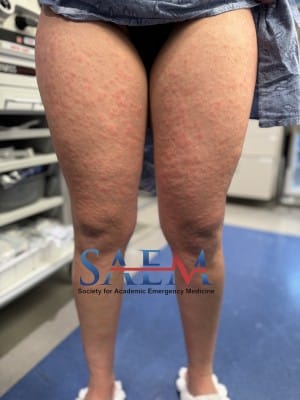
Skin: Key findings as shown in the image provided. There is a diffuse papular rash extending from the bilateral distal lower extremities up to level of the sternum with uniform involvement of the abdomen, chest, back, and upper extremities. Negative Nikolsky’s sign. No involvement of the head, neck, palms of the hands, or soles of the feet.

Pseudomonas aeruginosa folliculitis (“Hot Tub folliculitis”)

This patient presented with a history and exam classic for Pseudomonas aeruginosa folliculitis, or “hot tub” folliculitis. The primary risk factor for this condition is exposure to contaminated water, typically via public swimming pools or hot tubs with inadequate chlorine levels. Longer durations of exposure, female gender, and underlying skin trauma are additional risk factors. The infection is associated with a tender and pruritic rash which begins as papules and can progress to papulopustular or nodular lesions. The rash may develop on any body part that is exposed to the contaminated water. Symptoms classically begin within 8 to 48 hours of the initial exposure, however can develop up to five days later. A subset of patients may develop systemic symptoms of malaise and fever. Most cases are self-limited, resolving without treatment in one to two weeks. However, patients with significant cutaneous involvement or discomfort, systemic symptoms, or immunocompromised state should be treated empirically with an oral fluoroquinolone. Symptomatic

Take-Home Points

  • In patients presenting with follicular rashes, be sure to ask about public pool or hot tube exposures.
  • Hot tub folliculitis is a pseudomonas infection and can be treated with oral fluroquinolones.

1. Centers for Disease Control and Prevention (CDC). Pseudomonas dermatitis/folliculitis associated with pools and hot tubs–Colorado and Maine, 1999-2000. MMWR Morb Mortal Wkly Rep. 2000;49(48):1087-1091.

2. Tate D, Mawer S, Newton A. Outbreak of Pseudomonas aeruginosa folliculitis associated with a swimming pool inflatable. Epidemiol Infect. 2003;130(2):187-192. doi:10.1017/s0950268802008245

3. Jacob JS, Tschen J. Hot Tub-Associated Pseudomonas Folliculitis: A Case Report and Review of Host Risk Factors. Cureus. 2020;12(9):e10623. Published 2020 Sep 23. doi:10.7759/cureus.10623

4. Silverman AR, Nieland ML. Hot tub dermatitis: a familial outbreak of Pseudomonas folliculitis. J Am Acad Dermatol. 1983;8(2):153-156. doi:10.1016/s0190-9622(83)70017-4

5. Luelmo-Aguilar J, Santandreu MS. Folliculitis: recognition and management. Am J Clin Dermatol. 2004;5(5):301-310. doi:10.2165/00128071-200405050-00003

Athanasios Burlotos, MD

Athanasios Burlotos, MD

Resident Physician
Emergency Medicine
Boston Medical Center
Athanasios Burlotos, MD

Latest posts by Athanasios Burlotos, MD (see all)

Brianna Marschke, MD

Resident Physician
Emergency Medicine
Boston Medical Center

Latest posts by Brianna Marschke, MD (see all)

Avery Clark, MD

Avery Clark, MD

Attending Physician
Boston Medical Center
Andrew Mittelman, MD

Andrew Mittelman, MD

Assistant Professor of Emergency Medicine
Boston Medical Center