Trick of the Trade: Don’t miss the pneumothorax in needle thoracostomy
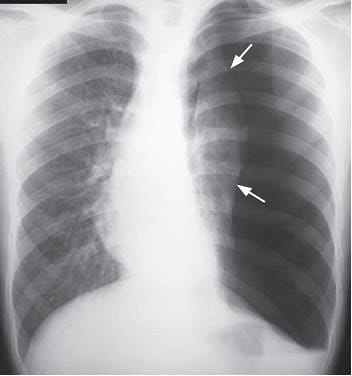
PTXtensionA patient arrives in PEA arrest and you note that her left chest has no breath sounds or lung sliding on bedside ultrasound. You suspect a tension pneumothorax.

You insert a standard 14g angiocather in the left 2nd intercostal space (ICS). You don’t hear a rush of air. The patient’s clinical condition deteriorates to impending asystole. How sure are you that your angiocatheter actually reached the pleural space?

(more…)

By |2017-08-03T00:59:44-07:00Oct 2, 2012|Tricks of the Trade|

Paucis Verbis: Delayed sequence intubation

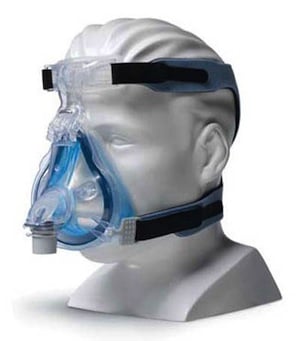
Bipap

A 40-year-old man presents with significant agitation and severe respiratory distress from a COPD exacerbation. His oxygen saturation is 75% on room air, and he has diffuse, tight wheezes on exam. You prepare to intubate the patient using a rapid sequence induction protocol: etomidate, succinylcholine, 8-0 endotracheal tube.

Or do you?

This pocket card discusses the delayed sequence intubation (DSI) protocol made famous by Dr. Scott Weingart and Dr. Rich Levitan.1 Thanks to Dr. Michelle Reina (EM resident at Univ of Utah) and Dr. Rob (Intermountain Medical Center in Utah) for designing this helpful card. Rob has even implemented a DSI protocol in his ED.

The card breaks down the reasoning and steps behind DSI. Anecdotally, ketamine has often calmed patients down enough during the preoxygenation phase to enhance oxygenation/ventilation so much so that intubation is not required.

PV Card: Delayed Sequence Intubation (DSI)


Go to ALiEM (PV) Cards for more resources.

Reference

  1. Weingart S, Levitan R. Preoxygenation and prevention of desaturation during emergency airway management. Ann Emerg Med. 2012;59(3):165-75.e1. [PubMed]
By |2022-04-05T15:07:58-07:00Aug 31, 2012|ALiEM Cards, Critical Care/ Resus|

Trick of the Trade: Incision and loop drainage of abscesses

Abscess Packing Hand

Why are we still teaching the traditional incision and drainage approach to simple abscess drainage? They require frequent, painful packing changes to ensure persistent drainage of retained pus.

Trick of the Trade

Incision and loop drainage (I&LD) technique

As per usual, Dr. Rob Orman (ercast) beat me to this. He already reviewed the technique on his blog in 2010. This stems from a landmark article in the Journal of Pediatric Surgery, which involves creating a persistently draining fistula at two points by using a small vascular loop, tied into a non-tensile loop.

It makes sense to extrapolate and use this technique for both pediatric and adult patients with uncomplicated abscess, especially if the patients may not follow-up for packing changes as scheduled. The added benefit is that showering is encouraged to help encourage drainage without the risk of dislodging the secured loop.

Questions

Does anyone have experience with this that they would like to share? Particularly, what if you don’t have the skinny vascular loops in your Emergency Department?

What are the follow-up instructions?

Per the Tsoraides article1:

  • Take a bath/shower TWICE daily for the first 3 days.
  • Remove the loop in 7-10 days (when the drainage stops and the overlying cellulitis resolves)

Reference

  1. Tsoraides S, Pearl R, Stanfill A, Wallace L, Vegunta R. Incision and loop drainage: a minimally invasive technique for subcutaneous abscess management in children. J Pediatr Surg. 2010;45(3):606-609. [PubMed]
By |2021-01-02T13:55:50-08:00Aug 14, 2012|Tricks of the Trade|
Go to Top