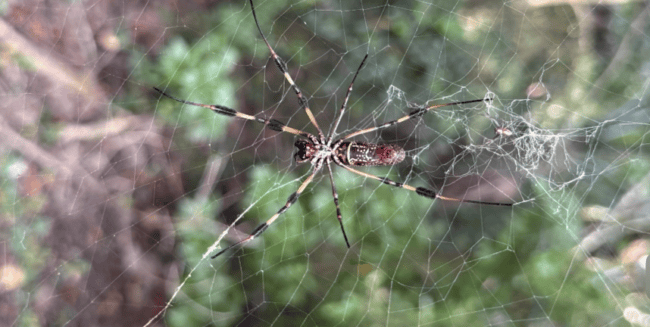
What is the spider pictured below?
- Atrax robustus (Sydney funnel-web spider)
- Phoneutria nigriventer (Brazilian wandering spider)
- Trichonephila clavata (Joro Spider)
- Trichonephila clavipes (Golden Silk Orb-Weaver)
[Author’s own image]

The American College of Medical Toxicology hosts this Toxicology Visual Pearls series. The post was peer reviewed on behalf of ACMT by Drs. Howard A Greller, Louise Kao, and Daniel Repplinger.
References
- Weems HV Jr, Edwards GB Jr. Golden Silk Spider, Trichonephila clavipes (Linnaeus). University of Florida IFAS Extension; EENY-229/IN467. Accessed February 2025. PMID: Not applicable. https://edis.ifas.ufl.edu/publication/IN467.
- Nelsen DR, Chuang A, Corbit AG et al. Keep calm and carry on: bites from Trichonephila clavataare unlikely and cause minimal discomfort, Journal of Medical Entomology, Volume 62, Issue 6, November 2025, Pages 1396–1408, PMID: 41123166.
- da Silva Junior PI. Venom composition and strategies in spiders. In: Spider Venoms. Academic Press; 2016:1-19. PMID: Not applicable. https://www.sciencedirect.com/science/chapter/bookseries/abs/pii/B9780123876683000015?via%3Dihub.

Fernando Tejeda-Castro, DO
Emergency Medicine Resident
Jefferson Einstein Hospital of Philadelphia
Jefferson Einstein Hospital of Philadelphia
Latest posts by Fernando Tejeda-Castro, DO (see all)
- ACMT Toxicology Visual Pearl – Big Spider, Small Risk - April 21, 2026

Michael Singer
Medical Toxicology Fellow
Jefferson Einstein Hospital of Philadelphia
Jefferson Einstein Hospital of Philadelphia
Latest posts by Michael Singer (see all)
- ACMT Toxicology Visual Pearl – Big Spider, Small Risk - April 21, 2026