Toxic Mushroom

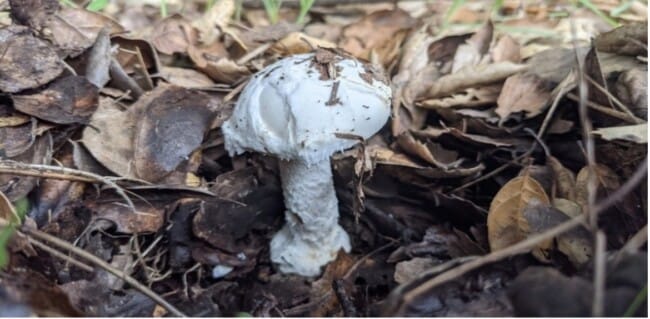
Ingestion of the pictured mushroom is most associated with which toxicity?

  1. Disulfiram-like reaction
  2. Hallucinations
  3. Liver failure
  4. Seizures

[Image credit to William Morris via Creative Commons]

3. Liver Failure

Background

This image depicts the deadly Amanita ocreata, one of several mushrooms more colloquially known as “destroying angels” within the Amanita genus [1]. Found on the Pacific coast of North America, Amanita ocreata thrives in the spring months and grows in association with oak trees.  It is characterized by a white cap that can develop a yellowish shade with a brown center, though the remainder of the mushroom below the cap is white. It has no distinct odor or taste, making it difficult to distinguish from edible species for foragers [2]. Consuming as little as half a mushroom cap can be fatal due to hepatorenal failure [3].  There are an estimated 900 to 1000 species of the genus Amanita found worldwide, some of which are non-toxic.  While there are other species of hepatotoxic mushrooms, fewer than ten Amanita species are responsible for 95% of the mushroom-related fatalities that occur in the United States. [4, 5].  Toxic Amanita species are found throughout the US, with most cases being reported on the Western coast, as exemplified by a 2025 California outbreak affecting over 20 patients and resulting in one fatality. [5,6]

What is the toxin found in hepatotoxic Amanita mushrooms? [5, 7-9]

There are three toxins; one is much worse than the others

Amatoxin

  • Cyclopeptide toxin causes the primary toxicity in these mushrooms
  • Present in nine Amanita species, eight Galerina species, and twenty-one Lepiota species
  • Thermostable and highly resilient, as drying and cooking have no effect on the toxin
  • Readily absorbed via the gut before undergoing enterohepatic circulation to reach the hepatocytes, where the toxin binds RNA polymerase II to derail transcription. Once bound, protein synthesis is compromised, leading to apoptosis and subsequent hepatocellular necrosis.
  • Similarly, cell death in the kidneys can result in acute tubular necrosis.
  • Primarily excreted by the kidneys, but undergoes enterohepatic circulation

Phallotoxin and Virotoxin

  • Not absorbed from the GI tract and does not produce significant toxicity from an oral route
  • Likely contributes to initial GI symptoms after ingestion

What is the clinical course of hepatotoxic Amanita mushroom poisoning? [4,7-10]

  • Amanita poisoning typically produces delayed nausea, vomiting, abdominal pain, and diarrhea starting about 6-24 hours post ingestion.
    • GI symptoms that develop and resolve within 6 hours can help distinguish less toxic mushroom ingestions
  • Liver and kidney damage develop after 24-72 hours, with symptoms including jaundice, oliguria, encephalopathy, and bleeding due to coagulopathy
    • Transaminitis with a mean AST/ALT of >5000/7000 U/L; the mean serum total bilirubin can reach >10 mg/dL.
  • In severe cases, symptoms can progress to complete liver and renal failure, convulsions, and coma within 3-7 days after ingestion.

What is the treatment of hepatotoxic Amanita mushroom poisoning? [7, 11-15]

  • Supportive care is the mainstay of amatoxin-containing mushroom toxicity, as there is no specific antidote.
  • Aggressive IV hydration is paramount with attention to correcting fluid losses, electrolyte deficiencies, and glucose.
  • Randomized controlled trials have not been performed due to ethical reasons. Several agents have been used with varying levels of support and evidence via retrospective reviews and case studies [11]:
    • Activated charcoal:
      • Consider regardless of the timing of presentation.
      • May reduce absorption of amatoxins if given early and may also prevent reabsorption hours later, as amatoxins undergo hepatic recirculation
      • Multidose activated charcoal may be used
    • N-acetylcysteine (NAC):
      • Increases glutathione stores and restores redox capacity in injured cells
      • While animal studies do not show conclusive benefit [12,13], possible benefits and a low side effect profile are generally believed to justify administration [14].
      • Follow your local protocols for dosing and regimen.
    • High dose Penicillin G (4 million units q4h):
      • Thought to compete with the liver uptake of amatoxin.
      • Analysis of clinical data from 2,108 amatoxin-related hospitalizations over 20 years showed little efficacy in practice [15].
      • If used, be aware of seizure risk
    • Silymarin:
      • Believed to inhibit organic anion transporting polypeptides (OATP), slowing amatoxin entry into the liver.
      • One large retrospective study reported benefits in patients [16].
      • In Europe, IV Silymarin is an approved pharmaceutical.
      • In the US, contact your local poison center or toxicologist to inquire about availability/acquisition.
    • Once severe liver injury occurs, a liver transplant may be the only life-saving option despite aggressive fluid resuscitation and supportive care.
    • Consulting a local toxicologist and/or poison center is recommended, as they will be familiar with regional mushrooms and potential resources for identification
    • Confirmatory testing is rarely available, although a point-of-care test has been studied [17].

Bedside Pearls

  • Ingestion of Amatoxin containing mushrooms is a rare but significant cause of acute fulminant liver failure.
  • Prognosis is dependent on the mushroom type, exposure amount, and time to care.
  • Delayed (>6 h) GI symptoms and rising transaminases 2-3 days post ingestion would be a typical course
  • Treatment is supportive without a known antidote, though there is some supporting literature for specific treatments.
  • In severe cases, liver transplantation is the only definitive management.
  • Consultation with a local toxicologist/poison center is recommended

References

  1. Morris, William. “Amanita Ocreata.” Org, 14 Mar. 2021, mushroomobserver.org/449402?q=1p9YK.
  2. Davis M, Sommer R, Menge J. Field guide to mushrooms of western North America. Univ of California Press; 2012 Sep 4.
  3. Sabeel AI, Kurkus J, Lindholm T. Intensive hemodialysis and hemoperfusion treatment of Amanita mushroom poisoning. Mycopathologia. 1995;131(2):107-114. doi:10.1007/BF01102888. PMID: 8532053.
  4. Trabulus S, Altiparmak MR. Clinical features and outcome of patients with amatoxin-containing mushroom poisoning [published correction appears in Clin Toxicol (Phila). 2012 Jun;50(5):450]. Clin Toxicol (Phila). 2011;49(4):303-310. doi:10.3109/15563650.2011.565772. PMID: 21563906
  5. The World Data. Mushroom Poisoning in the US 2025. December 7, 2025.  Available at: Mushrooms Poisoning in US 2025 | Statistics & Facts – The World Data.  Accessed March 24, 2026.
  6. California Department of Public Health. Outbreak of Potentially Deadly Amatoxin Poisoning Linked to the Consumption of Wild, Foraged Mushrooms.  December 5, 2025.  Available at: https://www.cdph.ca.gov/Programs/OPA/Pages/NR25-023.aspx. Accessed March 24, 2025.
  7. Garcia J, Costa VM, Carvalho A, et al. Amanita phalloides poisoning: Mechanisms of toxicity and treatment. Food Chem Toxicol. 2015;86:41-55. doi:10.1016/j.fct.2015.09.008. PMID: 26375431 .
  8. Lewis JH. Chapter 10-Drug-induced and toxic liver disease. Handbook of liver disease. 4th ed. Philadelphia: Elsevier. 2018:130-57.
  9. Mas A. Mushrooms, amatoxins and the liver. J Hepatol. 2005;42(2):166-169. doi:10.1016/j.jhep.2004.12.003. PMID: 15664239 .
  10. Viess, Debbie. “Amatoxin:  The Deadliest of All Mushroom Poisonings.” Bay Area Mushrooms, Bay Area Mycological Society, 14 Aug. 2022, org/poisonings/amatoxin.html
  11. Horowitz BZ, Moss MJ. Amatoxin Mushroom Toxicity. In: StatPearls. Treasure Island (FL): StatPearls Publishing; June 26, 2023. PMID: 28613706.
  12. Tong TC, Hernandez M, Richardson WH 3rd, et al. Comparative treatment of alpha-amanitin poisoning with N-acetylcysteine, benzylpenicillin, cimetidine, thioctic acid, and silybin in a murine model. Ann Emerg Med. 2007;50(3):282-288. doi:10.1016/j.annemergmed.2006.12.015. PMID: 17559970.
  13. Magdalan J, Ostrowska A, Piotrowska A, et al. Failure of benzylpenicillin, N-acetylcysteine and silibinin to reduce alpha-amanitin hepatotoxicity. In Vivo. 2009;23(3):393-399. PMID: 19454504.
  14. Ward J, Kapadia K, Brush E, Salhanick SD. Amatoxin poisoning: case reports and review of current therapies. J Emerg Med. 2013;44(1):116-121. doi:10.1016/j.jemermed.2012.02.020. PMID:  22555054 .
  15. Enjalbert F, Rapior S, Nouguier-Soulé J, Guillon S, Amouroux N, Cabot C. Treatment of amatoxin poisoning: 20-year retrospective analysis. J Toxicol Clin Toxicol. 2002;40(6):715-757. doi:10.1081/clt-120014646 PMID: 12475187.
  16. Mengs U, Pohl RT, Mitchell T. Legalon® SIL: the antidote of choice in patients with acute hepatotoxicity from amatoxin poisoning. Curr Pharm Biotechnol. 2012;13(10):1964-1970. doi:10.2174/138920112802273353. PMID:  22352731.
  17. Bever CS, Swanson KD, Hamelin EI, et al. Rapid, Sensitive, and Accurate Point-of-Care Detection of Lethal Amatoxins in Urine. Toxins (Basel). 2020;12(2):123. Published 2020 Feb 15. doi:10.3390/toxins12020123 PMID: 32075251.

Omar El Hely, MD

Omar El Hely, MD

Emergency Medicine Resident
Carolinas Medical Center, Charlotte NC
Omar El Hely, MD

Latest posts by Omar El Hely, MD (see all)

Ann-Jeannette Geib, MD

Ann-Jeannette Geib, MD

Medical Toxicologist Faculty
Department of Emergency Medicine
Carolinas Medical Center, Charlotte, NC