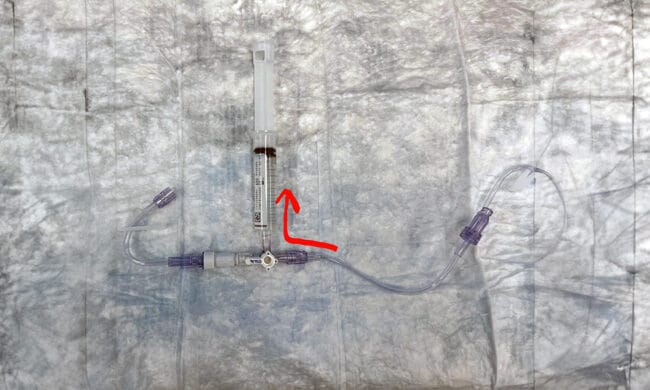
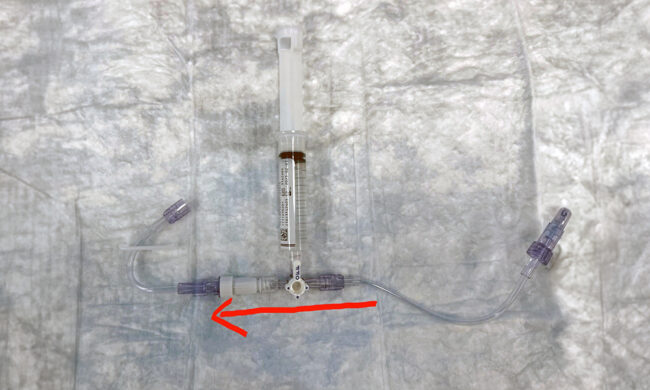
Trick of the Trade: Cut IV extension tubing for 2-person ultrasound guided nerve block
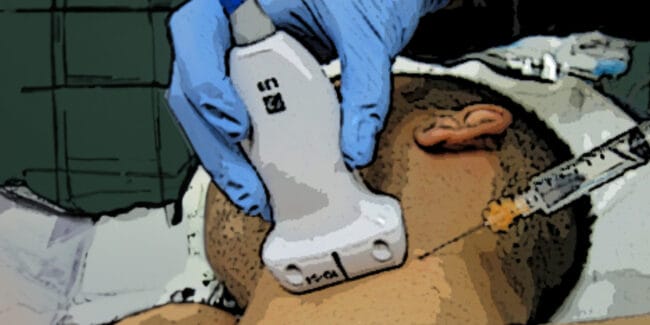
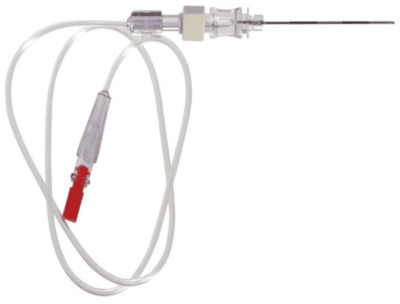
Ultrasound-guided procedures are difficult enough just identifying the anatomy. Performing a nerve block with the ultrasound in one hand and the needle in the other hand adds extra challenges. The simplest 1-person approach involves attaching a syringe with local anesthetic directly to the end of the procedural needle. A 2-person approach involves attach the syringe to a custom tubing-needle setup such as below. However, this custom setup may not be readily available.
Trick of Trade: Cut Standard IV Extension Tubing
Required equipment:
- Ultrasound linear probe
- 10 cc syringe
- IV tubing
- Procedural needle
- Shears
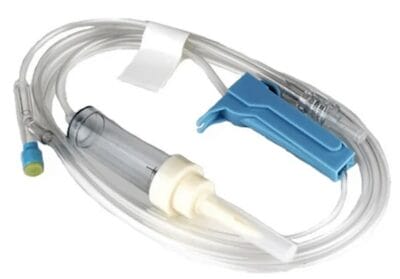
Almost all standard IV extension tubing that connects IV fluid bags to a peripheral IV have an injection port near the downstream end.
- Clamp the IV tubing just upstream from the injection port and cut off all the unused upstream IV tubing.
- Attach a 10 cc syringe with local anesthetic to the injection port.
- Attach the other end of this IV tubing (Luer lock attachment) to the procedural needle.
- Prime the IV line with the anesthetic.
- Perform the nerve block with one person advancing the needle under ultrasound guidance, while the other person aspirates and injects the anesthetic when needed.
Video: 2-person ultrasound-guided nerve block with cut IV tubing
Bonus Tip: This approach is applicable to many procedures requiring aspiration or instillation of anesthetic, such as peritonsillar abscess aspiration.
Read more from the Tricks of the Trade series.
 You have a severely dehydrated patient with a peripheral IV line, requiring urgent fluid resuscitation. However, the crystalloid fluids are not flowing freely. Multiple attempts were made to place this line with the latest having a flash of blood return and a smoothly flowing saline flush. You can not seem to find your pressure infusion cuff to squeeze the IV bag and accelerate fluid administration.