

About Craig Brockman, MD

Assistant Professor
Department of Emergency Medicine
University of Texas Southwestern

SAEM Clinical Images Series: Green Foot
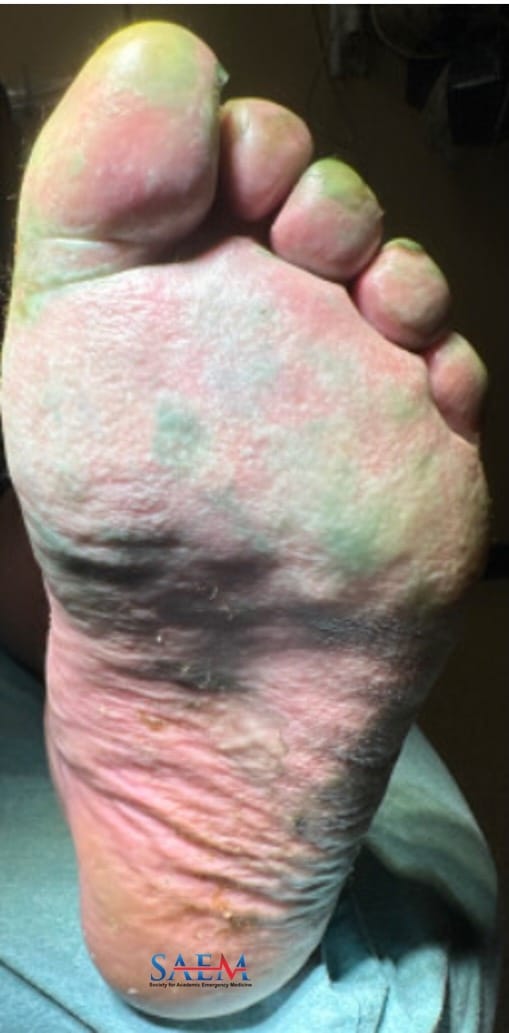
The patient is a 59-year-old male with a history of prior DVT, atrial fibrillation, HTN, alcohol use and COPD who presents to the Emergency Department with chest pain, dyspnea, and left lower extremity swelling and pain. He had a prior hospital admission two weeks ago for leg swelling and cellulitis. He was previously prescribed oral gentamicin and topical mupirocin for concerns of foot infection, which he has been compliant with taking. He has been working long hours as a construction worker, but knows of no chemical exposure to his feet and denies walking barefoot. He has had no fever and denies any other complaints at this time.
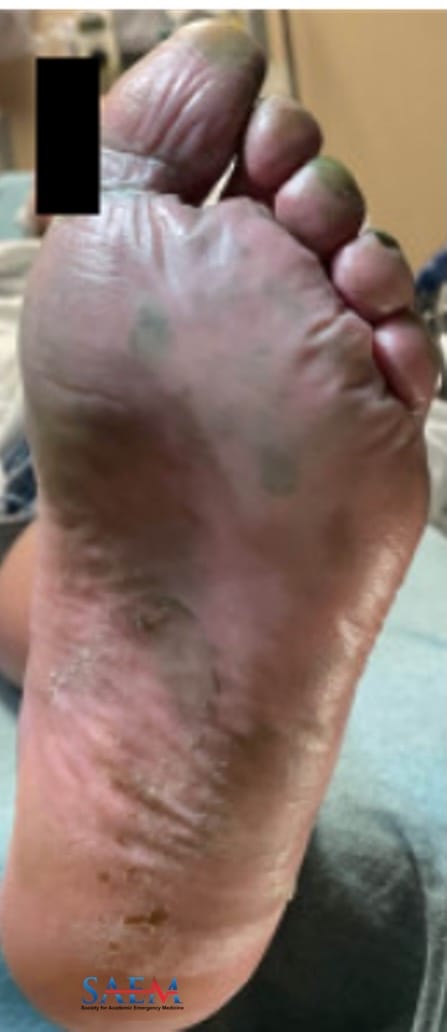
Vitals: BP 151/69; HR 93; R 18; T 97.7°F; O2 sat 95% room air.

General: No acute distress.

Respiratory: Mild wheezes bilaterally.

Extremities: Mild bilateral lower extremity swelling, worse on left compared to right. Left foot discolored as shown in the image – when asked, the patient states the discoloration started initially on the great toenail and progressed to the sole of the foot.

CBC: WBC: 10.2; Hgb: 12.7

Na: 130

ESR: 6

CRP: 0.8

CXR: Mild pulmonary edema.

Foot X-ray: No acute findings, old Lisfranc injury.

Ultrasound: Negative for DVT.

Green foot syndrome is a rarely diagnosed Pseudomonas aeruginosa infection secondary to chronic skin moisture of the feet, identified from the greenish discoloration of skin. The green discoloration is due to pyocyanin and pyoverdine, giving the skin a bluish-green color. Symptoms can also include pruritus, pain, malodor, and paresthesias. Our patient was admitted to the hospital with dermatology consultation, who recommended vinegar soaks, gentamicin cream, and 0.3% ciprofloxacin solution. Other case studies have reported successful treatment by removing the inciting agent and keeping skin dry, acidic soaks such as benzoyl peroxide, and/or oral fluoroquinolones. Green foot syndrome has been reported in soldiers wearing combat boots for long hours and in patients during prolonged cast use. The moist environment of damp skin in boots provides an ideal environment for P. aeruginosa to grow. Our patient often wore construction boots with 2 pairs of socks for long hours at work, which made him susceptible to this infection.

Take-Home Points

  • When patients present with lower extremity complaints, always carefully assess the feet; this patient’s initial complaint was not skin discoloration.

  • Pseudomonas aeruginosa infections can cause a greenish discoloration to feet chronically kept in moist conditions, such as frequent and extended shoe or cast use.

  • García-Martínez FJ, López-Martín I, Castellanos-González M, Segurado-Rodríguez MA. Green foot ulcers. Enferm Infecc Microbiol Clin. 2017 Oct;35(8):536-537. English, Spanish. doi: 10.1016/j.eimc.2015.10.010. Epub 2015 Nov 26. PMID: 26627144.
  • Spernovasilis N, Psichogiou M, Poulakou G. Skin manifestations of Pseudomonas aeruginosa infections. Curr Opin Infect Dis. 2021 Apr 1;34(2):72-79. doi: 10.1097/QCO.0000000000000717. PMID: 33492004.
  • Wu DC, Chan WW, Metelitsa AI, Fiorillo L, Lin AN. Pseudomonas skin infection: clinical features, epidemiology, and management. Am J Clin Dermatol. 2011 Jun 1;12(3):157-69. doi: 10.2165/11539770-000000000-00000. PMID: 21469761.
  • Sloan B, Meffert JJ. “Boot foot” with pseudomonas colonization. J Am Acad Dermatol. 2005;52(6):1109-1110. doi:10.1016/j.jaad.2005.01.105
  • Park, Y., & Bae, J. (2013). Green foot syndrome: A case series of 14 patients from an armed forces hospital. Journal of the American Academy of Dermatology, 69(4), e198-e199. https://doi.org/10.1016/j.jaad.2013.05.012
  • Lee SH, Cho SB. Cast-related green foot syndrome. Clin Exp Dermatol. 2009;34(7):2008-2009. doi:10.1111/j.1365-2230.2009.03317.x
  • Macgregor DM. An unusual presentation of immersion foot. Br J Sports Med. 2004 Aug;38(4):E11. doi: 10.1136/bjsm.2003.007385. PMID: 15273204; PMCID: PMC1724852.

By |2026-03-04T10:25:32-08:00Mar 13, 2026|Infectious Disease, SAEM Clinical Images|

SAEM Clinical Images Series: Back Lesion

skin lesion

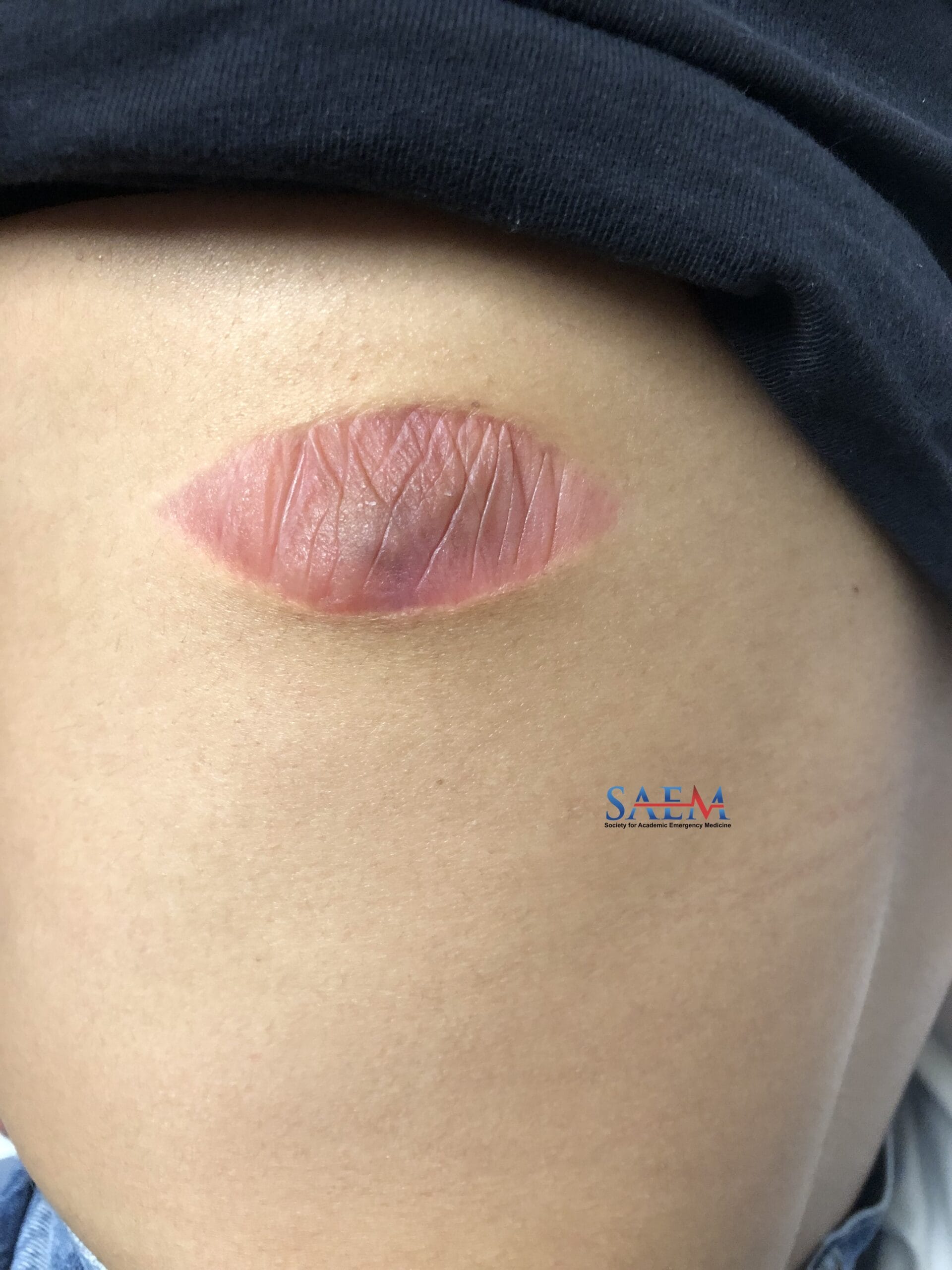
An 18-year-old-female with no known past medical history presented with a lesion on her back that had been present and enlarging for five months. It was not painful unless she touched it, and then only mildly tender. She denied any known cause, wound, prior rash, or other lesions. Her review of systems and past medical history were negative.

Vitals: Normal

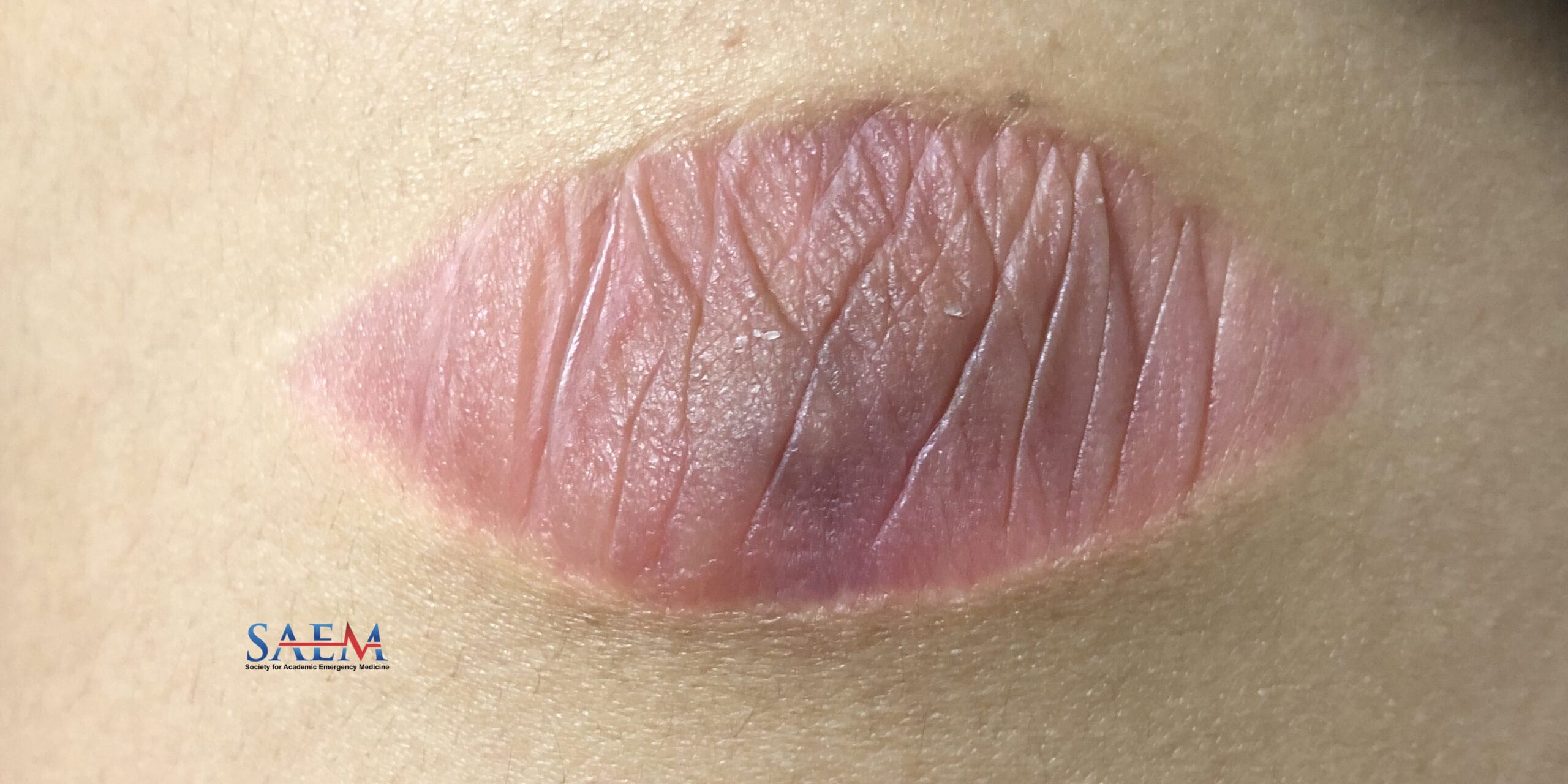
Skin: An erythematous lenticular, or biconvex, lesion with distinct borders is noted at the left posterior thorax below the scapula. It is soft with some slight nodularity on palpation, and only mild tenderness noted. There is no fluctuance. No other skin lesions are present. The rest of the examination is normal.

Ultrasound reveals a 1.7 x 0.8 x 1.1 cm superficial soft tissue mass inferior to the scapula on the left thorax.

CT scan of the chest confirms no intrathoracic extension or other lesions.

Biopsy is the next appropriate step. The lesion does not appear to be infectious, either viral, bacterial, or fungal. Furthermore, it has no appearance of an inflammatory reaction that would benefit from topical steroids. The differential includes a cystic structure, neurofibroma, or malignancy. Because of the concern for malignancy, a biopsy was performed in the emergency department after the ultrasound and CT scan confirmed there was no extension into the thorax. The biopsy revealed a pilomatrixoma, or pilomatricoma. Pilomatrixoma is a superficial benign skin tumor that arises from hair follicle matrix cells. They commonly occur in the first two decades of life with a mean age of 17 years. The most common presentation is an asymptomatic, firm, slowly growing mobile nodule. However, only 16% are accurately diagnosed on clinical examination. This case reveals the wide variation in visual presentation and confirms the inability to diagnose the lesion at the bedside. Complete surgical excision is curative.

Take-Home Points

  • Unknown skin lesions, with concern for malignancy, should be diagnosed by biopsy.
  • Pilomatrixoma is rarely diagnosed at the bedside.
  • Jones CD, Ho W, Robertson BF, Gunn E, Morley S. Pilomatrixoma: A Comprehensive Review of the Literature. Am J Dermatopathol. 2018 Sep;40(9):631-641. doi: 10.1097/DAD.0000000000001118. PMID: 30119102.

By |2024-01-28T21:32:23-08:00Feb 2, 2024|Dermatology, SAEM Clinical Images|

SAEM Clinical Images Series: My Shoulder Hurts

An 18-year-old male presents to the Emergency Department (ED) with right shoulder pain after wrestling with his brother. He heard a “pop,” and has been having pain along his right clavicle and shoulder since. He is unable to move his right shoulder. No numbness, tingling, or weakness in his arm or hand. No dysphagia, stridor, or shortness of breath. No medical or surgical history. He has no history of shoulder dislocation or fractures.

Vitals: HR 71; BP 139/77; RR 18; O2 sat 98% on RA

General: Uncomfortable appearing young man with his right arm held in adduction and internal rotation.

Respiratory: Clear breath sounds without stridor or shortness of breath.

CV: Heart is regular rate and rhythm without murmur, rub or gallop. Radial pulses are 2+ bilaterally, with brisk capillary refill.

MSK: Right shoulder without gross deformity. Right sternoclavicular joint is boggy, tender to palpation, and asymmetric when compared to the left. Limited active range of motion due to pain.

Neuro: Grip strength is 5/5 bilaterally, with intact motor and sensation demonstrated in the radial, median and ulnar distributions.

Shoulder and clavicular x-ray: No fracture or dislocation.

Point-of-care ultrasound: Clavicle (blue circle) posterior to the sternum (red square) at the sternoclavicular joint.

This is a posterior sternoclavicular dislocation. These dislocations are rare and are often the result of indirect lateral shoulder compression. It takes a high level of suspicion to diagnose as the physical exam and initial x-ray may be unrevealing. These patients require admission with emergent orthopedic consultation as there is a 30% chance of developing life-threatening complications due to damage of underlying structures including the trachea, esophagus, innominate artery and vein, and thoracic duct. Closed reduction in the operating room (OR) is typically the first line of treatment, with open reduction and internal fixation with cardiothoracic surgery consult available as the secondary treatment option.

CT with contrast is the imaging modality of choice, showing the sternoclavicular relationship in detail and allowing for evaluation of the underlying vascular and mediastinal structures. If unavailable, an oblique “serendipity view” x-ray may allow for better evaluation of the sternoclavicular joint than a standard shoulder or clavicle series. Additionally, point-of-care ultrasound can be an imaging modality that allows for quick and reliable bedside evaluation and diagnosis of sternoclavicular dislocation.

Take-Home Points

  •  Consider posterior sternoclavicular dislocation for those with traumatic shoulder or clavicular pain, particularly when the initial x-ray is unrevealing.
  • Posterior sternoclavicular dislocation can have subtle exam findings that are easily missed if a high level of suspicion is not maintained.
  • Posterior sternoclavicular dislocations can result in damage to underlying structures and require emergent orthopedic consultation for reduction in the OR with cardiothoracic backup available.

  • Bengtzen RR, Petering RC.Point-of-Care Ultrasound Diagnosis of Posterior Sternoclavicular Joint Dislocation. The Journal of Emergency Medicine. (2017) Volume 52,(4) 513-515. https://https://doi.org/10.1016/j.jemermed.2016.11.001.
  • Deren ME, Behrens SB, Vopat BG, Blaine TA. Posterior sternoclavicular dislocations: a brief review and technique for closed management of a rare but serious injury. Orthop Rev (Pavia). 2014 Mar 12;6(1):5245. doi: 10.4081/or.2014.5245. PMID: 24744842; PMCID: PMC3980158.
  • Grantier III RL, Craddock P. Recanting Impressions: Posterior Sternoclavicular Joint Dislocation. EMResident, Published 2018 June 6.
  • Roepke C, Kleiner M, Jhun P, Bright A, Herbert M. Chest Pain Bounce-Back: Posterior Sternoclavicular Dislocation. Ann Emerg Med. 2015 Nov;66(5):559-61. doi: 10.1016/j.annemergmed.2015.09.015. PMID: 26497437.

By |2023-03-18T23:11:47-07:00Mar 20, 2023|Orthopedic, SAEM Clinical Images|
Go to Top