

About Joshua Kern, MD

Attending Physician
Assistant Professor
UT Southwestern Medical Center

SAEM Clinical Images Series: Tropical Rash
rash

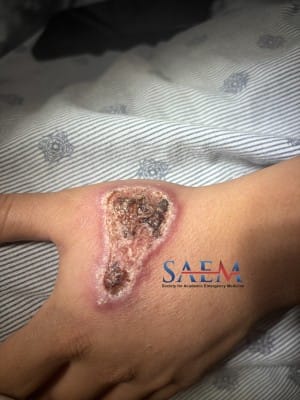
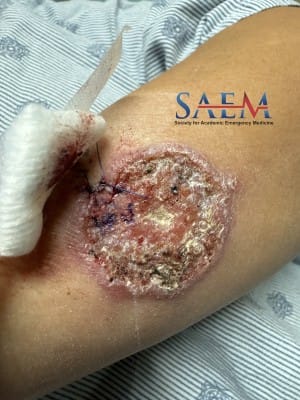
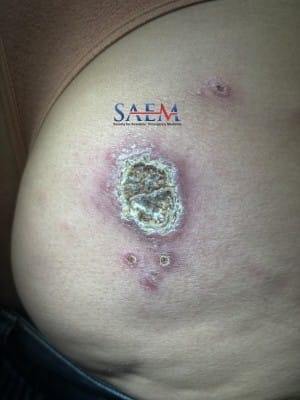
The patient is a 30-year-old female with no past medical history who presents to the Emergency Department with 2 months of non-healing ulcers on multiple parts of her body. She reports getting bitten by flies while traveling in wooded trails from Venezuela through Mexico. She reports the bites started as small scabs that have since enlarged, but they are non-painful or pruritic. She has ulcerative lesions on her left hand, right arm, back, and gluteal areas. She has taken multiple antibiotics from a doctor in Mexico including clindamycin, ceftriaxone, nitrofurantoin, flagyl, and doxycycline. She denies any fevers, chills, nausea, vomiting, weight loss, or night sweats, but given the persistence of the lesions, she comes in for evaluation.
Vitals: BP 143/91 HR 60 R 17 T 98.4 O2sat 100% room air.

General: Well-appearing, breast-feeding her child.

HEENT: Oropharynx is clear, moist mucous membranes, nares clear.
Cardiovascular: Regular rate and rhythm, no murmur.

Skin: There are multiple lesions as shown in the images provided. These
are annular ulcerated pink plaques with erythematous indurated borders
and are located diffusely. The larger lesion shown is on her right arm and
is newer than the other lesions shown on her hand and trunk.

CBC: WBC: 7.6 Hgb 12.2

CRP: 0.3

Hep C/HIV/syphilis/GCCT: negative

This patient has cutaneous leishmaniasis.

Cutaneous leishmaniasis (CL) is caused by the protozoan parasite Leishmania and is transmitted through the bite of an infected female sandfly. CL is commonly diagnosed in travelers and immigrants who are susceptible to exposure. The lesions of CL usually begin as small erythematous papules that increases in size and eventually ulcerate and crust over. Lesions generally have distinct borders that are raised and erythematous. The diagnosis can be made based on travel history, lesion appearance, skin biopsy, and serology. Without treatment, the ulcers heal slowly but can leave disfiguring scars. Treatment modalities include pentamidine, amphotericin B, antimoniate, paromomycin, imiquimod, thermotherapy and cryotherapy. Visceral leishmaniasis (VL) is the most serious form of infection and is almost always fatal if untreated. With VL, the parasites directly infect organs including the spleen, liver, bone marrow, and other viscera. Common signs and symptoms of VL include fever, weight loss, fatigue, weakness, night sweats, hepatosplenomegaly, and pancytopenia.

Take-Home Points

  • Cutaneous Leishmaniasis should be suspected in travelers who have been to endemic areas and present with non-healing skin ulcerations. Visceral Leishmaniasis is the most severe form of disease and carries an extremely high mortality rate if untreated.
  • The vector for this disease is the sandfly; diagnosis is made through skin biopsy and direct microscopy of the parasite.

1. Eiras DP, Kirkman LA, Murray HW. Cutaneous Leishmaniasis: Current Treatment Practices in the USA for Returning Travelers. Curr Treat Options Infect Dis. 2015;7(1):52-62. doi:10.1007/s40506-015-0038-4

2. Chappuis, F., Sundar, S., Hailu, A. et al. Visceral leishmaniasis: what are the needs for diagnosis, treatment and control?. Nat Rev Microbiol 5, 873–882 (2007). https://doi.org/10.1038/nrmicro1748
By |2025-10-27T08:26:58-07:00Oct 3, 2025|Dermatology, SAEM Clinical Images|

SAEM Clinical Images Series: What’s Coming Out of Your Eye?

open globe

A 32-year-old male with no significant past medical history presented to the emergency department (ED) from an outside hospital for further management of right eye pain and vision loss sustained after he was struck by a metal wire while at work. The patient presented to an outside “eye doctor” and was told to go to the nearest hospital for evaluation. At the outside hospital, he was given analgesia, antiemetics, and a tetanus booster, and transferred to our hospital for ophthalmologic evaluation. On arrival to our emergency department, the patient expressed continued eye pain with bloody discharge as well as blurry vision from his right eye. He had no other complaints and denied any other trauma or loss of consciousness during the event.

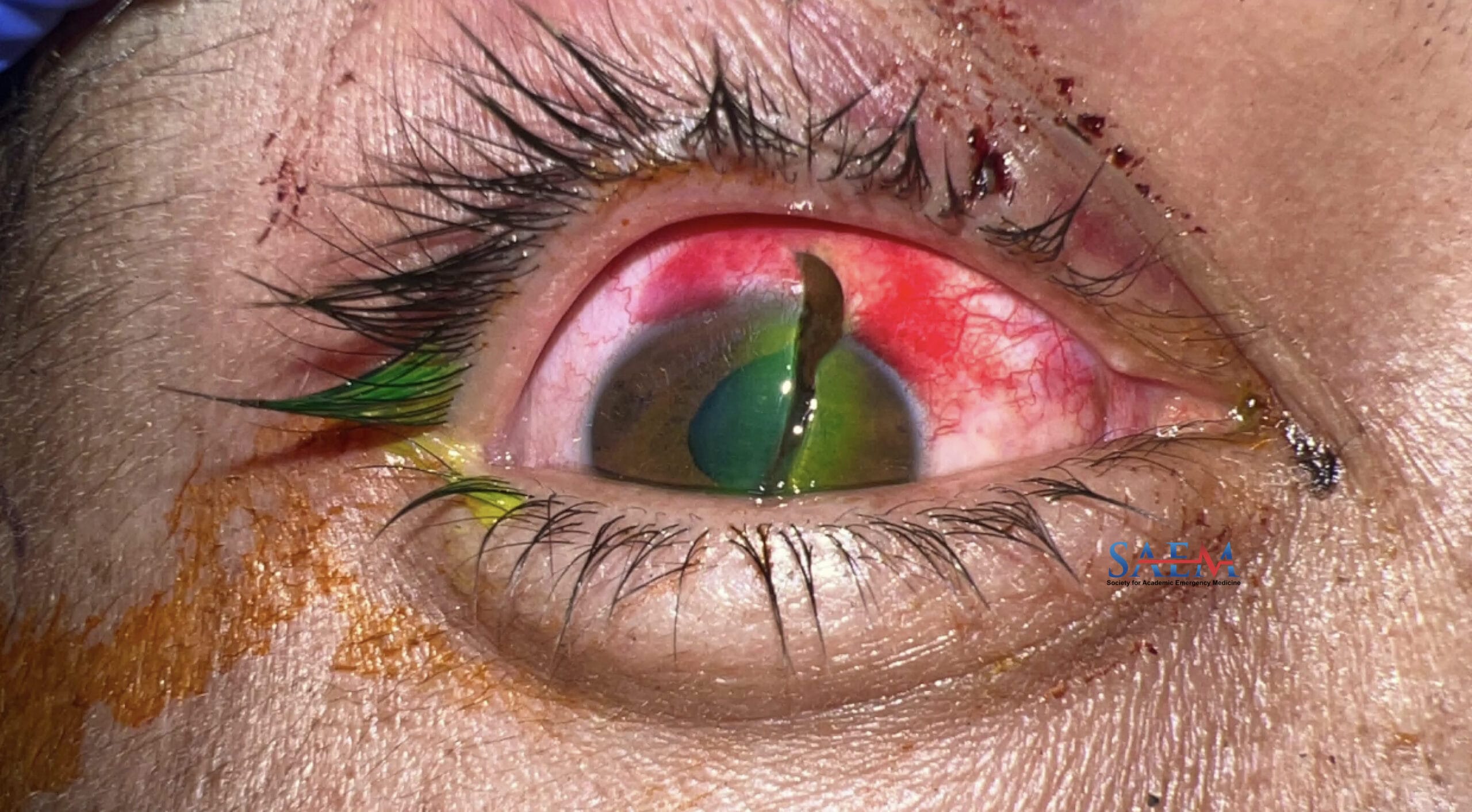
Right Eye: 12 mm corneoscleral laceration with superior iris prolapse through the laceration at the 12 o’clock position, approximately 6 mm in length. Pupil 3 mm, teardrop shaped, and reactive without relative afferent pupillary defect. Seidel test positive on fluorescein stain. Conjunctival injection superiorly. Visual acuity: able to count fingers. Extraocular movements intact. Ocular pressure deferred. 1 mm superior eyelid laceration.

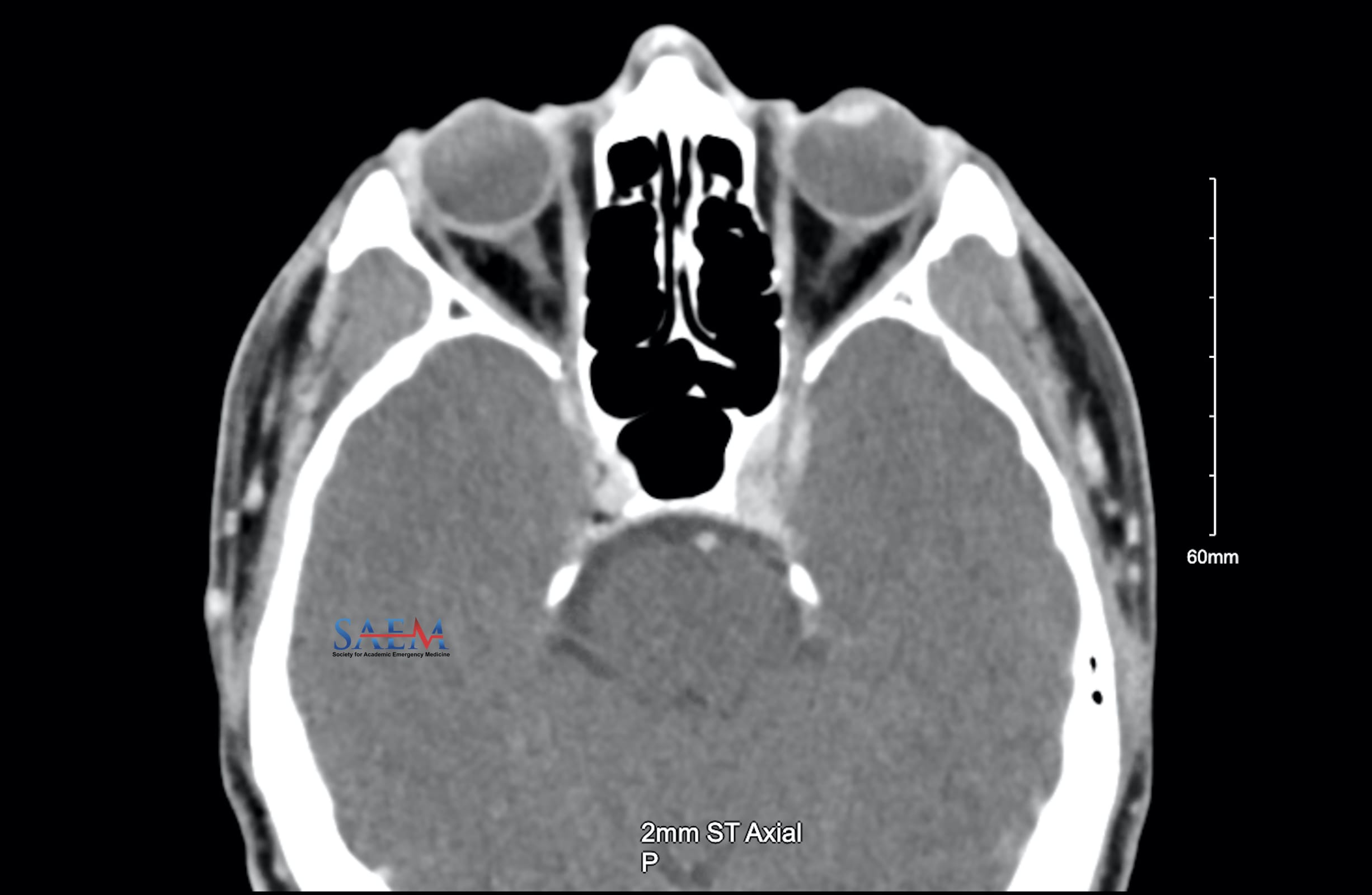
CT Orbits/Sella w/ IV Contrast: No acute orbital fracture. No evidence of retrobulbar hematoma or emphysema. Intraconal and extraconal fat planes are preserved. Extraocular muscles are symmetric and normal in position. The globes are grossly unremarkable. Absent right lens.

Open Globe Injury

In the photo, you can see the teardrop shape of the pupil, conjunctival injection, corneal laceration, and superior iris prolapse.

Tonometry and ocular ultrasound (US) are generally not recommended as you could squeeze more liquid out of the eye or increase the intraocular pressure even more, pushing the iris further out. An emergent ophthalmology consult is needed to plan for operative repair. The patient should be given an eye shield, IV antibiotics, and tetanus prophylaxis. Avoid increasing intraocular pressure by using anti-emetics, analgesia, and bed elevation. Recommended antibiotics are vancomycin and a third-generation cephalosporin to prevent endophthalmitis. Postoperatively, these patients need IV antibiotics x 48 hours, steroid eye drops, antibiotic ointment, an eyepatch, and recommendations for no heavy lifting, bending, or strenuous activity, and head of bed should be elevated at 45 degrees.

Take-Home Points

  • Open globe injuries present as eye pain, vision loss, teardrop pupil, afferent pupillary defect, and a corneal laceration.
  • Avoid ocular US or tonometry in these patients as these could increase intraocular pressure further and worsen the injury.
  • Management includes an eye shield, head of bed elevation, avoiding ocular manipulation, analgesia, and antiemetics. Update tetanus and start IV antibiotics – vancomycin and a third-generation cephalosporin. Consult ophthalmology emergently.
  • Open globe injury: Assessment and preoperative management. American Academy of Ophthalmology. (2023, March 23). https://www.aao.org/eyenet/article/open- globe-injury
  • Ahmed Y, Schimel AM, Pathengay A, Colyer MH, Flynn HW Jr. Endophthalmitis following open-globe injuries. Eye (Lond). 2012 Feb;26(2):212-7. doi: 10.1038/eye.2011.313. Epub 2011 Dec 2. PMID: 22134598; PMCID: PMC3272210.

By |2024-09-06T22:03:57-07:00Sep 13, 2024|Ophthalmology, SAEM Clinical Images|
Go to Top