About Michelle Lin, MD

ALiEM Founder and CEO
Professor and Digital Innovation Lab Director
Department of Emergency Medicine
University of California, San Francisco

Work in progress: Poster on blogging

I need your help with a project!

My poster on blogging was accepted to the annual UCSF Academy of Medical Educator’s Education Day. Feelings of joy and validation were quickly followed by terror and inadequacy.

In order to get my poster costs reimbursed, I have to get feedback from my co-authors and incorporate that feedback into the poster. As you can see from the poster title on top, I have no co-authors! Since you are all my virtual co-authors, I thought I’d solicit for comments and suggestions.

(more…)

By |2017-03-05T14:18:34-08:00Mar 16, 2010|Medical Education, Social Media & Tech|

Article review: ED crowding and education

HeartStopsm

“The effect of ED crowding on education”

My heart almost stopped when I read this article title in Amer J of Emerg Med. This was the premise of my recently completed study – using a prospective, time-motion methodology. I’m in the process of writing the manuscript. Did I get scooped by my friends at U Penn?

Whew. Fortunately, no. Different methodology.

This study was a cross-sectional study looking at learner assessment of education, using a validated tool called the ER (Emergency Rotation) Score. The results are interesting.

The problem

We know that ED crowding negatively impacts clinical care. How does it impact our teaching of medical students and residents? The ED is traditionally known as a great place for learning how to resuscitate high-acuity patients, to manage and risk-stratify undifferentiated cases, and to perform procedures. Experientially, I feel like I teach less when it gets extremely crowded.

Methodology

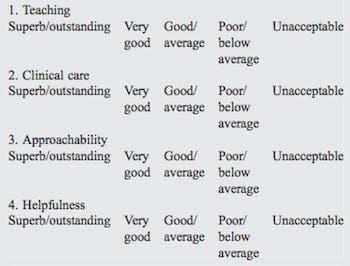
Over a 5-week period, 43 residents and 3 medical students prospectively assessed 34 attendings using a simple ER Score tool. There were 352 separate encounters. This validated tool assessed the attending based on 4 domains (teaching, clinical care, approachability, helpfulness) with each domain assessed on a 5-point scale. The scores were correlated with crowding measures (waiting room number, occupancy rate, number of admitted patients, and patient-hours).

ERScoresm
ER Score tool

What was their enrollment scheme?

Upon arrival, the research assistant selected the patient with the most recent admission order where the learner-attending pair was still present in the ED. The learner was asked to fill out the ER Score tool. For each admitted patient case, the research assistant also enrolled a non-admitted patient with a similar triage intake time. The learner for this non-admitted case was also asked to fill out the ER Score tool. The study group intentionally structured this methodology to oversample admitted patients, which they assumed impacted education more than non-admitted patients.

Results

The median score was 16 of 20. ED crowding levels were NOT associated with ER scores or their individual domains.

How fascinating that learners still felt that the quality of teaching and learning in the ED was maintained despite the ED being overwhelmed beyond capacity.

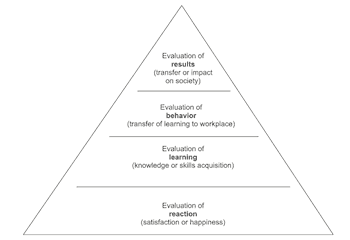
The next step is to follow Kirkpatrick’s model in conducting educational research. In this model, satisfaction/reaction-based studies are the first (lowest) tier. Such studies inherently have flaws based on bias, recall, and halo effect. The next study is to look at more objective measures assessing the impact of crowding on education. Hmm, I better get going on my manuscript.

Kirkpatrick.jpgKirkpatrick’s 4-tiered model to evaluate training and education

Reference
Pines JM, Prabhu A, McCusker CM, Hollander JE. The effect of ED crowding on education. Amer J Emerg Med (2010) 28, 217–220.


By |2016-11-11T19:01:31-08:00Mar 15, 2010|Education Articles, Medical Education|

Paucis Verbis card: Hyperkalemia management

Hyperkalemia is a common presentation in the Emergency Department, especially in the setting of acute renal failure. In one shift, I had 4 patients with hyperkalemia! All had from some form of renal failure.

This installment of the Paucis Verbis (In a Few Words) e-card series reviews the treatment options for hyperkalemia.

PV Card: Hyperkalemia


Adapted from [1]
Go to ALiEM (PV) Cards for more resources.

Reference

  1. Weisberg L. Management of severe hyperkalemia. Crit Care Med. 2008;36(12):3246-3251. [PubMed]
By |2021-10-19T19:04:37-07:00Mar 12, 2010|ALiEM Cards, Endocrine-Metabolic|

EM blogger roll call

BlogHow do I keep up with the information from the myriad of Emergency Medicine websites out there? Blogs, Twitter, Journals, oh my.

Thanks to LifeInTheFastLane, you can check out all the current EM bloggers out there with their Twitter name and RSS feed links! I had no idea there were so many. I can appreciate how much time and effort it took to compile this list. Fantastic job, guys.

(more…)

By |2016-11-11T19:01:33-08:00Mar 9, 2010|Social Media & Tech|

Paucis Verbis card: Aneurysmal subarachnoid hemorrhage

Atraumatic subarachnoid bleeds are most commonly caused by ruptured intracranial aneurysms.

This installment of the Paucis Verbis (In a Few Words) e-card series reviews the current management, knowledge, and challenges in aneurysmal subarachnoid hemorrhage (SAH).

PV Card: Subarachnoid Hemorrhage


Adapted from [1]
Go to ALiEM (PV) Cards for more resources.

Reference

  1. Edlow J, Malek A, Ogilvy C. Aneurysmal subarachnoid hemorrhage: update for emergency physicians. J Emerg Med. 2008;34(3):237-251. [PubMed]
By |2021-10-19T19:03:54-07:00Mar 5, 2010|ALiEM Cards, Neurology|

Trick of the trade: Irrigation scalp wound photos

I mentioned from an earlier post about building a “head basin” for collecting irrigation fluid prior to wound closure. This basin prevents a deluge of fluid from soaking the gurney sheets and patient.

I finally managed to capture this trick in action, while a student was irrigating an eyebrow laceration.

Pearl

When cutting out a semi-circular or rectangular hole in the basin, be sure that there remains a 2-4 inch lip at the bottom to ensure that fluid can collect in the basin.

By |2019-02-19T18:53:55-08:00Mar 3, 2010|Tricks of the Trade|
Go to Top