About Michelle Lin, MD

ALiEM Founder and CEO
Professor and Digital Innovation Lab Director
Department of Emergency Medicine
University of California, San Francisco

Article review: Conference attendance ≠ better test scores

AppleUniqueNot all learners should be expected to have the same learning style.

This is exemplified in a recent multicenter study, which addresses whether attendance at weekly residency conferences correlates with a better in-service training examination (ITE) score. The ITE score was used as an outcome measure, because it correlates with the resident’s likelihood for passing the official ABEM Board Exams. Both tests draw from questions in the Model of the Clinical Practice of Emergency Medicine.

(more…)

By |2019-02-19T18:59:55-08:00Jan 11, 2010|Medical Education|

Paucis Verbis card: TIA prognosis

Stroke

Here is another installment of the Paucis Verbis (In a Few Words) e-card series on the topic of Transient Ischemic Attacks (TIA) from EM Clinics of North America. I use this card a lot specifically for the ABCD2 risk-stratification score.

PV Card: Transient Ischemic Attacks


Adapted from [1]
Go to ALiEM (PV) Cards for more resources.

Reference

  1. Ross M, Nahab F. Management of transient ischemia attacks in the twenty-first century. Emerg Med Clin North Am. 2009;27(1):51-69, viii. [PubMed]
By |2021-10-19T19:18:21-07:00Jan 8, 2010|ALiEM Cards, Neurology|

Trick of the Trade: Finger nailbed laceration repair

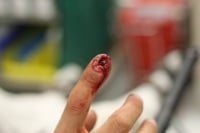
LacFingernailsmOver the years, I have been frustrated by how inelegant finger nailbed closure is. Nailbed lacerations are often sustained by a major crush injury, resulting in a stellate and irregular laceration pattern. This typically also requires the crushed fingernail to be removed. Cosmesis is never ideal because pieces of the nailbed are often missing, as seen in the photo above.

Occasionally, nailbed lacerations are caused by a cutting rather than a crush mechanism. In these cases, I use a different technique. I leave the fingernail on. In fact, I use the fingernail to help reapproximate the nailbed edges.

(more…)

By |2016-11-11T19:01:44-08:00Jan 6, 2010|Orthopedic, Tricks of the Trade|

Top 10 tips when making your rank list

MakingList“How do I decide how to order the residency programs on my rank list?”

On Feb 24, 2010, every residency applicant will have a brief moment of panic as their rank list is submitted and officially certified.

Next week, I’ll be joining a group podcast with Dr. Rob Rogers (Maryland) and Dr. Dave Manthey (Wake Forest) for the next installment of EMRAcast. This new podcast series was created by Rob for EMRA for the specific purpose of providing advice to medical students. I still find it fascinating how much you can get done virtually. We’ll all be using Skype from our respective offices and recording our conversation.

(more…)

By |2019-02-19T18:08:25-08:00Jan 5, 2010|Medical Education|

Article review: Service versus education

ERwaitingroomIt’s a busy day in the Emergency Department and there are 5 new patients to be seen. The waiting room is overflowing. As the attending, you are getting barraged with a million questions to answer and problems to fix.

There is also a case of a full-thickness burn patient going to the OR in the next few minutes. She’d be a perfect teaching case for the residents.

Should I have the residents go see the new patients, or should I pull them all aside to show them the physical findings and teach about burns for 5-10 minutes?
(more…)

By |2016-11-11T19:01:45-08:00Jan 4, 2010|Education Articles, Medical Education|

Paucis Verbis Card: CNS Infections

PV Card: CNS Infections

Here is another installment of the Paucis Verbis (In a Few Words) e-card series on the topic of CNS infections from EM Clinics of North America 2009.


Adapted from [1]
Go to ALiEM (PV) Cards for more resources.

Reference

  1. Somand D, Meurer W. Central nervous system infections. Emerg Med Clin North Am. 2009;27(1):89-100, ix. [PubMed]
By |2021-10-19T19:19:54-07:00Dec 29, 2009|ALiEM Cards, Infectious Disease, Neurology|
Go to Top