About Michelle Lin, MD

ALiEM Founder and CEO
Professor and Digital Innovation Lab Director
Department of Emergency Medicine
University of California, San Francisco

Article Review: Learning assessment using virtual patients

emergency

I am developing a new microsimulation module to help EM clerkship students gain a more realistic exposure to high-acuity patients. Emergent conditions, such as ectopic pregnancy, acute tricyclic overdose, and ST elevation MI, are usually cared for by senior residents and attendings. Rarely are students primarily involved in these cases.

(more…)

By |2016-11-11T19:01:51-08:00Nov 16, 2009|Education Articles, Medical Education|

A radiology pearl: A subtle orthopedic diagnosis

A man recently presents with knee pain after pivoting and torquing his knee while falling. He complains of concurrent mild ankle pain. He presents with this tib-fib xray. Realizing that a proximal fibular fracture can present concurrently with a medial malleolus fracture or deltoid ligament rupture, we obtained xrays of the ankle. We were looking for a Maisonneuve fracture.

Do you see an ankle injury in these four images?

(more…)

By |2016-11-11T19:01:52-08:00Nov 13, 2009|Orthopedic, Radiology|

Article review: How do you assess the quality of educational research articles?

Imagine this. You are about to conduct an innovative educational project and want to get a research publication out of it. What are considered strong methodological qualities of an educational research study? What can you do to improve your chances for publication?

The authors in this study developed and use an instrument to help measure the methodological quality of quantitative studies in medical education. This instrument, the Medical Education Research Study Quality Instrument (MERSQI), was used to show that scores were predictive of manuscript acceptance into the 2008 Journal of General Internal Medicine (JGIM) special issue on medical education.

What is the MERSQI instrument?
The 10-item MERSQI instrument can be divided into 6 domains, each with a maximum score of 3 points. Numbers within parenthesis denote the number of different items assessed in that domain. The maximum score is 18.

  • Study design
  • Sampling (2)
  • Type of data
  • Validity of evaluation instrument (3)
  • Data analysis (2)
  • Outcomes

The specific scoring criteria are seen in this table below, from an earlier publication on the MERSQI instrument (Reed DA et al, Association between funding and quality of published medical education research. JAMA. 2007;298(9):1002-1009). This earlier publication showed that a high MERSQI score correlated with successful funding of the study.

MERSQI scoring criteria (3 points per domain)
Click to enlarge table image.


So what garners a perfect MERSQI score of 18?

  • A randomized controlled trial conducted at over 2 institutions
  • A response rate of >75%
  • Data assessment was done using an objective measure (not self-assessment by study participant)
  • When using an evaluation instrument, internal structure validity, content validity, and criterion validity are reported.
  • The data is analyzed appropriately and goes beyond just descriptive analysis.
  • The outcome measure goes beyond simple survey measures and focuses on instead patient/health care outcomes.

Getting a perfect score of 18 is extremely difficult, as evidenced in this article. In the 100 submitted manuscripts to JGIM, the mean MERSQI score was 9.6 (range 5-15.5). Most manuscripts were single-group cross-sectional studies (54%), conducted at a single institution (78%). Few (36%) reported validity evidence for their evaluation instruments.

The mean total MERSQI score of accepted manuscripts was significantly higher than rejected manuscripts (p=0.003).

  • Mean score for ACCEPTED manuscript = 10.7
  • Mean score for REJECTED manuscript = 9.0

I have found the MERSQI scoring instrument extremely helpful in helping me design my educational research studies. Methodologic rigor is almost always the Achilles heel of rejected educational research submissions.

Reference

Reed DA, Beckman TJ, Wright SM, et al. Predictive validity evidence for medical education research study quality instrument scores: quality of submissions to JGIM’s Medical Education Special Issue. J Gen Intern Med. 2008 Jul;23(7):903-7.

By |2016-10-26T17:05:40-07:00Nov 9, 2009|Education Articles, Medical Education|

Trick of the Trade: Easy ocular application of fluoroscein

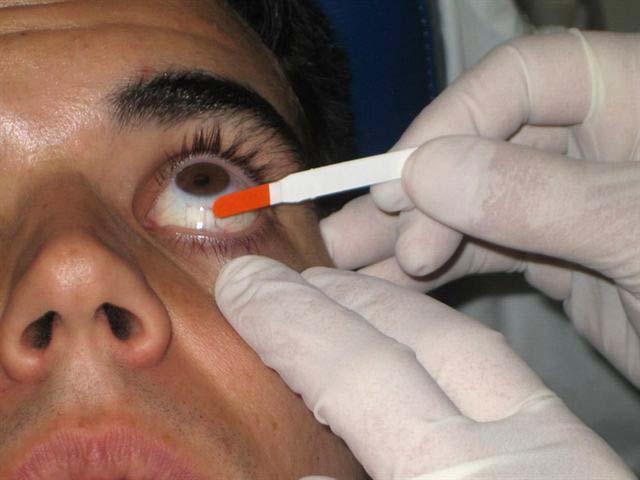
Fluorescein-1Gently instilling a fluorescein drop into a patient’s eye requires that the patient keep his/her eye still. What do you do for a patient who can’t quite stay still enough, such as an infant? This is an innovative trick of the trade, written by Dr. Sam Ko (Loma Linda EM resident) and Kimberly Chan (Loma Linda medical student).

(more…)

By |2016-11-11T19:01:53-08:00Nov 4, 2009|Ophthalmology, Tricks of the Trade|

Trick of the Trade: Super-sensitive to eyedrops

CornealUlcer-largeWe commonly encounter ocular complaints in the Emergency Department. Eye pain can result from chemical exposure, a foreign body, or infection. The first step involves instilling a few drops of topical anesthetics, such as proparacaine, to provide some pain relief. Occasionally, however, you encounter a patient who just can’t keep his/her eye open because of the fear of eyedrops.

(more…)

By |2016-11-11T19:01:54-08:00Oct 28, 2009|Ophthalmology, Tricks of the Trade|

Article review: Bedside teaching in the ED

Bedside teaching is a unique educational skill, which academic faculty are often assumed to just know how to do. In the ED, it is especially difficult to do this well, because of crowding and unexpected time-sensitive clinical issues, which create distractions and general chaos. Experientially, unpredictable clinical issues negatively impact bedside teaching. Thus, faculty should be flexible and knowledgeable of basic bedside teaching tenets.

(more…)

By |2016-10-26T17:05:40-07:00Oct 26, 2009|Education Articles, Medical Education|
Go to Top