


SAEM Clinical Images Series: Dermatology Deserving a Deeper Dive

A 22-year-old female without significant past medical history presented to the Emergency Department (ED) for a progressive rash for the past six months. She had initially complained of dry and peeling skin on bilateral hands and feet and had multiple ED and dermatology encounters where topical steroids, acyclovir, and methotrexate were prescribed with no improvement. The rash continued to progress with worsening pain and inability to flex fingers secondary to lesions and scabbing at the joints. The patient also developed painful sores in her mouth primarily involving the tongue. More concerningly, she had lost 60 pounds since the onset of the rash and mouth lesions which she attributed to the inability to eat due to significant pain. Otherwise, she denied systemic symptoms, exposures, new medications, or previous illnesses.
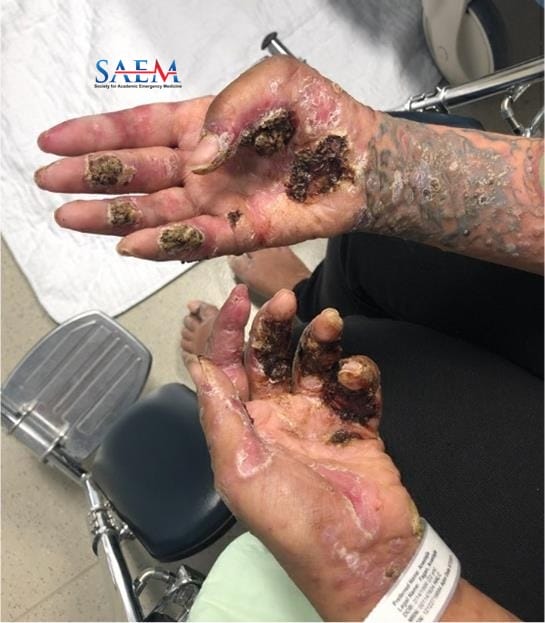
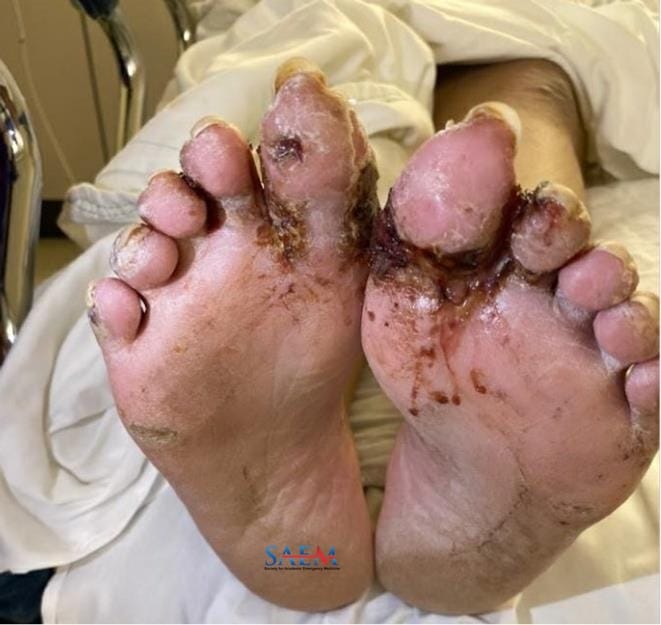
Vitals: Within normal limits
HEENT: Swelling, erythema, and mild desquamation of the tongue mucosa with adherent white discharge present. Lesions are limited to the surface of the tongue with no buccal involvement.
Cardiovascular/Respiratory: Heart sounds within normal limits. Bilateral breath sounds without wheezes, rales, or rhonchi.
Abdomen: Soft, non-tender and non-distended.
Skin: The patient was noted to have desquamated, scabbing and oozing lesions on bilateral palms and fingers, soles of the feet, and web spaces between toes. The patient had no observable vesicles/bullae, or target lesions. Negative Nikolsky sign.
Complete Blood Count (CBC): Mild anemia, stable from baseline.
Basic Metabolic Panel (BMP): Within normal limits.
CT Abdomen/Pelvis with contrast (relevant findings only): Large solid right retroperitoneal mass lobulated in contour with heavy coarse calcifications measuring 21.2 x 8.5 x 10.4 cm, traversing the right hemidiaphragm and extending to the right lower mediastinum. The diaphragm itself is asymmetrically thickened as compared with the contralateral left side with a small volume of adjacent retroperitoneal fluid and there is extension into the right neural foramina.
The diagnosis of paraneoplastic pemphigus (PNP) was made after skin biopsy along with the constellation of findings including desquamating cutaneous lesions, painful mucosal erosions, and large retroperitoneal mass concerning for malignancy. Skin biopsy findings in this case include a distinct suprabasilar cleft, apoptotic keratinocytes, eosinophilic spongiosis, and superficial perivascular lymphocytic infiltrate with scattered eosinophils. Focally, there was full-thickness necrosis of the epidermis and dermis.
Patients with concern for PNP without known malignancy require a full neoplastic workup. In this case, a biopsy of the retroperitoneal mass and subsequently full resection was notable for Castleman’s disease, a rare lymphoproliferative disorder. PNP is an often fatal paraneoplastic mucocutaneous blistering disease that is most commonly caused by various lymphoproliferative disorders including non-Hodgkin’s lymphoma, chronic lymphocytic leukemia (CLL), and Castleman’s disease. It is an extremely rare condition with an unknown incidence rate. The mucosal erosions present are a requirement for the diagnosis. It typically presents as an erosive stomatitis involving the tongue and is characteristically chronic, progressive, and painful. These lesions are the initial disease manifestation in almost one-half of patients with PNP and often lead to malnutrition secondary to pain with attempts at oral intake. The cutaneous lesions in the disease are widely variable in morphology and can present with tense or flaccid bullae, as well as inflammatory papules or plaques.
Take-Home Points
- In patients with a progressive rash involving the oral mucosa that have failed multiple outpatient regimens and have findings concerning for possible systemic involvement, dermatology consultation, tissue biopsy, and body imaging are often needed to confirm a diagnosis of complicated disease processes such as paraneoplastic pemphigus (PNP).
- Significant unintentional weight loss may be due to a variety of reasons stemming from one unifying etiology. In this case, our patient had both mouth pain limiting oral intake as well as a lymphoproliferative disorder.
- Anhalt GJ, Kim SC, Stanley JR, Korman NJ, Jabs DA, Kory M, Izumi H, Ratrie H 3rd, Mutasim D, Ariss-Abdo L, et al. Paraneoplastic pemphigus. An autoimmune mucocutaneous disease associated with neoplasia. N Engl J Med. 1990 Dec 20;323(25):1729-35. doi: 10.1056/NEJM199012203232503. PMID: 2247105.
- Kaplan I, Hodak E, Ackerman L, Mimouni D, Anhalt GJ, Calderon S. Neoplasms associated with paraneoplastic pemphigus: a review with emphasis on non-hematologic malignancy and oral mucosal manifestations. Oral Oncol. 2004 Jul;40(6):553-62. doi: 10.1016/j.oraloncology.2003.09.020. PMID: 15063382.

