


Trick of the Trade: A Fast Exit Strategy for the TACO Method in Heat Stroke Resuscitation
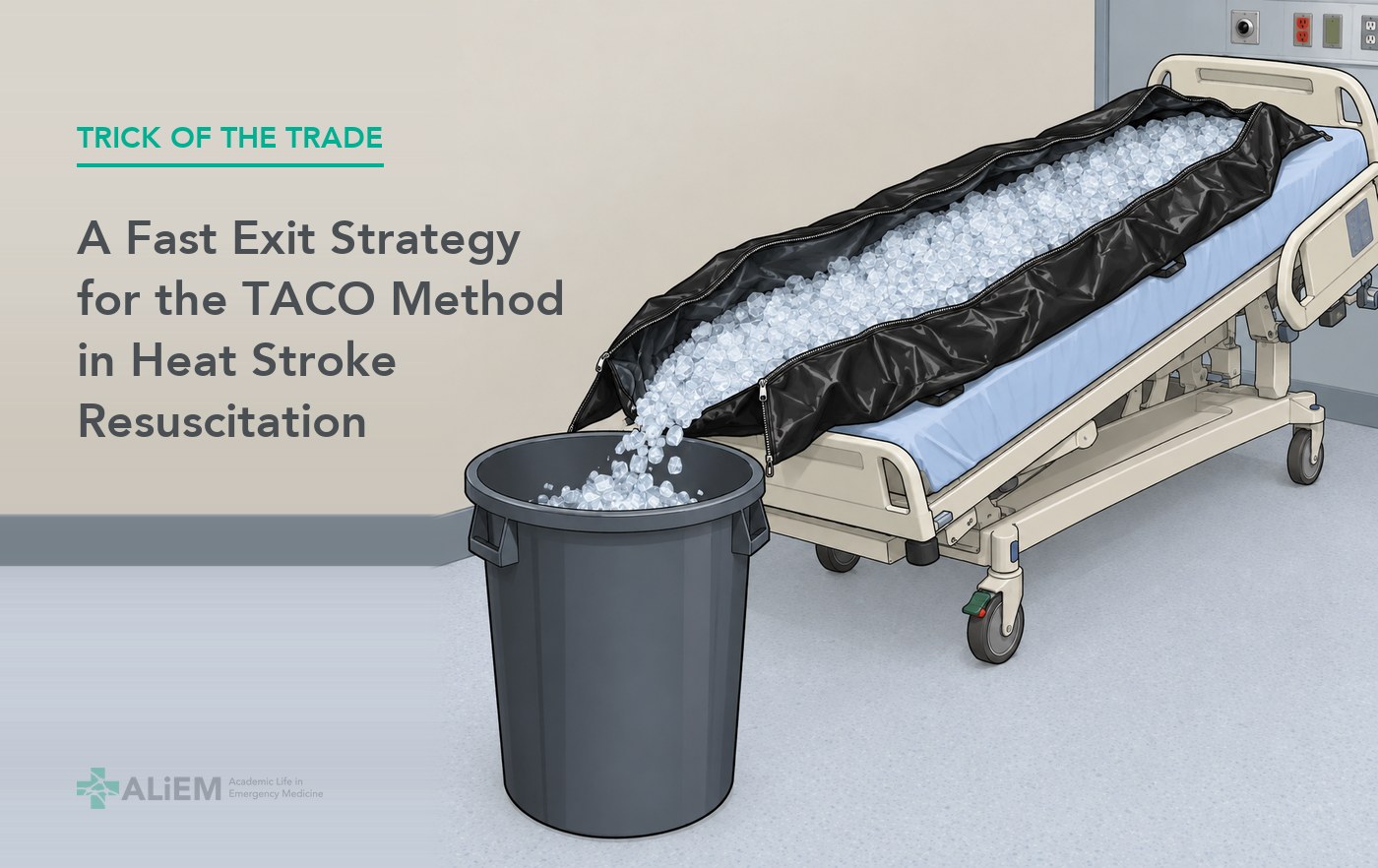
An unidentified male presents to the emergency department via ambulance after being found unresponsive in the heat. His initial rectal temperature is 108°F (42.2°C), and his GCS is 4 for nondescript groaning. The team quickly secures the airway and places a temperature-sensing urinary catheter while ice arrives from the cafeteria. They start rapid cooling, the cornerstone of heat stroke management, with the Tarp-Assisted Cooling with Oscillation (TACO) method and reach 102°F (38.9°C) quickly [1,2]. After a brief sigh of relief, another problem arises: how do you rapidly stop the cooling process to avoid overshooting into hypothermia?
The team now faces several logistical challenges in this common but time-sensitive scenario, including the management of multiple points of unwieldy but critical tubing while moving the patient, minimizing spillage of contaminated water, and, most importantly, preventing hypothermia. Most cooling protocols focus on how to start cooling by immersion, and not so much on how to end it. Our quick and simple trick adds one vital tool: gravity.
Trick of the Trade
Tilt the bed foot-down, cut open the foot of the body bag, and let gravity drain the ice-water slurry into a trash bin.
Materials
- Disposable body bag, used as the TACO immersion vessel
- Large trash bin
- Trauma shears
- Towels
Steps
- Perform TACO in a disposable body bag. While cooling is underway, place a large trash bin at the foot of the bed.
- Once core temperature reaches 102°F (38.9°C), raise the bed to maximum height.
- Place the bed in reverse Trendelenburg, so the foot of the bed tilts down.
- Use trauma shears to cut across the foot of the body bag. Be careful of the patient’s toes!
- Have the team push the ice-water slurry into the bin, with gravity to assist.
- When most of the ice water is in the bin, towel-dry the patient.
In our case, the patient was dry in less than 2 minutes and never became hypothermic. The team could then remove the body bag and reposition the patient safely, without the time pressure.
Tips
- Time-saving maneuver: if the patient needs an airway before cooling, place the temperature-sensing urinary catheter while intubation is underway.
- Continuous core temperature monitoring allows early recognition of when to stop active cooling.
- Reverse Trendelenburg lets gravity assist with rapid evacuation. This buys time later to reposition the patient carefully and avoid accidental removal of critical lines and tubes.
Read more from the Tricks of the Trade series.
References
- Luhring KE, Butts CL, Smith CR, et al. Cooling effectiveness of a modified cold-water immersion method after exercise-induced hyperthermia. J Athl Train. 2016;51(11):946-951. doi: 10.4085/1062-6050-51.12.07
- Comp G, Pugsley P, Sklar D, et al. Heat stroke management updates: a description of the development of a novel in-emergency department cold-water immersion protocol and guide for implementation. Ann Emerg Med. 2025;85(1):43-52. doi: 10.1016/j.annemergmed.2024.07.013