SAEM/CORD slides: Social Media for Emergency Educators
As requested by an audience member at today’s talk at SAEM, Drs. Rob Cooney, Mike Bond, and I are sharing our slides and handout on Social Media for Emergency Medicine Educators with you here.



As requested by an audience member at today’s talk at SAEM, Drs. Rob Cooney, Mike Bond, and I are sharing our slides and handout on Social Media for Emergency Medicine Educators with you here.

Pediatrics, Syncope, Wolff Parkinson White (WPW), PALS
10 yo boy BIBEMS s/p syncope. Pt was playing on the football field, running down field when he suddenly collapsed. Bystanders quickly went to the boy and within 1 minute the pt had regained consciousness without any intervention. When EMS arrived on the scene, the boy was sitting with his mother telling everyone he wanted to go back and play.Upon arrival in the ED, pt is well appearing, however had a heart rate of 180 bpm and BP of 115/80. EKG shows a wide complex tachycardia rhythm. If team gives AV nodal blocking agents, the pt will devolve into a VF rhythm, and the pt will become nonresponsive. If team administers procainamide, pt will go into a rate controlled rhythm that reveals WPW and should then be placed on a procainamide drip. If team performs cardioversion, the pt will go into a rate controlled rhythm that reveals WPW. If the team does nothing, the pt will eventually go into a ventricular fibrillation cardiac arrest.
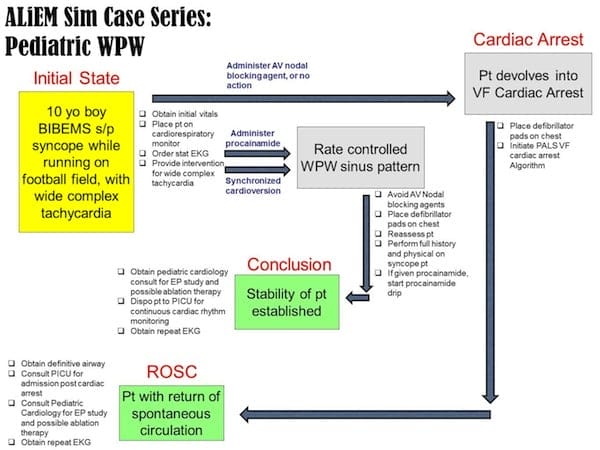
Download PDF of this flowchart
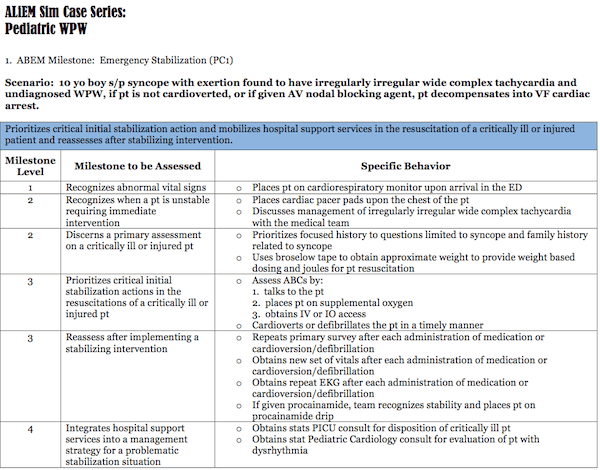
ED resuscitation bay
Translation |
| AV = atrioventricular |
| BIBEMS = brought in by EMS |
| BP = blood pressure |
| CXR = chest x-ray |
| HR = heart rate |
| IV = intravenous |
| LOC = loss of consciousness |
| neg = negative |
| RR = respiratory rate |
| pt = patient |
| s/p = status post |
| T = temperature |
| WPW = Wolff Parkinson White |
| US = ultrasound |
| VF = ventricular fibrillation |
| yo = year old |

Talking to colleagues is an essential skill especially as we advocate for our patients. We should not only know what’s going on with our patients, but also how to communicate our thoughts effectively and succinctly with our colleagues. In a great article by Dr. Chad Kessler et al 1 just published Academic Medicine, the authors state that although “communication skills may not develop naturally, [they] can be taught and fostered through evidence-based educational models.”
Have you ever created a simulation case with hidden objectives that the learners were not aware of? Would you ever purposefully try to trick or deceive learners in a simulation case?
Simulation can be used to reinforce clinical and procedural knowledge. It can teach important teamwork skills. It can also be used to learn about ourselves in morally and ethically challenging situations.

The app EMRA Basics of Emergency Medicine covers the 20 most common EM complaints in a concise manner. I first heard about it from Dr. Rob Orman’s (@emergencypdx) podcast (ERCast) where he endorsed it when it was only in book format. The book is great, thin, and it fits in a white coat pocket.
Here is an in-depth review of the app.
 Should the manikin ever die in a simulation scenario?
Effective simulations require suspension of disbelief and willingness by learners to play along with the game created by the facilitators. Without this buy-in, learners could argue against discrepancies, simply on the basis that the scenario is not real. Learners give their trust that the educators will also play the same game, and that the rules will not change.

The simulation scenario starts and things are going well. The learners are on their game. Instability – recognized, managed. Initial orders – done. And then it all falls apart. We’ve all been there.