Paucis Verbis: Right and posterior ECG leads

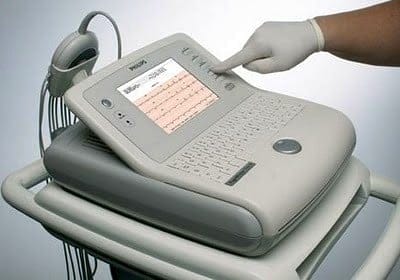
ECG EKG machine

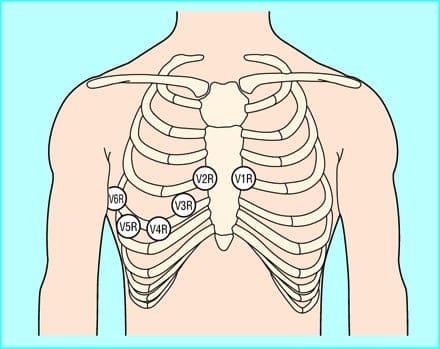
A standard 12-lead ECG can be very telling for patients with chest pain or shortness of breath. A right ventricular (RV) and posterior wall infarct, however, can present very subtly. You can obtain special right-sided (V1R-V6R) and posterior leads (V7-V9), if you are concerned. What are the indications for obtaining right-sided and posterior ECG leads?


Go to the ALiEM Cards for more resources.

Addendum 3/11/11:

Right sided ECG leads (V1R-V6R) are positioned in a mirror image fashion from the standard 12-lead precordial leads.
Right-Sided
Posterior ECG leads (V7-V9) are applied by moving V4-V6 in the posterior positions.
ecg08_f9c

By |2021-10-16T19:28:52-07:00Mar 11, 2011|ALiEM Cards, ECG|

Paucis Verbis: Sgarbossa’s Criteria with LBBB

EKG_LBBB

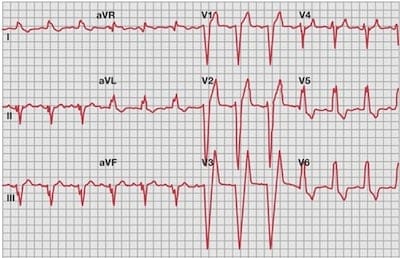
It is difficult to determine if a patient with a left bundle branch block (LBBB) has an acute myocardial infarction (AMI) because ST segments are “appropriately discordant” with the terminal portion of the QRS. That means if the QRS complex is negative (or downgoing), the ST segment normally will be positive (or elevated). Similarly if the QRS complex is positive (or upgoing), the ST segment will be negative (or depressed).

PV Card: Sgarbossa’s Criteria

In 1996, Sgarbossa et al looked through the GUSTO-1 trial patients with LBBB and AMI. They derived 3 criteria which may help diagnose the “hidden” AMI. The criteria are:

1. ST elevation ≥ 1 mm concordant with QRS complex (most predictive of AMI of the 3 criteria)
2. ST depression ≥ 1 mm in lead V1, V2, or V3
3. ST elevation ≥ 5 mm where discordant with QRS complex

Use these criteria with caution though. None of these criteria are perfect. They are to help you risk-stratify. For instance, criteria #3 (ST elevation ≥ 5 mm) can exist in asymptomatic patients with LBBB because of concurrent left ventricular hypertrophy and high voltages.

Thanks to Tom Bouthillet at ems12lead.com for the useful illustration above.
Go to ALiEM (PV) Cards for more resources.
By |2021-10-17T09:25:38-07:00Nov 5, 2010|ALiEM Cards, Cardiovascular, ECG|

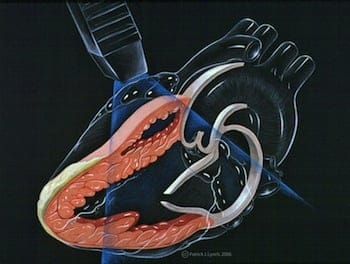
Paucis Verbis card: When murmurs need echo evaluation

Cardiac Echocardiography

Have you been in a situation where you are the first to detect a cardiac murmur in a patient? If you are hearing it in a busy, loud Emergency Department, I find that it’s at least a grade III.

Should you order an echocardiogram for further outpatient evaluation? It depends on the grade and characteristic of the murmur, in addition to the patient’s symptoms. For instance, all diastolic murmurs require an echo. There is a useful ACC/AHA algorithm which helps you decide.

PV Card: When Murmurs Need Echocardiography Evaluation


Adapted from [1]
Go to ALiEM (PV) Cards for more resources.
Thanks to Amy Kinard, an Emergency RN and aspiring Family Nurse Practitioner, for drafting this useful Paucis Verbis card for me during her studies. Keep the great ideas coming, everyone!

Reference

  1. Bonow RO, Carabello BA, Chatterjee K, et al. 2008 Focused Update Incorporated Into the ACC/AHA 2006 Guidelines for the Management of Patients With Valvular Heart Disease: A Report of the American College of Cardiology/American Heart Association Task Force on Practice Guidelines (Writing Committee to Revise the 1998 Guidelines for the Management of Patients With Valvular Heart Disease): Endorsed by the Society of Cardiovascular Anesthesiologists, Society for Cardiovascular Angiography and Interventions, and Society of Thoracic Surgeons. Circulation. 2008;118(15):e523-e661. doi: 10.1161/circulationaha.108.190748
By |2021-10-18T10:05:29-07:00Sep 17, 2010|ALiEM Cards, Cardiovascular|

Paucis Verbis card: TIMI risk score

Chest PainHow do you risk-stratify undifferentiated chest pain patients in the Emergency Department? There are a multitude of causes for chest pain. We are always taught to think of the 5 big life-threats: ACS, PE, aortic dissection, tension pneumothorax, and pericardial tamponade.

So how do YOU risk-stratify your patients for unstable angina (UA) and non-ST elevation myocardial infarction (NSTEMI)? STEMI’s are usually obvious. UA and NSTEMIs — not so much.

Fortunately a 2000 JAMA article and a followup Academic Emergency Medicine 2006 study have solidified the TIMI risk scoring system as a reasonable risk-stratification tool for all-comer ED patients with chest pain requiring an ECG.

Generally there is an upslope in risk at a TIMI score of 3 and greater.

PV Card: TIMI Risk Score


Adapted from [1, 2]
Go to ALiEM (PV) Cards for more resources.

References

  1. Pollack C, Sites F, Shofer F, Sease K, Hollander J. Application of the TIMI risk score for unstable angina and non-ST elevation acute coronary syndrome to an unselected emergency department chest pain population. Acad Emerg Med. 2006;13(1):13-18. [PubMed]
  2. Antman E, Cohen M, Bernink P, et al. The TIMI risk score for unstable angina/non-ST elevation MI: A method for prognostication and therapeutic decision making. JAMA. 2000;284(7):835-842. [PubMed]
By |2021-10-18T10:09:44-07:00Aug 27, 2010|ALiEM Cards, Cardiovascular|

Paucis Verbis card: Acute limb ischemia

Thrombectomy acute limb ischemia

Acute limb ischemia (ALI) is a true vascular emergency. It doesn’t occur as frequently as the more high-profile conditions as cerebrovascular accidents and acute myocardial infarcts, but it portends similarly high morbidity and mortality risk.

  • How do you stage a patient with ALI, based on the Rutherford classification system?
  • What is the ED treatment plan?
  • Should this patient go to Interventional Radiology or the Operating Room for more definitive management?

PV Card: Acute Limb Ischemia with Rutherford Classification


Go to ALiEM (PV) Cards for more resources.

By |2021-12-21T13:31:37-08:00Aug 13, 2010|ALiEM Cards, Cardiovascular|
Go to Top