



PV card: PE Severity Index (PESI) score

Do you send some of your low-risk patients with pulmonary embolism home?
This is a controversial issue which warrants a look at risk stratification tools. The primary one used is the validated Pulmonary Embolism Severity Index (PESI) score. In Lancet 2011, the authors looked at whether PESI class I and II (low risk) patients could be managed safely as outpatients. It turns out in their study, regardless of whether their PESI class I and II patients were treated as outpatients and inpatients, all fared equally well from a complications standpoint (recurrent clot, bleeding from anticoagulation).
I like the validated PESI scoring system to risk-stratify patients as low vs high risk for complications. I, however, do caution people to look closely at the exclusion criteria for this study before applying this to all ED patients.
The exclusion filter was so strict that they likely have captured a very narrow and unrealistic scope of patients to be widely applicable. It makes sense from a research standpoint to have these criteria to achieve internal validity but the question is external validity. Two exclusion criteria that struck me as awfully strict were: (1) needing parenteral opioids or (2) active alcohol or drug abuse.
Bottom line
For me, this study alone seems not have enough external validity to decide about the decision to treat PE patients as inpatient vs outpatient. Although I think that ultimately some can be managed as outpatients, I’d like to see more studies.
PV Card: PESI Score for Pulmonary Embolism
See other ALiEM (PV) Cards.
Paucis Verbis: D-Dimer test
 D-Dimer: To order or not to order?
That’s the question when it comes to risk stratifying a patient for a pulmonary embolism with a low pretest probability. One should consider confounding conditions which may cause an elevated D-Dimer level. There’s always confusion about what may cause an elevated D-Dimer besides venous thromboemboli. So I thought I would make a pocket card as a reminder.
PV Card: D-Dimer Test
Adapted from [1]
Go to ALiEM (PV) Cards for more resources.
Reference
- Wakai A, Gleeson A, Winter D. Role of fibrin D-dimer testing in emergency medicine. Emerg Med J. 2003;20(4):319-325. [PubMed]
Paucis Verbis: Ventilator settings for obstructive lung disease

Following up with last week’s Paucis Verbis card on Ventilator Settings for Acute Lung Injury and ARDS, here is the card on Ventilator Settings for Obstructive Lung Disease. This is for patients who present with acute asthma or COPD exacerbation who require endotracheal intubation.
What initial ventilator settings should you set for these patients?
Go to ALiEM (PV) Cards for more resources.
Thanks to Dr. Jenny Wilson for the card and Dr. Scott Weingart for the original stellar podcast from which this card was derived.
Paucis Verbis: Ventilator settings for acute lung injury and ARDS
A patient presents with severe multilobar pneumonia and refractory hypoxia requiring endotracheal intubation. The respiratory therapist connects your patient to the ventilator.
“What settings would you like your patient on?”
Back in 2010, Dr. Scott Weingart posted a great podcast on “Dominating the Vent“. It’s such a fantastic distillation of the practical aspect of ventilator setting management of all intubated patients except those with an acute asthma or COPD exacerbation, Dr. Jenny Wilson and I thought this would be a great Paucis Verbis card to have in your peripheral brain.
Note: The tidal volume should be calculated based on Predicted Body Weight (PBW), which is based on patient gender and height. The calculation is at the bottom of the card. Using a patient’s actual weight might yield a tidal volume that is way too high. The initial vent settings in the example box are for a patient with a PBW of 70 kg. That’s basically a 5’9″ man or 5’11” woman.
PV Card: Ventilator Settings for Lung Protection
Adapted from [1]
See ALiEM (PV) cards.
Thanks to Dr. Jenny Wilson for the idea and writing this card, and Dr. Scott Weingart for a great podcast as always.
Reference
- Ventilation with lower tidal volumes as compared with traditional tidal volumes for acute lung injury and the acute respiratory distress syndrome. The Acute Respiratory Distress Syndrome Network. N Engl J Med. 2000;342(18):1301-1308. [PubMed]
Paucis Verbis: Legionella pneumonia
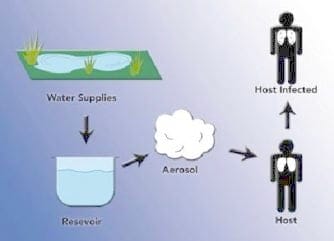
Did you know that there was an unexplained spike in Legionnaire’s disease (pneumonia caused by Legionella pneumophila) during the 2009 H1N1 flu pandemic?
Since the flu season is rapidly approaching, I thought I would review what Legionnaire’s disease looks like. Yes, they will have a fever, cough, and pneumonia on CXR. These patients are generally pretty sick and almost always need hospitalization. What makes it unique? The trick is to look for extrapulmonary findings, which help to distinguish it from other atypical pneumonias. Relative bradycardia is a sure tip.
Why do we want to differentiate it from other pneumonias? Legionnaire’s disease requires reporting to your state’s health department to help track for outbreaks.
PV Card: Legionella and Legionnaire’s Disease
Adapted from [1]
Go to ALiEM (PV) Cards for more resources.
More information on Legionella from the CDC website.
Reference
- Cunha B. Legionnaires’ disease: clinical differentiation from typical and other atypical pneumonias. Infect Dis Clin North Am. 2010;24(1):73-105. [PubMed]
Paucis Verbis: Fibrinolytics for Acute Pulmonary Embolism

When would you give fibrinolytics for a Pulmonary Embolism?
This Paucis Verbis card summarizes recommendations found in Circulation’s recently published Scientific Statement from the American Heart Association. Although it is rare to give fibrinolytics for a pulmonary embolism (PE) in the Emergency Department, it is important to remember when lytics are indicated.
PV Card: Fibrinolysis for Acute Pulmonary Embolism
Adapted from [1]
Go to ALiEM (PV) Cards for more resources.
Reference
- Jaff M, McMurtry M, Archer S, et al. Management of massive and submassive pulmonary embolism, iliofemoral deep vein thrombosis, and chronic thromboembolic pulmonary hypertension: a scientific statement from the American Heart Association. Circulation. 2011;123(16):1788-1830. [PubMed]