Series Editor: Mike O’Brien, PharmD
Quick evidence-based pearls on all things pharmacology and pharmacy-related in Emergency Medicine



Series Editor: Mike O’Brien, PharmD
Quick evidence-based pearls on all things pharmacology and pharmacy-related in Emergency Medicine
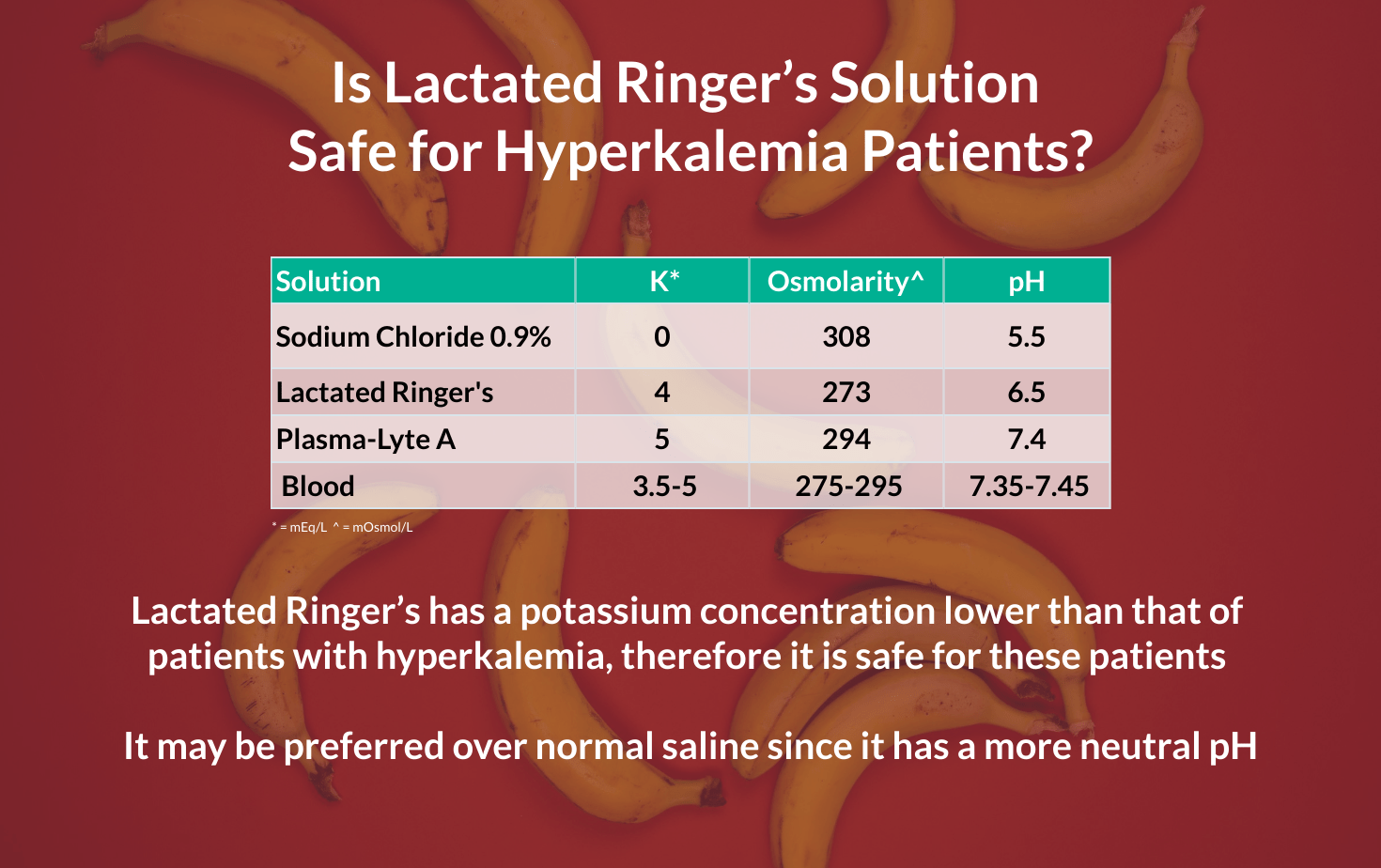
There are three primary fluids used for resuscitation, each contains varying amounts of potassium per liter (Table 1):
Additionally, these fluids contain markedly different amounts of other electrolytes, some of which directly influence their pH (Table 1).
| Solution | Na* | Cl* | K* | Ca* | Lactate* | Acetate* | Osmolarity^ | pH |
|---|---|---|---|---|---|---|---|---|
| Sodium Chloride 0.9% (normal saline) | 154 | 154 | – | – | – | – | 308 | 5.5 |
| Lactated Ringer’s | 130 | 109 | 4 | 2.7 | 28 | – | 273 | 6.5 |
| Plasma-Lyte A | 140 | 98 | 5 | – | 27 | 294 | 7.4 | |
| Blood | 135-145 | 96-106 | 3.5-5 | 8.5-10.5 | 0-1 | NA | 275-295 | 7.35-7.45 |
Table 1: Characteristics of IV fluids vs blood [1-3] (* = mEq/L; ^ = mOsmol/L); note: this is not an exhaustive list of fluid contents
A common question is if the balanced fluids containing potassium (Lactated Ringer’s and Plasma-Lyte A) are safe to use in hyperkalemia patients. The answer is YES! Despite containing potassium, these fluids will still decrease the serum potassium level of a hyperkalemic patient. This is because the potassium concentration in these fluids is lower relative to the patient’s serum potassium level and dramatically lower than the patient’s intracellular potassium concentration.
A secondary analysis of the SMART trial did not find a difference in severe hyperkalemia (K ≥7 mEq/L) in hyperkalemic patients that received a balanced fluid (8.5%) vs those that received normal saline (14%) (p=0.24) [4]. The authors concluded that:
Our results suggest that the acid-base effects of isotonic crystalloids are more important for potassium homeostasis than the relatively small amount of potassium in these fluids.
A breakdown of the SMART Trial secondary analysis by Journal Feed summarizes other major findings and concludes, “It’s reasonable to choose LR to treat hyperkalemia over NS.” Lastly, Dr. Josh Farkas provides a succinct summary of this topic in a 2014 EMCrit/Pulmcrit post which is helpful in understanding the interplay between fluid balance and the different replacement options. Additionally, he discusses the potential for normal saline to cause a non-anion gap metabolic acidosis thereby leading to increased serum potassium levels.
Balanced fluids (Lactated Ringer’s and Plasma-Lyte A) containing potassium can safely be used in patients with hyperkalemia. Given their more neutral pH, they may be preferred over normal saline in some patients.
Read other articles in the EM Pharm Pearls Series and find previous pearls on the PharmERToxguy site.
A previous EM Pharm Pearl focused on the adverse events associated with the use of IV olanzapine for agitation. This pearl addresses concerns around using parenteral (IV or IM) olanzapine with parenteral benzodiazepines.
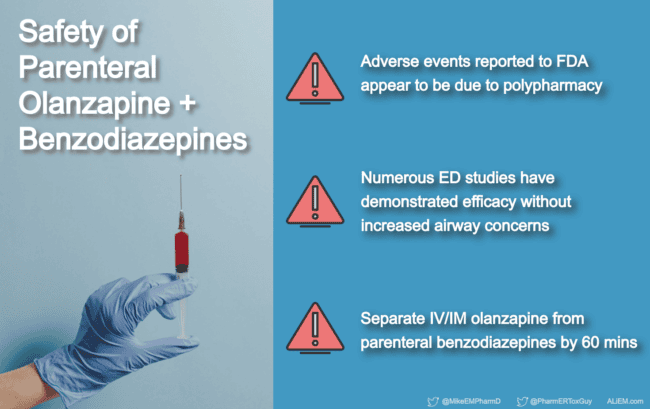
Olanzapine has two FDA boxed warnings, one for increased mortality when used long-term in older adults with dementia-related psychosis and another pertaining to adverse effects of extended release IM olanzapine. However, there exists a potential risk of excess sedation and respiratory depression when IM/IV olanzapine is administered with parenteral benzodiazepines for agitation. The European Medicines Agency recommends separating the administration of IM/IV olanzapine and parenteral benzodiazepines by at least 60 minutes. The FDA does not have a specific recommendation regarding separation of the 2 medications, but cautions against co-administration citing a lack of data. Currently, IM olanzapine is the only second generation antipsychotic with a precaution listed in its FDA prescribing information. This advisory is the result of 160 post-marketing adverse events, including 29 fatalities, associated with IM olanzapine [1].
When the above cases submitted to the FDA are thoroughly investigated, the problem appears to be related to polypharmacy rather than an olanzapine/benzodiazepines alone [2, 3]. This FOAMcast podcast provides an excellent summary of the data (Table 1). Additionally, the timing of fatalities after the last dose of olanzapine is prolonged in many cases (Table 2) and many of the causes of death are unattributable to olanzapine [1]. Several ED studies have used IV/IM olanzapine in combination with parenteral benzodiazepines to treat agitated patients without an increased signal of airway compromise [4-6].
| Table 1: Summary of Fatalities Associated with Olanzapine (n=29) | ||
|---|---|---|
| Olanzapine Alone | Olanzapine
+ Benzodiazepines |
Olanzapine + Benzodiazepines + Other Medications |
| 3/29 | 1/29 | 25/29 |
Adapted from FOAMcast podcast: Olanzapine + Benzodiazepines – What is the FDA warning about? [1]
| Table 2: Timing of Fatalities Following Last Olanzapine Dose (n=29) | ||||
|---|---|---|---|---|
| ≤ 1 hour | 1-12 hours | 12-24 hours | > 24 hours | Unknown |
| 3/29 | 4/29 | 8/29 | 11/29 | 3/29 |
Marder [1]
Separating IV/IM olanzapine from parenteral benzodiazepines by 60 minutes is likely a safe practice, if co-administration of these medications is necessary or desired to treat agitated patients. Patients with ethanol on board are at a higher risk of adverse events [7, 8]. Monitoring should be commensurate with the patient situation and medication(s) chosen.
Read other articles in the EM Pharm Pearls Series and find previous pearls on the PharmERToxguy site.

The ability to safely and effectively sedate agitated patients in the emergency department (ED) is paramount to provide prompt medical care and protect ED staff. Intravenous (IV) antipsychotics are frequently utilized, instead of other routes, given their more rapid onset of action. Similar to haloperidol, olanzapine can be used safely via the IV route despite both being FDA-approved for intramuscular (IM) administration only.
The table below summarizes the primary data evaluating IV olanzapine in the ED [1-5]. While IV olanzapine is a safe option for some agitated patients, some of these studies report a higher risk of respiratory complications or respiratory depression with the IV route compared to IM olanzapine or other IV treatment options. An Annals of Emergency Medicine commentary argues IV olanzapine might not be necessary for non-emergent cases of agitation or non-agitation indications and the IM route may suffice [6].
| Study | Olanzapine Dose | Adverse Event Rate – Olanzapine | Adverse Event Rate – Comparators | Notes |
|---|---|---|---|---|
| Chang 2013 (N=336) |
10 mg | 8.3% | IV Droperidol: 10.7% Placebo: 15.7 % |
|
| Martel 2016 (N=713) |
1.25-20 mg | Minor: 11.4% Major: 2.6% |
N/A | Adverse events were respiratory complications; 7 patients intubated |
| Taylor 2017 (N=92) |
5-10 mg | 20% | IV Midazolam + Droperidol: 22% IV Droperidol: 16.2% |
|
| Yap 2017 (N=92) |
10 mg | 21.4% | IV Midazolam + Droperidol: 20.6% IV Droperidol: 6.7% |
Methamphetamine-induced agitation |
| Cole 2017 (N=784) |
1.25-20 mg | 3.7% | IM olanzapine: 2.0% | Adverse events were respiratory depression |
Table: Adverse Events from IV Olanzapine for Agitation in the ED [1-5]
Treatment of agitated patients in the ED can be complex. Respiratory complications after medication administration may be related directly to the medication(s), the reduction of sympathetic drive, or both. All agitated patients should be monitored after receiving medications for sedation. The exact time course of this monitoring is not known and likely medication specific. Patients at high risk of neurologic, cardiovascular, or hemodynamic compromise should be monitored even more closely. This could include an ECG, pulse oxygenation, vital signs, and direct observation, as appropriate based on the patient-specific factors.
Medication selection for treating agitation in the ED requires thoughtful consideration of factors such as onset time (read more about “Onset of IM Medications for Severe Agitation“), duration, adverse events, and patient-specific variables. IV olanzapine is an option and monitoring should be commensurate with the situation and medication(s) chosen.
For further information, please read this in-depth literature review of IV olanzapine for the management agitation [7].
Read other articles in the EM Pharm Pearls Series and find previous pearls on the PharmERToxguy site.

In the continued fight against COVID-19, a January 22, 2021 press release from the Montreal Heart Institute touted the potential of colchicine, citing results from the COLCORONA trial [1, 2]. We’ve learned to be especially skeptical of any study results reported only via press release before undergoing full peer-review and publication. Nevertheless, the authors claim a non-significant (p=0.08) relative risk reduction of 19% (absolute risk reduction 1.1%) in hospitalizations, mechanical ventilation, and death. Note that the pre-print of the study has still not been peer-reviewed [3]. This study comes on the heels of the much smaller GRECCO-19 study published in June 2020 [4].
Early in 2020, promising results on hydroxychloroquine for treatment of COVID-19 led to a large increase in its use in outpatients and inpatients. It is now known that there is virtually no role for hydroxychloroquine and that this spike in use led to serious toxicity both from therapeutic use and overdose [5, 6]. The same may be anticipated for colchicine. And, if there is a drug that toxicologists fear more than hydroxychloroquine in overdose, it’s colchicine.
This 2010 Clinical Toxicology review article provides further information and education on colchicine toxicity.
Read other articles in the EM Pharm Pearls Series.

The 2020 ACLS guidelines provide recommendations on the medication-specific management recommendations for toxicology [1]. Although the name of the guidelines emphasize they are ‘Advanced,’ these are still relatively basic toxicology recommendations and largely apply to patients in cardiac arrest or refractory shock. There are also our 2020 ACLS guideline summaries on vasopressor and non-vasopressor medications used during cardiac arrest and arrhythmia management.
| Intervention | Beta-adrenergic blocker | Calcium channel blocker | Evidence (COR/LOE) |
|---|---|---|---|
| High-dose insulin | Reasonable | Reasonable | 2a/C-LD |
| Glucagon IV | Reasonable | May be considered | 2a/C-LD and 2b/C-LD |
| Calcium | May be considered | Reasonable | 2b/C-LD and 2a/C-LD |
| ECMO | Might be considered | Might be considered | 2b/C-LD |
Table: Medications and interventions in the management of beta-adrenergic and calcium channel blocker toxicity (COR: class of recommendation, LOE: level of evidence, ECMO: extracorporeal membrane oxygenation)

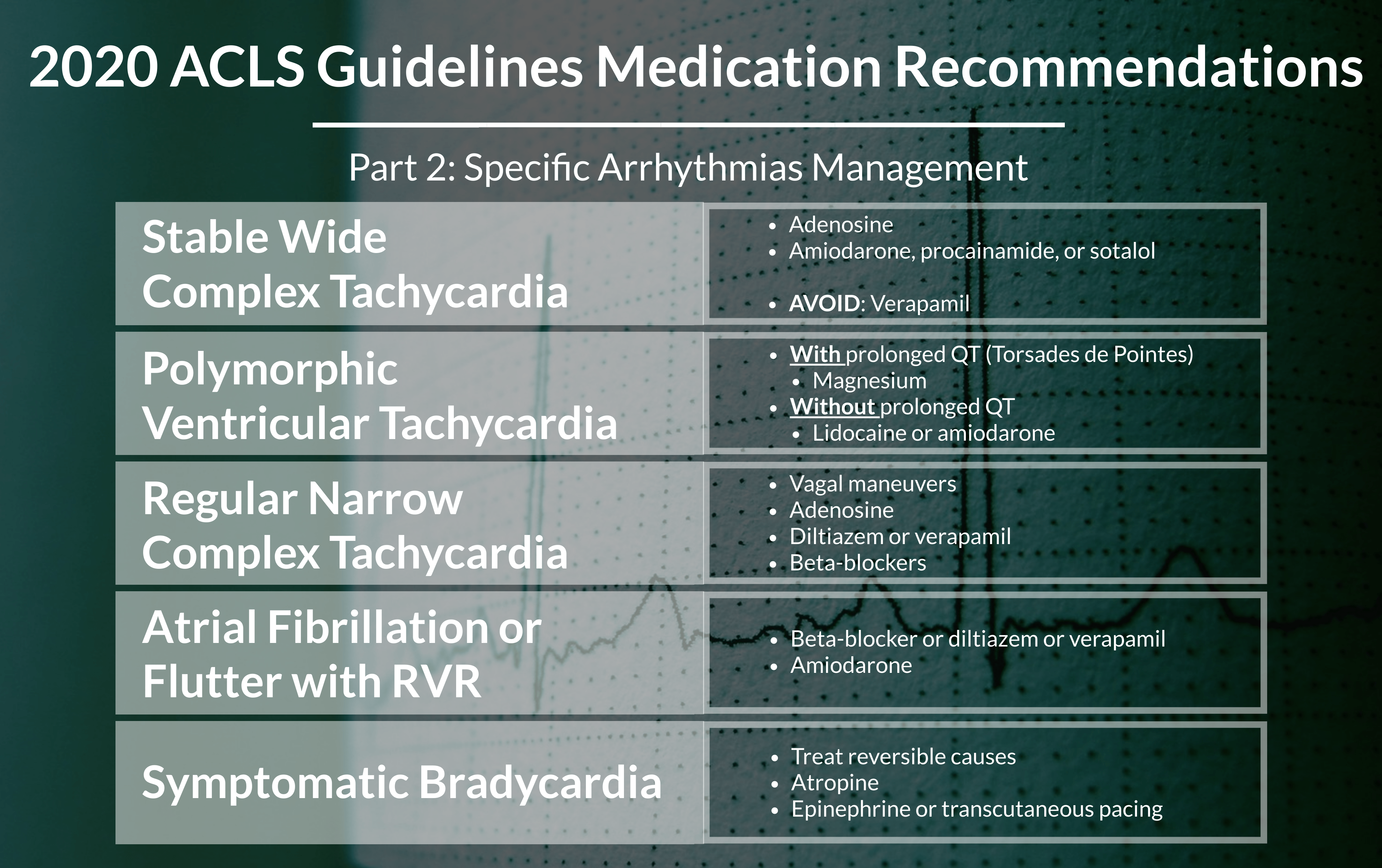
The 2020 ACLS guidelines provide recommendations on the medication-specific management for arrhythmias including wide-complex tachycardia, regular narrow-complex tachycardia, atrial fibrillation/flutter, and bradycardia [1]. There are also our 2020 ACLS guideline summaries on vasopressor and non-vasopressor medications used during cardiac arrest and toxicology-related conditions.
| Wide-complex tachycardia | Medication(s) | Evidence |
|---|---|---|
| Hemodynamically stable | Adenosine | COR 2b, LOE B-NR |
| Amiodarone, procainamide, or sotalol | COR 2b, LOE B-R | |
| NOTE: Verapamil is harmful | COR 3, LOE B-NR | |
| Polymorphic VT with long QT (torsades de points) | Magnesium | COR 2b, LOE C-LD |
| Polymorphic VT without long QT | Lidocaine or amiodarone | COR 2b, LOE C-LD |

The 2020 ACLS Guidelines were published in October 2020 [1]. This first of 3 blog posts will focus on vasopressor and non-vasopressor medications during cardiac arrest. Part 2 will focus on specific arrhythmia management and Part 3 will focus on toxicologic interventions.
There were no major updates for vasopressors and non-vasopressors used during cardiac arrest. The American Heart Association (AHA) published Highlights of the 2020 Guidelines [PDF] as a clear and concise summary. Now that the AHA is releasing focused updates in the 5-year period between guidelines (like this one on lidocaine), fewer major changes likely will be needed when the full guidelines are published.
| Vasopressor | Non-Vasopressor |
|---|---|
|
Epinephrine
|
Amiodarone or lidocaine
|
|
Vasopressin
|
Steroids
|
|
Calcium
|
|
|
Sodium bicarbonate
|
|
|
Magnesium
|
Table: Vasopressors and non-vasopressors used during cardiac arrest (VF: ventricular fibrillation, pVT: pulseless ventricular tachycardia)