Series Editor: Mike O’Brien, PharmD
Quick evidence-based pearls on all things pharmacology and pharmacy-related in Emergency Medicine



Series Editor: Mike O’Brien, PharmD
Quick evidence-based pearls on all things pharmacology and pharmacy-related in Emergency Medicine

Nitroglycerin (NTG) is an important intervention to consider for patients with Sympathetic Crashing Acute Pulmonary Edema (SCAPE) as it significantly reduces preload, and even modestly reduces afterload with high doses. For acute pulmonary edema in the ED, NTG is often administered as an IV infusion and/or sublingual tablet. Starting the infusion at ≥ 100 mcg/min produces rapid effects in many patients and can be titrated higher as tolerated, with doses reaching 400 mcg/min or greater. Combined with noninvasive positive pressure ventilation (NIPPV) and in some cases IV enalaprilat, patients often turn around quickly, from the precipice of intubation to comfortably lying in bed [1, 2]. But what does the literature say about starting with a high-dose NTG IV bolus followed by an infusion?
A 2021 prospective, pilot study of 25 SCAPE patients proposed a clear and systematic protocol (below) for treating these critically ill patients with a combination of high-dose NTG bolus (600 – 1000 mcg over 2 mins) followed by an infusion (100 mcg/min) and NIPPV [3].There were no cases of hypotension after the bolus and 24 of the 25 patients were able to avoid intubation. Additionally, an earlier PharmERToxGuy post summarizes some of the previous studies evaluating the use of a high-dose NTG IV bolus for acute pulmonary edema.
It is important to note that some institutions may not allow IV push NTG or may limit the use of NTG boluses. Providers may then opt to implement dosing strategies such as bolusing from an IV infusion pump or initiating the infusion at a high rate for a short period (e.g., NTG 300 mcg/min for 2-3 minutes) before reducing the rate to a more traditional infusion rate (e.g., 100 mcg/min).

Click for full-sized version [3]
Read other articles in the EM Pharm Pearls Series and find previous pearls on the PharmERToxguy site.

There are a few unique scenarios when beta-blockers may be indicated for patients in cardiac arrest. Use of esmolol for refractory ventricular fibrillation was summarized in a 2016 PharmERToxGuy post with an accompanying infographic. Another potential use for beta-blockers is in the rare case of a patient with inhalant-induced ventricular dysrhythmias. The term ‘sudden sniffing death’ refers to acute cardiotoxicity associated with inhaling hydrocarbons. Check out this ACMT Toxicology Visual Pearl for more information about the background and diagnosis of inhalant abuse.
It is thought that inhalants causes myocardial sensitization via changes in various cardiac channels (e.g., sodium channels, potassium channels, calcium channels, or gap junctions) leading to prolonged repolarization and conduction [1, 2]. Additionally, chronic inhalant use can lead to structural heart damage. When the above alterations are combined with a sudden increase in catecholamines (e.g., exercise, caught sniffing), a dysrhythmia can develop which is often fatal [2-4].
There are no case reports to support the use beta-blockers to treat inhalant-induced dysrhythmias. However, the case reports below include patients that ingested various hydrocarbons who developed ventricular dysrhythmias and improved following the initiation of beta-blockers. As the adverse cardiac effects should be similar between inhaled and ingested hydrocarbons, we can potentially extrapolate this data to patients with inhalant-induced dysrhythmias.
| Demographics | Agent(s) Ingested | Cardiac Effects | Interventions | Resolution of dysrhythmia following BB? |
|---|---|---|---|---|
| 39 yo M [5] | Trichloroethylene | pVT/VF arrest | Defibrillation, Propranolol bolus and infusion |
Y |
| 70 yo F [6] | Trichloroethylene | Bigeminy, Junctional rhythm | Esmolol bolus and infusion |
Y |
| 23 yo F [7] | Chloral hydrate | VF arrest | Esmolol bolus and infusion |
Y |
| 27 yo M [8] | Chloral hydrate, Loxapine, Fluoxetine | Stable VT | Propranolol bolus and infusion |
Y |
| 3 yo M [9] | Chloral hydrate | Sinus tachycardia, Bigeminy, Trigeminy, NSVT | Esmolol bolus and infusion |
Y |
| 44 yo M [10] | Chloral hydrate | Stable VT | Propranolol bolus, Labetalol infusion |
Y |
BB=beta-blocker; pVT=polymorphic ventricular tachycardia; VT=ventricular tachycardia; VF=ventricular fibrillation; NSVT=non-sustained ventricular tachycardia
Read other articles in the EM Pharm Pearls Series and find previous pearls on the PharmERToxguy site.
 Background
Naloxone can be administered via multiple routes, with nebulization gaining popularity in the past decade. A previous ALiEM Trick of the Trade presented this unique method of administration. In order for nebulized naloxone to be effective patients need to have some level of respiratory effort. It should not be used in patients in respiratory arrest or impending respiratory arrest. It may be a more gentle way to wake up patients to confirm the diagnosis of opioid toxicity and to gather a history. Theoretically, if the patient arouses enough to start experiencing mild withdrawal, they can ‘self-titrate’ and remove the nebulizer mask.
Mix 2 mg naloxone (5 mL of naloxone 0.4 mg/mL) with 3 mL of 0.9% sodium chloride for inhalation in a nebulizer cup.
Anecdotal reports tout the benefits of nebulized naloxone, but what does the literature say?
Importantly, aside from the two case reports, the above studies both primarily included patients without severe respiratory depression. As far as the safety of nebulized naloxone, Baumann et al. reported 5 patients (out of 26) who seemed to have mild-to-moderate symptoms of withdrawal following administration [3]. So this raises a question that must be answered on a patient specific basis: Does the benefit of this therapy outweigh the risk in patients who may not require naloxone to begin with? An alternative approach, if IV access is established, is to try low-dose diluted IV naloxone.
Many of the studied patients may not have needed naloxone in the first place as they had an initial respiratory rate 13-14, with a few developing withdrawal symptoms. Nebulized naloxone may have a role in the “not-too-sick” opioid overdose in whom you want to prove your diagnosis and wake the patient up enough to obtain a history. It is not a therapy for an apneic patient with suspected opioid overdose.

Bupropion ingestions are one of the scarier poisonings due to a relatively narrow therapeutic index and the numerous adverse effects that may occur. Medical toxicologist Dr. Dan Rusyniak details his hatred of this drug in overdose in a Tox & Hound blog post aptly-titled Illbutrin. When bupropion was first approved in the 1980s, the max dose was 600 mg/day [1]. However, reports of seizures, particularly in patients with bulimia, caused its temporary removal from the market [2]. It was reintroduced a few years later with a max dose of 450 mg/day [3]. Common signs and symptoms noted in overdose include seizures, agitation, sinus tachycardia, and QRS/QTc prolongation. Seizures occur in up to 40% of overdose cases, are often refractory to initial therapy, and can happen as long as 24 hours after an overdose with extended release formulations [4, 5].
A study of 256 patients from the Toxicology Investigators Consortium (ToxIC) Registry identified three factors associated with seizure development after bupropion overdose [6, 7].
Agitation and tremors are more common in patients who develop seizures with bupropion compared to those who do not [4]. Additionally, presence of tachycardia (heart rate >100 bpm) has a sensitivity of 91% and a negative predictive value of 93% for development of seizures [4].
Read other articles in the EM Pharm Pearls Series and find previous pearls on the PharmERToxguy site.

A previous ALiEM post from 2013 by an EM pharmacist colleague argued the case against one-time vancomycin doses in the ED prior to discharge. The take-home points from this post were:
- No evidence that a one-time vancomycin has any benefit
- This practice is not recommended by the Infectious Diseases Society of America (IDSA)
- May extend the patient’s ED stay by at least an hour for the IV infusion, depending on the dose
- Increases the cost of the ED visit (e.g., IV line, medication, RN time)
- Pharmacokinetically 1 dose of vancomycin doesn’t make sense
- Vancomycin 1 gm IV x1 provides sub-therapeutic levels for patients with normal renal function
- Efficacy is based on overall exposure (e.g., AUC/MIC) achieved with repeated dosing over several days
- Subtherapeutic vancomycin concentrations lead to development of resistance
Despite the above points, a one-time dose of vancomycin prior to the patient being discharged on an oral regimen is a common practice [1].
As stated above, a single dose of vancomycin is unlikely to provide a therapeutic benefit and may only serve to reassure clinicians. The 2020 consensus guidelines regarding vancomycin monitoring for serious MRSA infections reinforce the recommendation of achieving an AUC0-24/MIC ratio of ≥400, as a ratio <400 increases resistance and has inferior efficacy [2]. Since the AUC is dependent on overall time of exposure plus concentration, a single dose for an average patient with normal renal function is not adequate (Figure 1). The graph below also demonstrates how long it generally takes for vancomycin to reach steady state when patients receive a dose every 8 hours.
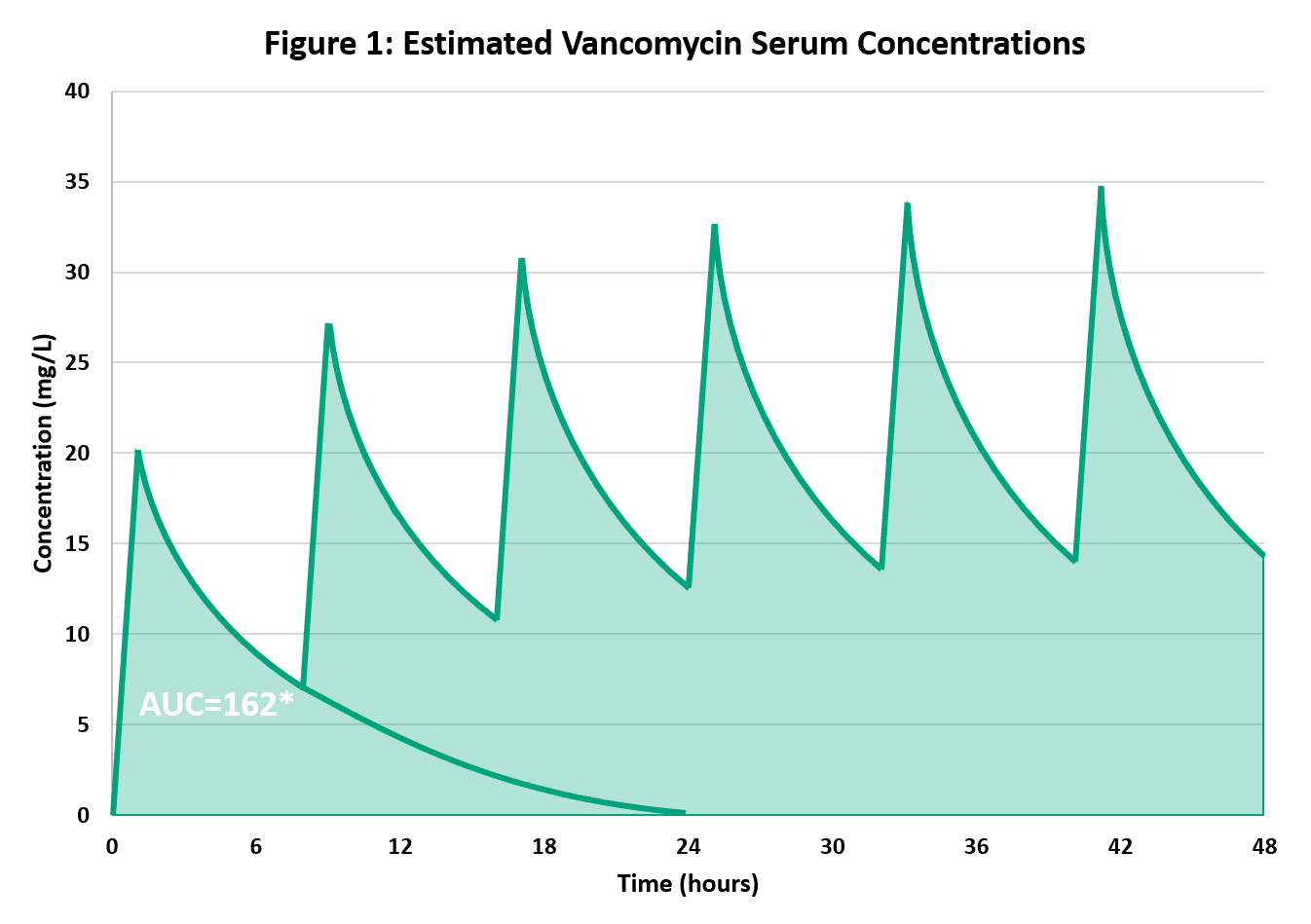
*The estimated AUC above assumes a 30 yo male that weights 70kg and is 6′ tall with a serum creatinine of 1.0 mg/dL.
A randomized trial conducted at Christiane Care Health System compared patients who received a vancomycin loading dose of 30 mg/kg or 15 mg/kg [3]. Just twelve hours after this initial dose, 34.6% of patients who received 30 mg/kg had vancomycin levels in the therapeutic range (trough >15 mg/L) vs. 3% of patients who received 15 mg/kg (p < 0.01).
Even large vancomycin loading doses rarely achieve therapeutic levels after one dose. Therefore, if the plan is to discharge, skip the one-time dose altogether and choose an antimicrobial regimen that will be continued in the outpatient setting (e.g., doxycycline or sulfamethoxazole/trimethoprim if concerned for MRSA or cephalexin for most other patients).
Read other articles in the EM Pharm Pearls Series and find previous pearls on the PharmERToxguy site.

Rapid and precise control of blood pressure is vital for patients with a hypertensive emergency or an acute stroke. Commonly, nicardipine is utilized in these situations, with nitroprusside being a less appealing alternative. The most recent AHA/ASA Acute Ischemic Stroke Guidelines, updated in 2019, also recommend clevidipine as a first-line antihypertensive option [1]. Clevidipine is a dihydropyridine calcium channel blockers, similar in mechanism to nicardipine and amlodipine. The main advantage of clevidipine over nicardipine is related to its pharmacokinetics (Table 1). Given its shorter half-life of elimination, clevidipine can be titrated every 1-2 minutes. Additionally, if hypotension does occur, stopping the clevidipine infusion allows blood pressure to rebound quickly.
| Medication | Onset | Duration | Half-Life |
|---|---|---|---|
| Clevidipine | 2-4 mins | 5-15 mins | 1-15 mins |
| Nicardipine | 10-20 mins | 1-2 hours | 2-4 hours |
| Nitroprusside | 1-2 mins | 1-10 mins | 2 mins |
Table 1: Pharmacokinetics of Common Antihypertensive Infusions [Micromedex; Lexicomp]
Most studies demonstrate equivalent outcomes between clevidipine and other agents (e.g., nicardipine, nitroprusside, nitroglycerin) [2-5]. The ECLIPSE trial is the largest to assess the safety and efficacy of clevidipine [6]. The authors randomized cardiac surgery patients to clevidipine, nicardipine, nitroprusside, or nitroglycerin and found no difference in the incidence of myocardial infarction, stroke, or renal dysfunction. They noted that mortality was higher in patients receiving nitroprusside vs clevidipine, but equivalent compared to the the other medications. Additionally, clevidipine treated patients had significantly fewer excursions outside the prespecified blood pressure range than patients treated with any of the other agents.
Clevidipine is formulated in a 20% lipid emulsion and packaged in a glass vial. This causes clevidipine to appear similar to propofol, which could lead to safety issues. Also, care should be taken when using both clevidipine and propofol concomitantly, especially at high doses, as both provide clinically significant amounts of lipids, so triglycerides should be monitored.
Clevidipine is a safe and effective antihypertensive to use in patients that require rapid and strict blood pressure control, specifically in patients with an aortic dissection or an acute ischemic/hemorrhagic stroke.
Read other articles in the EM Pharm Pearls Series and find previous pearls on the PharmERToxguy site.

Droperidol is safe and effective for the treatment of severely agitated patients in the ED [1-3]. But what about its use for agitation in elderly patients specifically?
Two Australian studies evaluated droperidol in more than 200 older adults (≥ 65 years old) in the prehospital and ED settings [4,5]. Both studies found droperidol to be effective in elderly patients with acute behavioral disturbances. The median time to sedation was ~20-30 minutes with doses ranging from 2.5-10 mg (Table 1).
| Characteristic | Page, et al (n=162) | Calver, et al (n=47) |
|---|---|---|
| Median Age | 78 years | 81 years |
| Initial Droperidol IM Dose | 5 mg | 10 mg (n=30) 5 mg (n=15) 2.5 mg (n=2) |
| Median Time to Sedation | 19 mins | 10 mg: 30 mins 5 mg: 21 mins 2.5 mg: NA |
| Patients Sedated with ≤ 10 mg Droperidol | 144 (89%) | 34 (72%) |
Table 1: Efficacy of droperidol in older adults
Additionally, each study broke down each time a patient experienced an adverse event (Table 2). Overall, these adverse events were uncommon (4.5%), mild in nature, and resolved spontaneously or with minor interventions. No patients developed Torsades de Pointes.
| Study | Age/Sex | Droperidol Dose | Adverse Events | Management | Time Post-Droperidol |
|---|---|---|---|---|---|
| Page, et al (n=162) | 76 yo Male | 5 mg | SBP <90 (88/54) | Spontaneous Resolution | – |
| 87 yo Female | 10 mg | SBP <90 (80/46) | Spontaneous Resolution | – | |
| 79 yo Female | 5 mg | SBP <90 (83/48) O2 sat <90% (80%) |
Supplemental Oxygen 500 mL IV Fluid |
– | |
| 82 yo Male | 5 mg | RR <12 (RR 10) | Spontaneous Resolution | – | |
| 86 yo Male | 5 mg | O2 sat <90% (88%) | Supplemental Oxygen | – | |
| Calver, et al (n=49) | 75 yo Male | 10 mg | SBP <90 | – | 30 mins |
| 68 yo Female | 10 mg | SBP <90 | – | 5 mins | |
| 73 yo Male | 10 mg | Airway Obstruction | – | 100 mins | |
| 87 yo Female | 2.5 mg | Oversedation | – | 480 mins |
Table 2: Safety of droperidol in older adults
Taking the above points into account, droperidol appears to be both effective and safe in agitated adults ≥ 65 years of age for the treatment of agitation. The study authors recommend starting with 5 mg and repeating, if necessary, rather than initially using a dose of 10 mg.
Read other articles in the EM Pharm Pearls Series and find previous pearls on the PharmERToxguy site.
