Trick of the Trade: Splinting the ear

EarHematomaDressing

One of the hardest bandages to apply well is one for auricular hematomas. After drainage, how would you apply a bandage to prevent the re-accumulation of blood in the perichondrial space?

Traditionally, one can wedge xeroform gauze or a moistened ribbon (used for I&D’s) in the antihelical fold. Behind the ear, insert several layers of gauze, which have been slit half way to allow for easier molding around the ear. Anterior to the ear, apply several layers of gauze to complete the “ear sandwich”. Finally, secure the sandwich in place with an ACE wrap, which ends up being quite challenging because of the shape of the head.

(more…)

By |2016-11-11T19:59:20-08:00Aug 10, 2011|ENT, Trauma, Tricks of the Trade|

Trick of the Trade: Making a beanie hat

Scalp lacerations are a common condition in the Emergency Department. Some require no bandage over once the injury is repaired. Because the scalp is so vascular, others require a pressure dressing over the site to minimize hematoma formation.

How do you bandage these patients? It is difficult to secure any wrap or square gauze over the site, because the head is round and the hair is slippery.

(more…)

By |2019-01-28T22:36:18-08:00Jul 27, 2011|Tricks of the Trade|

Tricks of the Trade: Underwater ultrasonography

Basketweaving

I’ve heard of underwater basketweaving, but underwater ultrasonography?

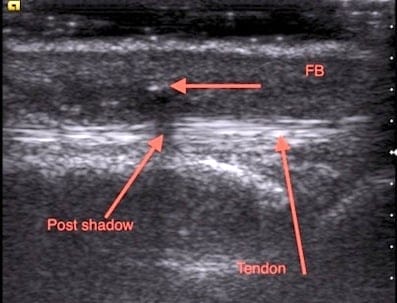
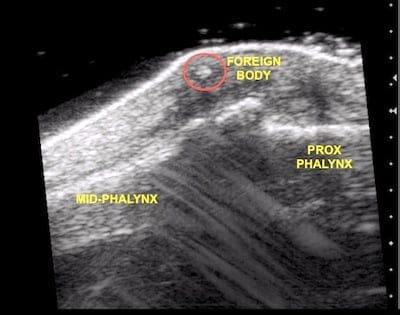
Bedside ultrasonography is a great tool to help find small foreign bodies. Commonly foreign bodies get lodged superficially in the patient’s extremities. Because superficial structures (<1 cm deep) are difficult to visualize on ultrasound, you should apply a really generous, thick layer of ultrasound gel to create some distance. Alternatively, you can add a step-off pad, such as a bag of saline or fluid-filled glove, to place between the patient’s skin and transducer. What’s a quicker and easier way to create some distance yet preserve image quality?

Trick of the Trade

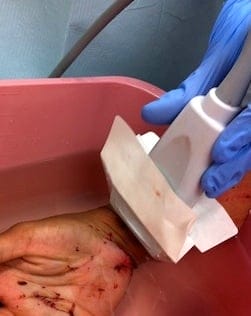
Submerse both the body part and the ultrasound transducer under water.

ultrasonography water bath

For this “bath water technique”, start by holding the transducer perpendicular to the wound and about 1 cm away from the skin. You can adjust the distance to optimize the image quality.

FB_Hand

FB_Hand2

Thanks to Andy at Emergency Medicine Ireland blog for these 2 ultrasound images! 

This submersion technique has been published in American Journal of EM in 2004 as a painless alternative to gel or a step-off pad, because the transducer does not need to apply any pressure on the patient’s wound.

Reference
Blaivas M, Lyon M, Brannam L, Duggal S, Sierzenski P. Water bath evaluation technique for emergency ultrasound of painful superficial structures. Amer J Emerg Med. 2004; 22(7), 589-93 PMID: 15666267

By |2026-06-16T16:03:08-07:00Jul 20, 2011|Tricks of the Trade, Ultrasound|

Trick of the Trade: Anesthetizing the nasal tract

 
ViscLidocaine

One of the most uncomfortable procedures that we do on patients is a nasogastric (NG) tube. The maximal pain comes when the NG tube has to make a right angle turn in the posterior nasopharynx. The same goes for the nasopharyngeal (NP) fiberoptic scope. There are many approaches to topical anesthesia, including using benzocaine sprays, gargling with viscous lidocaine, squirting viscous lidocaine in the nares +/- afrin spray, and nebulizing lidocaine. None, however, really apply an anesthetic directly over the most sensitive area AND test for its effectiveness.

(more…)

By |2016-11-11T18:52:40-08:00Jul 13, 2011|ENT, Tricks of the Trade|

Trick of the Trade: A mini-suction device

Beads2

You are doing a shift in the pediatric ED and you are evaluating a kid with a small bead in her ear. There are a ton different approaches you can use (eg. tissue adhesive glue on a q-tip stick). If the bead is in too deep, blindly trying to adhere the foreign body to the glue is a bit risky. Sometimes applying gentle irrigation might not be enough to wash out the bead. You want to avoid irrigation if you worry about a tympanic membrane rupture.

(more…)

By |2019-01-28T22:42:38-08:00Jun 29, 2011|Tricks of the Trade|
Go to Top